
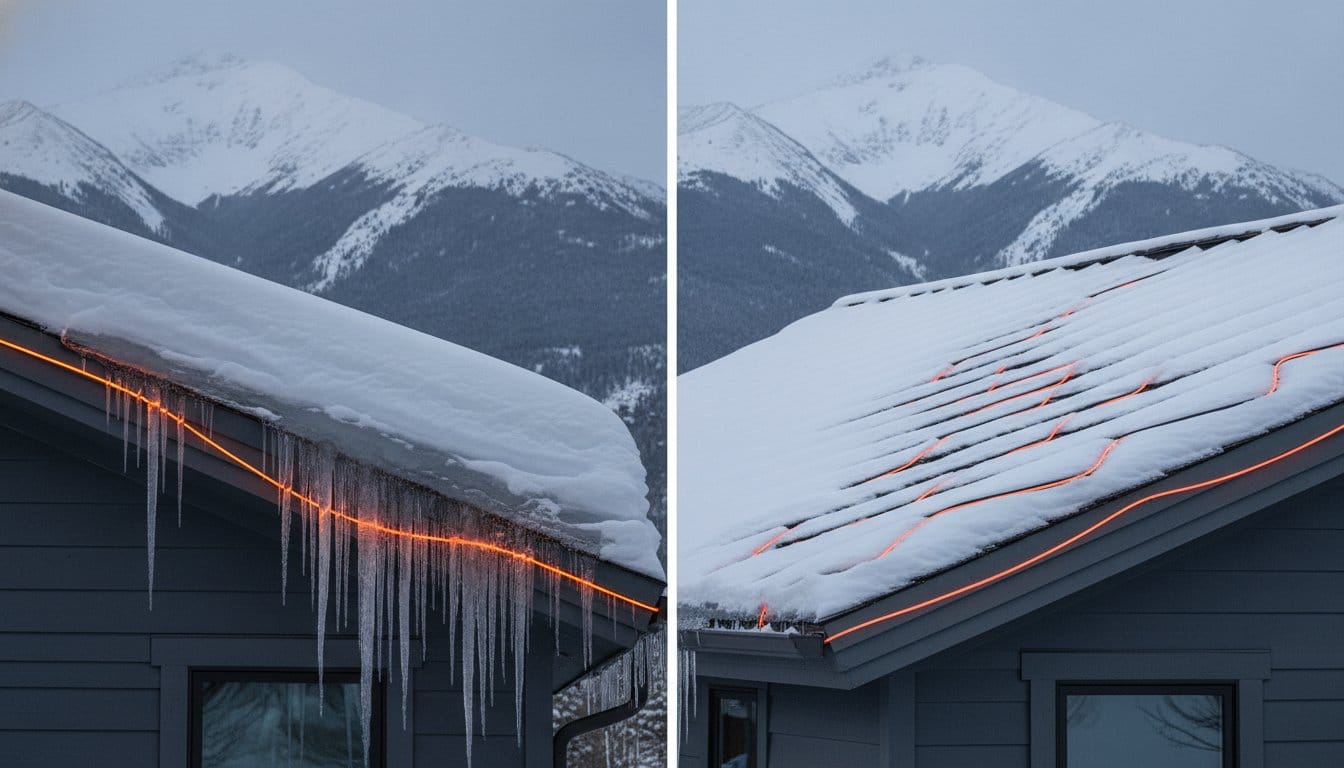
When heavy snow blankets your roof, the last thing you want to worry about is an ice dam causing thousands of dollars in damage to your gutters, shingles, and interior walls. A roof de-icing system is the most effective defense, but a critical choice stands in your way: should you install self-regulating or constant wattage heat cable? The answer determines not only the effectiveness of your system but also its safety, energy efficiency, and long-term cost.
Choosing the wrong cable—especially an off-the-shelf product not designed for Utah’s harsh winters—can lead to failed protection, sky-high energy bills, and even a serious fire risk. This guide breaks down the technical differences, real-world performance, and hidden costs of each technology, empowering you to make an informed investment that protects your property for years to come.
Understanding the Core Technology: How Heat Cables Differ
At its core, the goal of any roof heat cable is simple: to create and maintain a clear drainage path for meltwater. When snow on your roof melts, it runs down to the colder eaves and gutters, where it refreezes. This process forms an ice dam, a destructive barrier that forces water back up under your shingles. Heat cable prevents this by warming the roof edge, gutters, and downspouts just enough to keep water flowing freely.
While the goal is the same, the two primary types of heat cable achieve it in fundamentally different ways. This technological difference has massive implications for safety, performance, and operational cost.
What is Self-Regulating Heat Cable?
Self-regulating heat cable is an advanced, “smart” technology. It features a conductive carbon matrix core sandwiched between two parallel bus wires. This core is the key to its intelligence. As the ambient temperature drops, the carbon matrix contracts, creating more electrical pathways and generating more heat. Conversely, as the temperature rises, the core expands, reducing the electrical pathways and decreasing its heat output.
- Intelligent Heat Adjustment: The cable automatically adjusts its power output along its entire length. A section in a cold, shady gutter will produce more heat than a section basking in the winter sun.
- Inherent Safety: This self-regulating nature prevents the cable from overheating or burning itself out. It can be overlapped during installation without creating dangerous hot spots, a critical safety feature.
- Energy Efficiency: By producing heat only when and where it’s needed, self-regulating cables consume significantly less energy than their constant wattage counterparts.
What is Constant Wattage Heat Cable?
Constant wattage heat cable is a simpler technology. It functions much like the heating element in a toaster, using a fixed-resistance wire to generate a consistent, unvarying amount of heat per foot. Once it’s turned on, it produces the same heat output whether the temperature is 32°F or -10°F.
- Fixed Heat Output: This cable provides a predetermined wattage (e.g., 5 watts per foot) regardless of the surrounding conditions. It’s either “on” at full power or “off.”
- Risk of Overheating: Because the heat output is fixed, the cable cannot be overlapped or installed too closely together. Doing so will cause heat to build up, which can damage the cable, your roofing material, and create a significant fire hazard.
- Reliance on External Controls: To operate safely and avoid wasting massive amounts of energy, constant wattage systems require external thermostats, sensors, and controllers to turn them on and off.
It’s also crucial to distinguish between professional-grade constant wattage systems used in specific industrial applications and the consumer-grade “heat tape” sold at hardware stores. The latter is often the source of homeowner frustration, as it is typically underpowered for heavy snow and lacks the durability to survive more than one or two seasons in a demanding mountain climate.
Self-Regulating Heat Cable: The Intelligent De-Icing Solution
For residential and commercial properties in regions like Utah, Idaho, and Wyoming, self-regulating heat cable has become the professional standard for ice dam prevention. Its superior safety, efficiency, and durability make it the most reliable long-term investment for protecting your property.
Energy Efficiency and Cost Savings
The primary advantage of self-regulating technology is its energy efficiency. While the upfront material cost may be higher, the long-term operational savings are substantial. A professionally designed self-regulating system can use up to 30-50% less electricity than a comparable constant wattage system over the course of a winter.
This “demand-based” heating is particularly effective in the Intermountain West, where a roof can experience dramatic temperature swings in a single day. A section of roof may be frozen in the shade of a chimney while another is warmed by direct sunlight. A self-regulating cable adapts to these microclimates, delivering targeted heat only where needed and powering down elsewhere. This not only saves money but also extends the lifespan of the cable by reducing unnecessary thermal stress.
To learn more about how smart systems can protect your home, explore our homeowner’s guide to energy-efficient roof de-icing.
Safety and Installation Flexibility
Safety is the most critical advantage of self-regulating cable. The technology’s inability to overheat makes it the only choice for complex rooflines, valleys, and downspouts where cables must be routed closely or even touch. The risk of “hot spots”—a leading cause of cable failure and roof fires with constant wattage products—is completely eliminated.
This flexibility allows for a more effective and comprehensive installation. A master craftsman can route the cable precisely where it’s needed to create reliable meltwater channels without being constrained by rigid spacing requirements. It’s safe for all common roofing materials, including asphalt shingles, wood shake, and standing seam metal. This inherent safety is why licensed electrical contractors overwhelmingly recommend self-regulating cable for any application where the cable may come into contact with debris like pine needles or leaves, which can trap heat and create a fire risk with lesser products.
Constant Wattage Heat Cable: High-Output Performance and Risks
While self-regulating cable is the superior choice for most applications, professional-grade constant wattage cable serves specific, niche purposes. It is a powerful tool that, when used correctly by experts with robust control systems, can be effective. However, when used improperly—particularly the consumer-grade versions—it becomes inefficient, ineffective, and dangerous.
When Constant Wattage Makes Sense
In certain industrial or highly specialized commercial settings, constant wattage cable may be specified. These scenarios typically involve:
- Long, Straight Runs: On extremely long, simple rooflines or pipelines, constant wattage cables can sometimes be more cost-effective upfront, as they are less susceptible to voltage drop over very long distances.
- Consistent Environmental Conditions: In an industrial facility where temperatures are stable and a constant, high level of heat is required for process maintenance, a fixed-output cable can be a viable solution.
- Budget-Driven Projects with Advanced Controls: For projects with severe upfront budget constraints, a constant wattage system paired with sophisticated, multi-sensor controllers can be designed to operate safely. However, the cost of these advanced controls often negates the initial savings on the cable itself.
The Hidden Dangers and Performance Failures of Improper Use
The user feedback is spot on: constant wattage heat cable from the hardware store does not perform well in high snowfall or very cold climates. These products are the primary source of the negative reputation surrounding “heat tape.”
Here’s why they fail and pose a risk:
- Inadequate Power for Heavy Snow: Consumer-grade constant wattage cables often lack the power to melt through the heavy, wet “lake effect” snow common in Utah. The fixed output is simply overwhelmed, allowing ice dams to form right over the cable.
- The Overlapping Fire Hazard: DIY installations frequently involve overlapping the cable to route it through gutters and downspouts. With constant wattage cable, every overlap creates a hot spot that will eventually melt through the cable’s insulation, short out, and create a serious fire risk.
- Wasted Energy and High Bills: Without a smart controller, this cable runs at 100% power anytime it’s plugged in, even on a warm, sunny winter day. This leads to shocking electricity bills and a dramatically shortened lifespan due to constant, unnecessary operation.
- Failure in Variable Conditions: A constant wattage cable can’t adapt. It might keep a sunny spot completely dry while a nearby shaded area, receiving the same inadequate amount of heat, forms a massive ice dam. This is a common failure on complex roofs or north-facing roof planes.
Ultimately, DIY constant wattage installation is one of the leading causes of winter roof fires. For a deeper look at the risks, see our guide comparing professional systems vs. DIY heat tape.
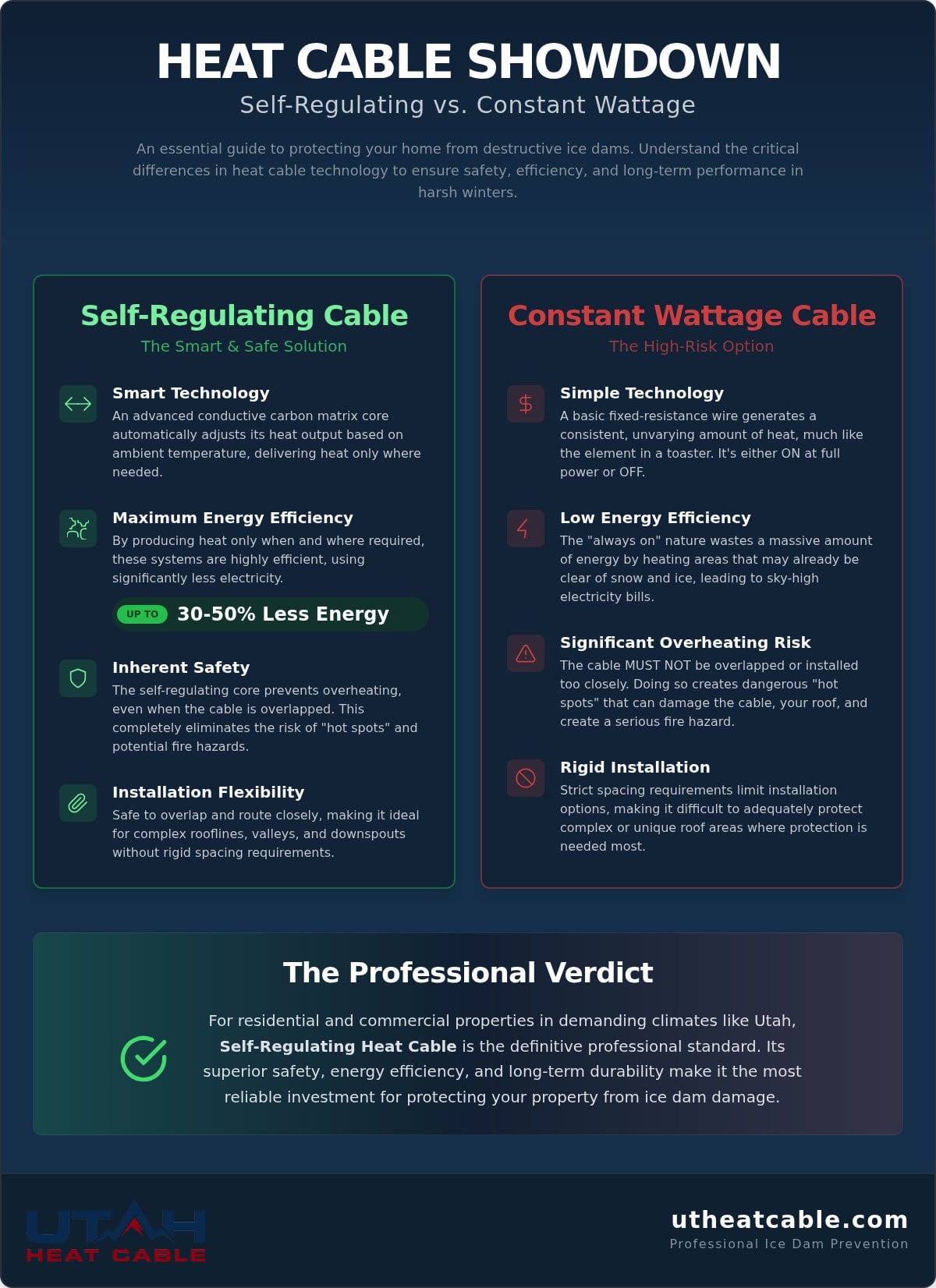
Direct Comparison: Self-Regulating vs. Constant Wattage
For a homeowner or property manager in the Intermountain West, the choice becomes clear when the technologies are compared side-by-side in the context of our unique climate. The question isn’t just “which is cheaper to buy?” but “which provides the best long-term value and protection?”
Performance in Mountain Climates
Utah’s mountain climate, with its heavy snowfall, deep freezes, and intense solar radiation, is the ultimate testing ground for de-icing systems.
- Temperature Swings: In places like Park City, temperatures can swing 40 degrees in a day. Self-regulating cable adapts seamlessly, ramping up power during a frigid night and conserving energy on a sunny afternoon. Constant wattage cable either runs inefficiently or, if controlled by a simple thermostat, may fail to turn on during a critical melt-freeze cycle.
- Heavy Snowfall: Professional-grade self-regulating cable is engineered with sufficient wattage to handle heavy, dense snow. It melts a path effectively, while consumer-grade constant wattage cables often get buried and become useless when they’re needed most.
- Return on Investment (ROI): The initial investment in a self-regulating system is higher. However, the ROI is realized within a few seasons through significantly lower utility bills, a much longer system lifespan (often 20+ years for professional systems vs. 1-3 years for DIY kits), and the avoidance of costly ice dam repairs. You are choosing to pay for a durable asset rather than endlessly paying the utility company for an ineffective solution.
Choosing the Right Cable for Your Roof Type
The right cable also depends on your roof’s material and structure. While self-regulating cable is universally compatible, its advantages are especially pronounced on certain roof types.
- Metal Roofs: Metal roofs are notorious for shedding snow and ice in dangerous avalanches. A heat cable system must be robust and expertly installed to manage this. The safety and flexibility of self-regulating cable make it the ideal choice for creating precise melt channels without risking hot spots against the conductive metal. For more details, read our buyer’s guide for metal roof heat cables.
- Gutters and Downspouts: These areas are choke points where ice forms first. Clearing them is critical. The ability to safely loop and concentrate self-regulating cable inside gutters and downspouts ensures a clear path, while doing the same with constant wattage cable is a recipe for failure.
Not sure which one you need for your specific roof? The best performance comes from a system designed for your property’s unique needs. Get a custom design from Utah Heat Cable.
Professional Installation: Ensuring Safety and Longevity
The performance gap between self-regulating and constant wattage cable is widened even further by the quality of the installation. An expertly designed and installed self-regulating system is a permanent asset for your home. A poorly installed DIY kit is a temporary fix and a potential liability.
Code Compliance and Safety Standards
A professional installation by a licensed electrical contractor is about more than just attaching a cable to your roof. It’s a comprehensive electrical project governed by strict safety codes. Specifically, NEC (National Electrical Code) Article 426 dictates the requirements for “Fixed Outdoor Electric Deicing and Snow-Melting Equipment.”
A professional installation ensures:
- GFCI Protection: All heat cable systems must be protected by a Ground-Fault Circuit-Interrupter, which is a critical safety device that prevents electric shock.
- Dedicated Circuits: A robust heat cable system requires its own dedicated circuit in your electrical panel to handle the load safely without overloading other household circuits.
- Proper Mounting and Connections: Professionals use UV-resistant, non-damaging clips and hardware to secure the cable without penetrating your roof membrane. All electrical connections are made in waterproof junction boxes to prevent moisture intrusion and system failure.
This “master craftsman” approach ensures your system is not only effective but also safe, code-compliant, and built to last, protecting your home from both ice dams and electrical hazards.
The Utah Heat Cable Advantage
As licensed electrical contractors specializing in heat-trace design, we have seen the aftermath of failed DIY projects and underpowered systems. Our expertise covers the full range of properties in the region, from single-family homes in Salt Lake City to large-scale commercial and HOA properties in Park City’s most challenging high-altitude environments.
We provide a comprehensive de-icing solution, from an expert assessment of your property’s specific needs to a custom system design and a flawless, code-compliant installation. We treat every project as a long-term investment in your property’s safety and value.
Don’t leave your home’s protection to chance or a hardware store quick fix. Schedule your professional heat cable consultation today and get a permanent solution to winter ice problems.
Frequently Asked Questions (FAQs)
- Can self-regulating heat cable be cut to length?
- Yes. Because of its parallel construction, self-regulating cable can be cut to any length in the field without changing its heat output per foot. This allows for perfect customization on site. Constant wattage cable, however, comes in fixed, factory-terminated lengths and cannot be altered.
- Is it safe to leave constant wattage heat cable plugged in all winter?
- No. Leaving a constant wattage cable plugged in without a thermostat or controller is both a fire hazard and incredibly wasteful. The cable can overheat if covered by debris and will consume a massive amount of electricity on days when it isn’t needed.
- Do I need a special controller for self-regulating cable?
- While self-regulating cable can technically run without a controller, pairing it with an ambient or moisture-sensing controller is highly recommended for maximum energy efficiency. The controller ensures the system only energizes when conditions are right for ice formation (typically below 38°F), saving significant energy costs.
- What happens if I overlap constant wattage heat cable?
- Overlapping constant wattage heat cable is extremely dangerous. The two sections of cable will trap heat between them, causing the temperature to rise uncontrollably. This will melt the cable’s outer jacket and insulation, leading to an electrical short and creating a serious risk of fire.
- How long does professional-grade heat cable typically last?
- A professionally installed, high-quality self-regulating heat cable system has a typical lifespan of 20 to 30 years. Consumer-grade constant wattage kits from hardware stores often fail after only 1 to 3 seasons of harsh weather.
- Does heat cable use a lot of electricity?
- The energy consumption depends entirely on the technology and controls. A constant wattage system left on continuously will use a very large amount of electricity. A professionally installed self-regulating system paired with a smart controller is highly energy-efficient, activating only when necessary to prevent ice formation.
- Can I install self-regulating heat cable on a metal roof?
- Yes, self-regulating cable is the preferred and safest option for metal roofs. Its ability to be routed in complex patterns without overheating is essential for properly protecting the valleys, eaves, and other critical areas of a metal roof system.
- Why is my heat cable not melting the snow?
- This is a common problem with underpowered, consumer-grade constant wattage cables. They may not have enough power to handle heavy, wet snow or extreme cold. Other causes can include a tripped GFCI breaker, a failed thermostat, or physical damage to the cable. A professional assessment is the best way to diagnose the issue.