
What if the breaker that seems big enough for your roof and gutter heat cable still isn’t the right choice? Safe heat cable electrical requirements depend on more than cable length: the product’s nameplate, system load, site conditions, and locally adopted electrical code all matter. It’s understandable to want a clear answer about circuit capacity and protection, especially when wiring is exposed to wet, icy weather. But a general rule can’t replace a system-specific review.
This guide explains which product and site details shape the electrical design, why continuous-load calculations and ground-fault protection need careful attention, and how product instructions fit alongside code requirements. You’ll also learn what a qualified heat-trace contractor evaluates before installation, from the cable type to the circuit and protection devices. With that groundwork, you can better understand how a complete roof de-icing system is designed for safe, dependable operation.
Key Takeaways
- Heat cable electrical requirements depend on the specific cable, voltage, length, application, and manufacturer instructions, not a one-size-fits-all rule.
- Use product data to establish system demand before assessing circuit capacity and protection; a dedicated circuit depends on the load, code, and site conditions.
- Controls are part of the system design, so consider how they fit the cable and the roof and gutter layout.
- A licensed electrical contractor can evaluate the system and applicable local requirements, which may vary by project location.
Heat Cable Electrical Requirements Start with the Specific System
Heat cable electrical requirements describe the electrical supply, circuit capacity, protective devices, and controls specified for a particular installation. They can’t be determined safely from roof size alone. The cable’s voltage and rated output, planned length, intended application, and manufacturer’s installation instructions all affect the design. As with any electric heater, the cable converts electrical energy into heat, but its circuit needs depend on the product and how it’s installed.
That distinction matters because product examples aren’t universal specifications. A voltage or breaker recommendation for one cable applies to that product and configuration, not automatically to another roof or gutter system. Floor-warming cable specifications also don’t establish requirements for outdoor de-icing: the application, cable construction, and installation instructions may differ.
Which cable and project details determine the electrical requirements?
Begin with the cable documentation, then relate it to the planned layout. Self-regulating and constant-wattage cables are different system types, so their output and product-specific requirements shouldn’t be assumed to match. A qualified installer reviews the relevant details together:
- Cable type: Identify whether the design uses self-regulating or constant-wattage heat cable.
- Nameplate data: Record the stated voltage and rated output for the specific cable.
- Planned length and application: Confirm how much cable the roof and gutter layout calls for and where it will be installed.
- Manufacturer instructions: Use the product’s installation information to guide the circuit and system design.
These details provide the starting point for assessing supply, circuit capacity, protection, and controls. Utah Heat Cable designs and installs both self-regulating and constant-wattage systems, with the electrical design considered as part of the complete roof and gutter de-icing installation.
How Circuit Capacity, Protection, and Controls Are Assessed
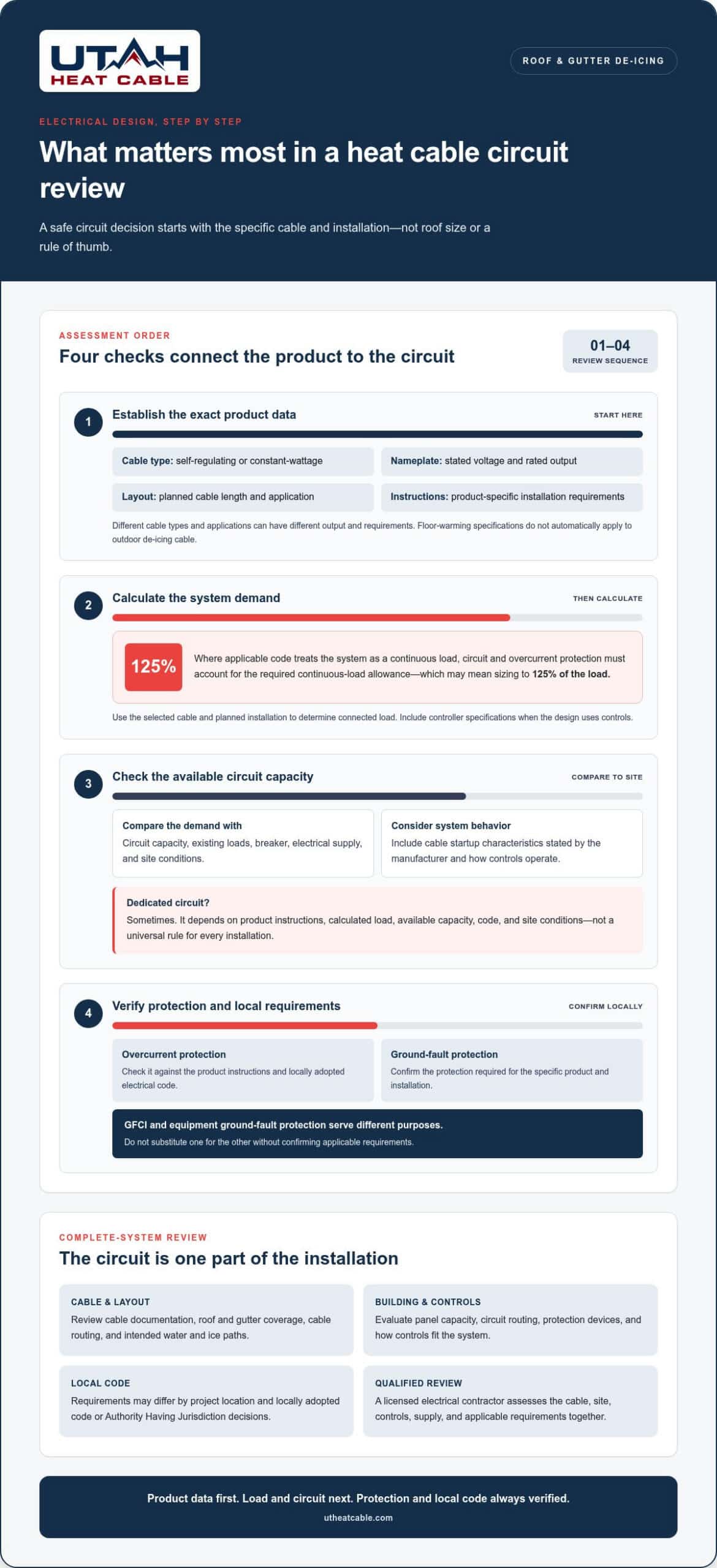
A safe circuit decision follows a sequence, not a rule of thumb. An electrician uses product information and the roof or gutter layout to connect the cable load to the building’s available electrical supply.
- Confirm product data. Review the cable’s nameplate and installation instructions, including voltage, rated output, planned length, and any stated startup characteristics. Include controller specifications where the design uses controls.
- Calculate system demand. Determine the connected load from the selected cable and planned installation. Where applicable code treats the system as a continuous load, the circuit and overcurrent protection must account for the required continuous-load allowance, which may mean sizing to 125% of the load.
- Assess circuit capacity. Compare the calculated demand with the circuit’s capacity, existing loads, breaker, supply, and site conditions. A dedicated circuit may be specified if the product instructions, load, or applicable code call for it, but it isn’t a universal requirement for every installation.
- Verify protection. Check the required overcurrent and ground-fault protection against the product instructions and locally adopted electrical code. GFCI and equipment ground-fault protection serve different purposes, so one shouldn’t be substituted for the other without confirming the applicable requirements.
Does heat cable need a dedicated circuit?
Sometimes. An electrician considers the system’s demand alongside other loads, available breaker capacity, cable startup behavior stated by the manufacturer, and how the controls operate. That review helps determine whether an existing circuit is suitable or a dedicated circuit is needed. The heat cable electrical safety guidance provides additional context for planning.
These heat cable electrical requirements are part of the roof and gutter system design, not a breaker choice made in isolation. For project-specific roof and gutter de-icing system design and installation, a licensed electrical contractor can assess the cable, site, controls, and locally applicable requirements together.
Plan a Code-Compliant Roof Heat Cable Installation
A roof de-icing system needs to be planned as a complete installation, not treated like indoor floor-warming cable placed outdoors. Roof and gutter layouts, cable routing, electrical supply, controls, and protection all affect the design. A licensed electrical contractor reviews these details alongside the cable’s product documentation and the requirements that apply at the property.
What should a professional review before installation?
The review starts with the product instructions and nameplate, then connects those requirements to the building and the planned cable layout. The contractor evaluates electrical panel capacity, circuit routing, required protection, and how any controls fit the system. This helps ensure the electrical plan supports the intended roof and gutter coverage rather than relying on assumptions from a different cable or application.
Local requirements matter, too. Utah, Idaho, and Wyoming properties may fall under different locally adopted electrical codes and Authority Having Jurisdiction decisions. The applicable requirements can vary by project location, so an approval or design approach for one jurisdiction shouldn’t be assumed to apply elsewhere. A licensed contractor verifies the relevant local requirements as part of planning the work.
Roof planning also means considering where water and ice need a clear path, then coordinating the cable layout with that purpose. The roof winterizing guide to heat cable offers related context for preparing a roof system. With the site, cable, and local requirements reviewed together, heat cable electrical requirements become part of a practical de-icing design, not a generic set of breaker assumptions.
Utah Heat Cable designs and installs roof and gutter de-icing systems. Explore our roof and gutter heat cable services to see how system planning and installation come together.
Start Planning Your Heat Cable System
As you prepare for winter, make electrical planning an early part of the roof-protection design, before cable routes and control choices are fixed. A coordinated plan can account for the roof’s drainage paths, the areas that need de-icing, and how electrical work fits the property. Heat cable electrical requirements are best resolved around the actual site and selected system, rather than copied from a generic product example. Early planning also helps keep design decisions purposeful as the project moves toward installation.
Utah Heat Cable develops custom heat-trace designs for residential, commercial, industrial, and HOA properties. Bringing the roof layout and electrical plan together from the outset supports a system tailored to the building’s needs. Plan a professionally designed heat cable system and take a confident step toward winter readiness.
Frequently Asked Questions
Can heat cable be connected to an extension cord?
Don’t connect roof heat cable to an extension cord unless the cable manufacturer explicitly permits that setup. An extension cord can introduce a connection point exposed to weather and may not suit the system’s electrical load or intended installation. For a hardwired system, use the specified supply and connection method. A qualified electrician can determine the appropriate setup for the particular cable and site.
Can roof heat cable be installed on any roof material?
No, roof heat cable isn’t automatically compatible with every roofing material or installation method. The cable’s listing and manufacturer instructions determine its intended use and how it may be attached or routed. Before installation, the roof surface, drainage path, and cable layout should be considered together. That project-specific review is especially important for homes across Utah, Idaho, and Wyoming, where local requirements can differ.
How much electricity does roof heat cable use?
Electricity use depends on the cable’s rated output, installed length, and how long the system operates. To estimate energy use, multiply the system’s power in kilowatts by its operating hours; the result is kilowatt-hours. A controller may affect runtime, but it doesn’t change the need to use the product’s actual electrical rating. Without those details, a reliable consumption estimate isn’t possible.
Is self-regulating heat cable the same as electric floor-warming cable?
No. Self-regulating heat cable is a cable type used in applications such as roof and gutter de-icing, while electric floor-warming cable is designed for a different installation. Their electrical ratings, construction, and instructions aren’t interchangeable by assumption. For roof work, use cable specifically intended for that application and follow its documentation rather than applying floor-warming specifications to an exterior system.