
What affects the power use of a roof heat cable, and how can you avoid heating areas that do not help water drain? An energy efficient roof heat cable can adjust its output as temperatures change, while suitable controls can help manage when the system operates. It still uses electricity, so planning the cable route and coverage matters.
Efficiency depends on more than cable type. Roof shape, overhangs, gutters, downspouts, and the path meltwater needs to follow all affect system design. This article explains how self-regulating and constant-wattage cables differ, what to consider when planning coverage, and how controller options fit into operation. Utah Heat Cable designs and installs systems for properties in Utah, Idaho, and Wyoming, with layouts tailored to each roof’s drainage needs.
Key Takeaways
- An energy efficient roof heat cable adjusts its heat output as temperatures change, but it still uses electricity while operating.
- Plan coverage around roof shape and drainage routes so meltwater has a continuous path through roof edges, gutters, and downspouts.
- Conditions and building layouts vary across Utah, Idaho, and Wyoming, so cable placement should suit the property rather than follow a one-size-fits-all layout.
- For complex roofs or drainage needs, custom design and licensed electrical installation can help match cable coverage to the property.
How Does Energy-Efficient Roof Heat Cable Work?
In brief: Roof heat cable applies heat along selected roof and drainage areas to help meltwater follow a clear route off the roof. It is not intended to heat the entire roof or eliminate electricity use. Good planning matches the cable route to where water needs to flow.
That drainage path matters because ice dams can form when meltwater refreezes near the roof edge. Understanding ice dam formation and prevention helps explain why cable placement should follow the roof’s actual water routes rather than rely on a standard layout.
What self-regulation changes, and what it does not
Self-regulating cable changes its heat output in response to the temperature around it. One section may produce more heat while a warmer section produces less. This variable output can help manage power use compared with constant-wattage cable, which provides a consistent output.
Self-regulation does not mean the cable uses no electricity. Total use depends on the amount of cable, where it is installed, operating conditions, and any control settings. A longer layout covering roof edges, gutters, and downspouts has different power needs from a shorter run serving one drainage area. Cable type alone cannot make a poor layout effective: coverage needs to support a continuous path for meltwater.
When comparing cable options, consider the roof areas that need coverage and how the system will be controlled. Utah Heat Cable designs heat-trace systems using self-regulating and constant-wattage cable, with controller options suited to the project. Explore the self-regulating heat cable and system options to learn more.
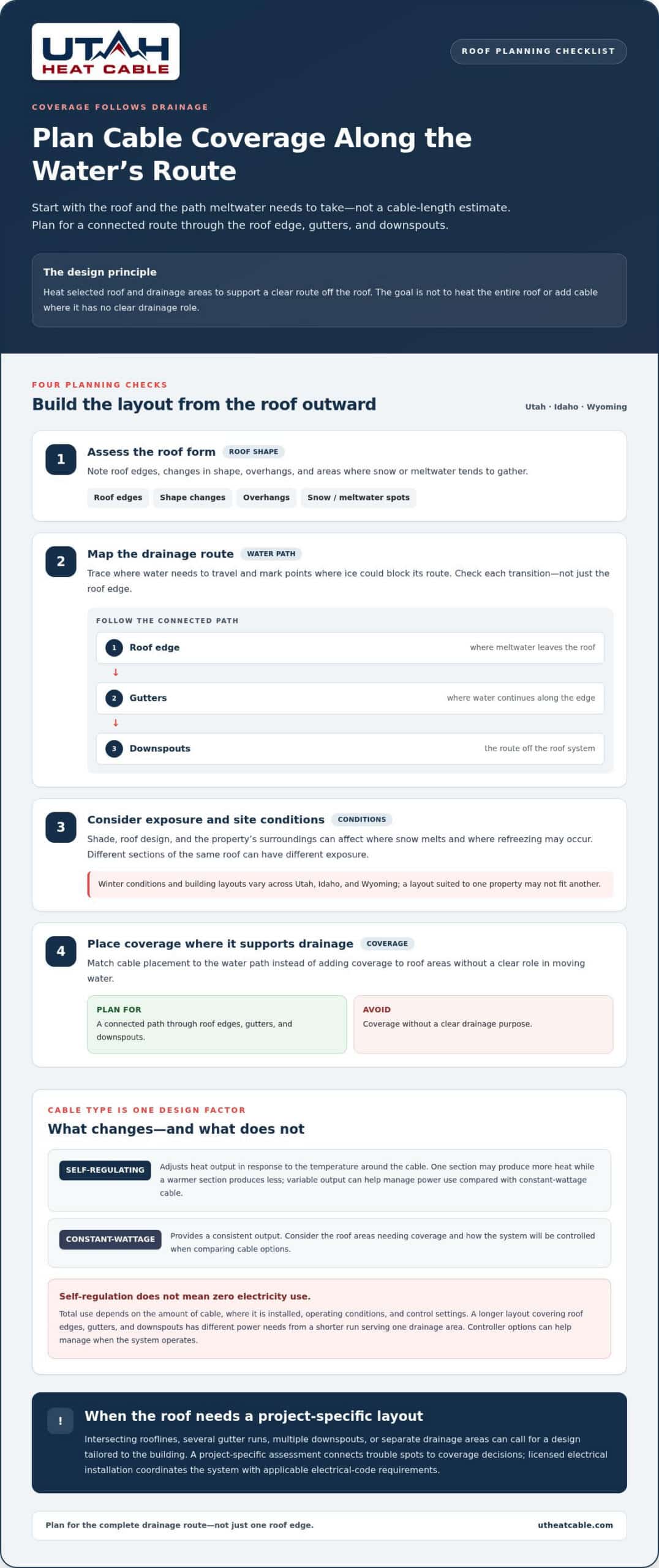
How to Plan Efficient Roof Heat Cable for Utah, Idaho, and Wyoming
A useful plan starts with the roof, not a cable-length estimate. Winter conditions and property layouts vary across Utah, Idaho, and Wyoming, so a layout suited to one building may not fit another. Plan cable coverage around the drainage route, from the roof edge through the gutters and downspouts.
- Assess the roof form. Note roof edges, changes in shape, overhangs, and areas where snow or meltwater tends to gather.
- Map drainage routes. Trace where water needs to travel through gutters and downspouts, and note points where ice could block the route.
- Consider exposure and site conditions. Shade, roof design, and the property’s surroundings can affect where snow melts and where refreezing may occur.
- Plan coverage. Place cable where it supports the drainage path rather than adding coverage to roof areas without a clear role in moving water.
Which roof and drainage details shape the plan?
Pay particular attention to transitions between roof edges, gutters, and downspouts. Warming only the roof edge may not support drainage if meltwater then reaches a cold or blocked gutter. Shade and other site conditions matter too: two sections of the same roof can have different exposure. A roof winterizing guide can help put cable planning in the wider context of seasonal roof preparation.
Utah Heat Cable designs project-specific heat-trace systems around roof layout and drainage needs. The design connects observed trouble spots to practical coverage decisions, rather than relying on a generic cable-length estimate. Learn more about roof heat cable planning.
When a Professionally Designed Roof Heat Cable System Makes Sense
A simple roof with one clear drainage route may need a different layout from a property with intersecting rooflines, several gutter runs, or multiple downspouts. Custom design is useful when roof geometry creates separate drainage areas or when dependable winter drainage is a priority for the building. An energy efficient roof heat cable system should account for those specific needs instead of applying the same layout to every property.
Utah Heat Cable designs and installs roof heat cable and snow-melt systems for residential, commercial, industrial, and HOA properties across Utah, Idaho, and Wyoming. As a licensed electrical contractor, the company coordinates system design with professional installation.
What to expect from a project-specific assessment
A project-specific design considers the roof areas that need coverage and the drainage paths the system is intended to support. That means looking beyond one roof edge to how connected roof sections, gutters, and downspouts work together. The resulting layout is tailored to the building’s shape and use, helping avoid coverage without a clear drainage purpose.
A design matched to the roof, paired with licensed electrical installation, helps create a system suited to the property and installed according to applicable electrical-code requirements. This planning also provides a basis for choosing cable and controller options. It cannot promise a particular reduction in energy use: actual operation depends on the system and conditions.
If roof complexity or drainage concerns make planning difficult, a project-specific design can clarify the coverage needed. Explore roof heat cable and de-icing services from Utah Heat Cable.
Take the Next Step Toward Winter Readiness
Before winter weather returns, note where ice or blocked drainage has caused concern and which roof areas are affected. These observations can help focus system planning on the drainage problems that matter, rather than adding cable coverage without a clear purpose. Consider the complete route from the roof edge through the gutters and downspouts, especially if the property has multiple roof sections.
Plan a roof heat cable solution for your property with Utah Heat Cable. The team designs and installs heat-trace systems for properties in Utah, Idaho, and Wyoming.
Frequently Asked Questions
How much electricity does roof heat cable use?
There is no single usage figure that fits every roof. Electricity use depends on the cable type, the areas covered, operating conditions, and control settings. A system serving several roof edges and downspouts has different power needs from one covering a limited drainage area. A project-specific design relates planned coverage to the property instead of relying on a generic estimate.
Does roof heat cable need to run continuously?
Not necessarily. The operating schedule depends on the system design, controller options, and conditions that create ice or drainage concerns. For a property in Utah, Idaho, or Wyoming, the appropriate operation can vary with the roof layout and equipment. Follow the system’s design and operating guidance rather than assuming it should stay on all winter or that a particular setting eliminates electricity use.
Can roof heat cable prevent ice dams on every roof?
No. Roof heat cable can support drainage in selected areas, but it is not a universal solution or a guarantee against ice dams. Heating a roof edge, for example, may not resolve a separate blockage farther along the drainage route. The system’s role is to help manage ice risk in the areas it is designed to serve, as part of a property-specific winter plan.