
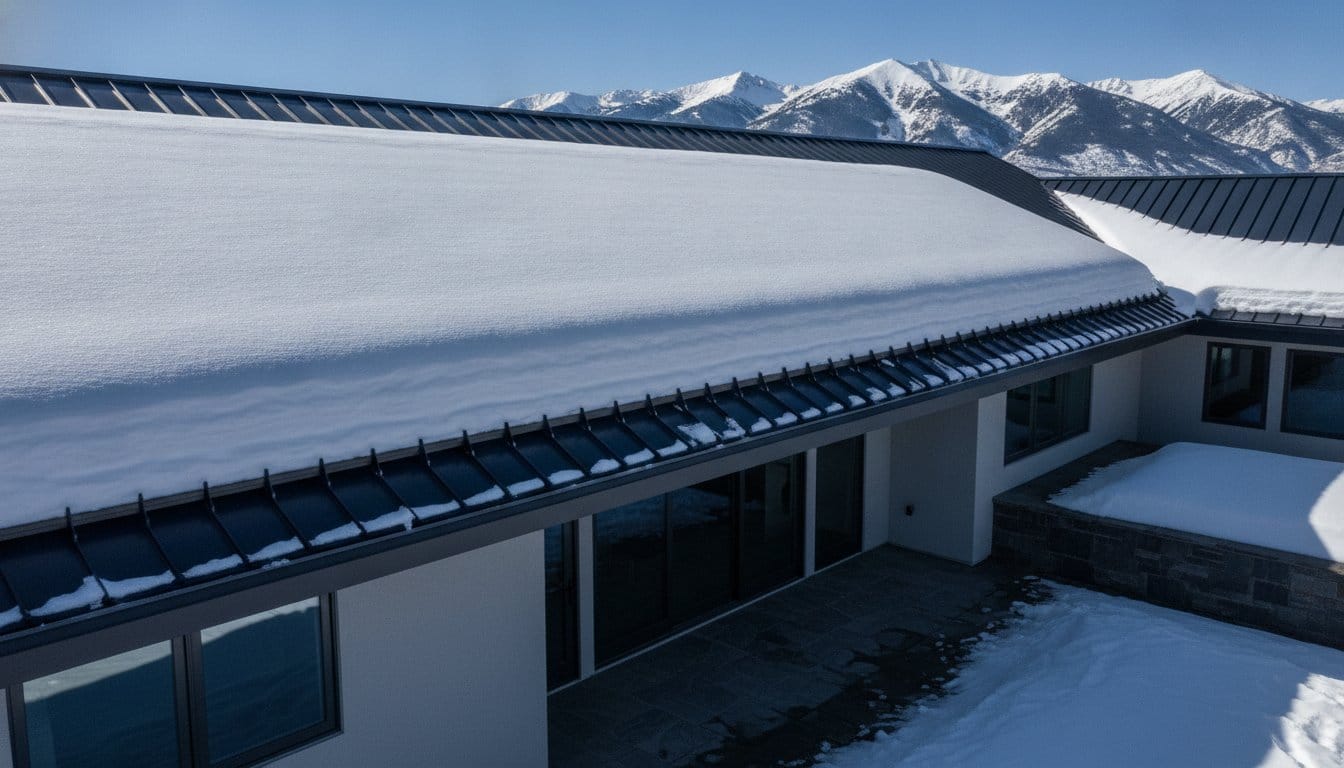
Imagine standing on your porch during a quiet winter afternoon when a thunderous roar erupts from above. Within seconds, hundreds of pounds of packed snow and ice slide off your slick metal panels, crushing your expensive landscaping and narrowly missing the walkway where your kids or pets play. This phenomenon, known as a roof avalanche, is a common hazard for homeowners in high-snow regions. Installing a professional snow retention system for metal roofs is the only way to break up these heavy drifts and keep them securely in place until they melt away safely.
It’s natural to feel anxious about the integrity of your home, especially if you’re worried that drilling into metal might lead to future leaks. You want a solution that protects your family without compromising the sleek aesthetic of your architecture. We’ll show you how to select an engineered system that matches your roof’s style and handles the specific snow loads of your local climate. We’ll also look at the technical layout requirements and placement strategies that ensure your gutters stay attached and your property remains a safe haven all winter long.
Key Takeaways
- Identify the structural differences between pad and rail systems to determine which architectural approach best suits your standing seam or screw-down roof.
- Discover how a professionally designed snow retention system for metal roofs manages shear force to prevent guards from failing under heavy mountain snow loads.
- Learn how to combine snow guards with self-regulating heat cables to create a comprehensive shield that protects both your gutters and your landscaping.
- Understand the critical role of professional torque and sealing techniques in preserving your manufacturer’s warranty and preventing moisture intrusion.
- Move from basic property maintenance to an engineered safety strategy that eliminates the risk of dangerous, unpredictable roof avalanches.
What is a Snow Retention System and Why Does Your Metal Roof Need One?
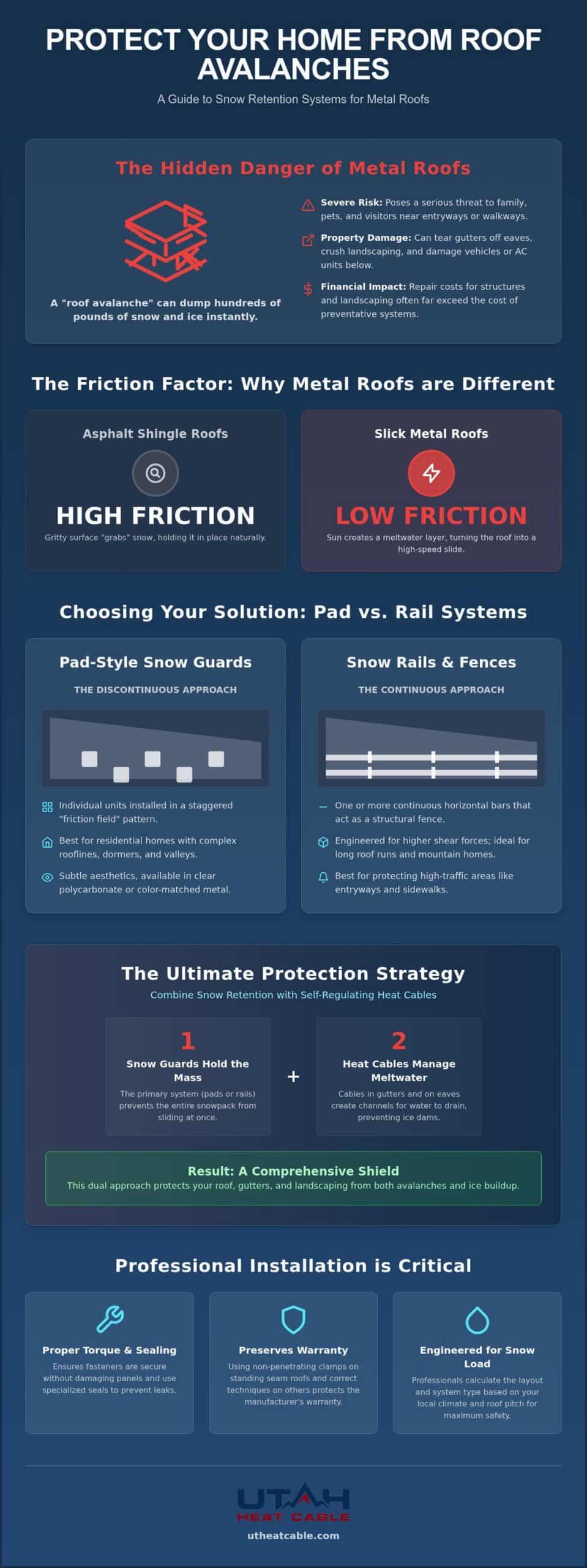
A Snow guard or retention system is an engineered array of components designed to hold snow on a roof surface until it can melt or shed in small, controlled amounts. While many homeowners view them as decorative accents, they’re actually critical safety infrastructure. A properly designed snow retention system for metal roofs acts as a mechanical brake, preventing the entire accumulation of a winter storm from sliding off at once. This isn’t about stopping the snow entirely; it’s about managing its release so it doesn’t become a liability. Without these guards, your roof essentially becomes a launchpad for heavy, frozen debris.
The Dangers of Unmanaged Roof Snow
When snow builds up on a smooth surface, gravity pulls it downward, creating massive amounts of tension. If that tension breaks, you face a roof avalanche. These sudden slides can dump thousands of pounds of compacted ice onto entryways, posing a severe risk to anyone standing below. Beyond the physical danger to family and pets, these slides often tear gutters clean off the eaves and crush expensive landscaping or mechanical equipment like AC units. If you’re concerned about how to prevent snow slides on walkways and entrances from becoming a recurring hazard, understanding the mechanics of roof avalanches is the essential first step. The financial impact of replacing a high-end gutter system or repairing a lower roof tier that was struck by falling ice far outweighs the cost of preventative retention. It’s much easier to hold the snow in place than it is to fix the aftermath of a slide.
Metal Roofs vs. Shingle Roofs: The Friction Factor
Metal roofs present a unique challenge because they have a significantly lower friction coefficient than traditional asphalt shingles. Shingles are gritty and naturally “grab” the snow, whereas metal panels are essentially a high-speed slide once a thin layer of meltwater forms. This is where thermal expansion plays a role. As the sun hits the metal, the panels warm up quickly, even in freezing air temperatures. This heat breaks the bond between the ice and the roof surface. Because metal is such an efficient conductor, a massive slide can occur on a sunny afternoon even if the pitch of your roof is relatively shallow. This sudden loss of friction is exactly why a specialized snow retention system for metal roofs is required for these surfaces.
Types of Snow Retention: Pad-Style vs. Rail Systems
Selecting the right snow retention system for metal roofs requires a clear understanding of your property’s specific needs. Every roof has a unique personality, defined by its pitch, the length of its runs, and its structural profile. The two primary approaches, pad-style and rail systems, offer different benefits depending on whether you’re looking for subtle protection or heavy-duty structural support. Your roof type is the biggest factor here; standing seam roofs allow for non-penetrating clamps, while screw-down roofs require mechanical fasteners with specialized seals. The goal is always to create a reliable barrier that respects the integrity of your home’s exterior.
Pad-Style Snow Guards (The Discontinuous Approach)
Pad-style guards are individual units, sometimes called cleats or snow blocks, that are installed in a staggered pattern across the roof surface. This configuration creates a “friction field” that anchors the snow blanket at multiple points. Because they’re spaced out, they’re often the go-to choice for residential homes with complex rooflines, dormers, or valleys. These guards can be made from clear polycarbonate to remain nearly invisible or from color-matched metal to blend with your panels. On standing seam roofs, we use high-strength clamps to attach them without ever piercing the metal, which is vital for preserving your warranty. For other metal profiles, they’re often secured with specialized adhesives or mechanical fasteners that include EPDM rubber washers to prevent moisture intrusion.
Snow Rails and Fences (The Continuous Approach)
When you’re dealing with long roof runs or high-traffic areas like sidewalks and entryways, rail systems provide a more robust solution. These consist of one or more continuous horizontal bars that act as a structural fence. They’re engineered to handle significantly higher shear forces than individual pads, making them ideal for commercial buildings or mountain homes that see heavy accumulation. Many modern rail designs, such as the ColorBar style, feature a channel where a strip of your actual roofing metal is inserted. This creates a seamless look that maintains your home’s architectural style while providing elite-level safety. If you’re struggling to decide which system is right for your climate, we can help you evaluate your roof’s load requirements to ensure a safe, lasting installation.
It’s important to remember that these systems aren’t just about the hardware; they’re about the engineering behind the layout. Whether you choose the low-profile look of pads or the heavy-duty strength of rails, the placement must be calculated to handle the specific weight of snow common in your region. A master craftsman understands that the “why” behind the placement is just as important as the “how” of the installation.
How Snow Retention Systems are Engineered for Load
Installing a snow retention system for metal roofs isn’t as simple as attaching a few brackets and calling it a day. It’s a calculated engineering task that accounts for “shear force,” which is the gravitational pull trying to slide a massive snowpack down your roof’s slope. If you only install a single row of guards at the eaves, you’re asking a small amount of hardware to hold back thousands of pounds of pressure. This often leads to “point loading,” where the weight is concentrated on too few points, potentially buckling your roof panels or ripping the guards out entirely. A professional approach involves distributing that weight across the entire roof plane to ensure the system remains a protective shield, not a liability.
Calculating Your Local Snow Load
In regions like Utah, Idaho, and Wyoming, we deal with unique environmental challenges that require specific data. Ground snow load is the starting point, but roof snow load is the figure that actually matters for your installation. Factors like roof pitch and wind exposure determine how much snow actually stays on your panels. Snow density refers to the mass of water per unit volume of snow, a factor that dictates how much weight your roof must support as the snowpack matures and compacts. Because our local snow is often heavy and moisture-rich, a snow retention system for metal roofs in Park City requires a much denser layout than one in a drier, lower-elevation climate. We use these metrics to determine exactly how much force each bracket will need to withstand during a record-breaking winter. Facility managers overseeing larger structures should also review the broader implications of industrial roof ice prevention engineering for safety and structural integrity, as the same load-calculation principles apply at scale.
The Importance of Professional Layout Design
A master craftsman maps out a “holding field” rather than just a single line of defense. We look at your rafter length and roof pitch to determine if multiple rows of retention are necessary. If the distance from the ridge to the eave is too long, the snow at the top creates a massive “drag load” that can overwhelm guards at the bottom. Professional layout design incorporates a safety factor, ensuring the hardware can handle peak storm events that exceed average yearly totals. This methodical approach accounts for the cumulative pressure of several storms piling up over weeks. DIY placements often fail because they underestimate these cumulative forces. By calculating the exact number of attachment points needed per square foot, we provide a long-term solution that protects your property without ever compromising the metal’s structural integrity.
Synergy: Integrating Snow Retention with Heat Cables
While a snow retention system for metal roofs is your primary defense against sudden avalanches, it’s only one half of a complete winter protection strategy. On their own, snow guards hold back the weight, but they don’t prevent the formation of ice dams or frozen gutters. When you integrate high-quality heat cables with a retention system, you create a synchronized solution that manages both the weight of the snow and the flow of the meltwater. We often call this the ‘dynamic duo’ of roof care because each component makes the other more effective. The guards stabilize the snowpack, while the cables ensure that as the snow melts, the water has a clear, heated path to the ground.
Strategic placement is the secret to this synergy. If snow is allowed to slide even a few inches, it can build up enough momentum to crush or pull heat-trace systems right out of the gutters. By anchoring the snow higher up the roof plane, you protect your heating equipment from mechanical damage. This setup allows the heat cable to focus on its primary job: keeping the eave and gutter clear of ice buildup without the constant threat of being buried or broken by shifting ice slabs.
Protecting Your Heat Cable Investment
Replacing a damaged heat-trace system every few seasons is a frustrating and unnecessary expense. When heavy ice slides down a slick metal panel, it acts like a giant scraper, often taking everything in its path with it. Snow rails provide a structural barrier that shields your gutter and eave heating systems from these forces. By designing a layout that accounts for both retention and drainage, we ensure that your self regulating heat cable stays exactly where it was installed. This protective approach extends the lifespan of your equipment and gives you the peace of mind that your home is ready for the next big storm. If you want to see how these systems work together on your specific roof profile, you can explore our integrated winter protection solutions today.
Automated Solutions for Snow Management
Modern technology allows for even greater efficiency through the use of advanced sensors and controllers. Instead of running your heat cables manually, you can use automated systems that trigger the heating elements only when moisture and freezing temperatures are both present. This is especially useful for preventing ice dams that might otherwise form behind your snow guards. When a snow retention system for metal roofs is loaded with a fresh pack, the bottom layer often begins to melt due to heat loss from the home. Without a clear path provided by heat cables, that water refreezes at the cold eave, creating a dangerous ice dam. A master craftsman understands these underlying mechanics and designs a system where the electrical and mechanical components work in total harmony to protect your property’s structural integrity.
Professional Installation: Ensuring Safety and Warranty Compliance
A metal roof is a significant investment designed to last for decades, but an incorrectly installed snow retention system for metal roofs can compromise that longevity in a single afternoon. Many manufacturers have strict guidelines regarding how accessories are attached to their panels. If you choose a DIY approach or hire a general contractor who lacks specialized experience, you risk voiding your roof’s warranty. Professional installers understand the precise torque requirements for mechanical fasteners and the necessity of using high-grade EPDM seals to prevent moisture intrusion. This methodical attention to detail ensures your home remains watertight while the system performs its job under heavy pressure.
Protecting the Roof Membrane and Finish
For standing seam roofs, non-penetrating clamps are the gold standard for protection. These engineered components grip the seam of the metal without ever piercing the panel, which keeps the roof’s moisture barrier completely intact. It’s also vital to account for galvanic corrosion. When incompatible metals like steel and aluminum touch in a moist environment, a chemical reaction occurs that can eat through your roof finish. A master craftsman ensures every component is metallurgically compatible. If your roof profile requires adhesive-mounted guards, the application must happen within a specific temperature window to ensure a permanent bond. Installing these in late autumn when it’s too cold often leads to the guards popping off during the first major thaw.
Safety is another factor that shouldn’t be overlooked. Metal surfaces are notoriously slick, especially when a thin layer of morning frost or moisture is present. Professionals use specialized fall-protection equipment and high-traction footwear designed specifically for metal inclines. This equipment allows for a precise installation that simply isn’t possible when you’re struggling to maintain your footing on a steep pitch. Once the system is in place, it requires minimal care, though we recommend a quick visual check after a record-breaking winter to ensure no clamps have shifted under the stress of the season’s “drag load.”
Why Choose a Local Specialist?
The Mountain West presents environmental challenges that standard “out of the box” kits aren’t designed to handle. A local specialist provides a system that is strictly to code and “Utah-tested” for the dense, heavy snow common in our region. This expertise ensures that your layout is engineered for the specific shear forces of your town’s elevation, providing a level of security that generic solutions can’t match. You gain the peace of mind that comes from knowing your property is shielded by a professional-grade installation. Protect your home today with a custom snow retention layout from Utah Heat Cable and ensure your family stays safe all winter long.
Secure Your Property with Professional Snow Management
Protecting your home from the weight of a Mountain West winter requires more than just off-the-shelf hardware. It’s a matter of precise engineering and understanding how a snow retention system for metal roofs interacts with your specific architecture. We’ve explored how proper load distribution prevents structural damage and how integrating heat cables creates a comprehensive shield against ice dams and avalanches. By utilizing non-penetrating options for standing seam roofs, you can maintain your manufacturer’s warranty while gaining the peace of mind that your family and landscaping are safe from sudden slides.
As a licensed electrical contractor, Utah Heat Cable specializes in custom-engineered layouts that are built specifically for the heavy snow loads found in Utah, Idaho, and Wyoming. Don’t wait for the first heavy accumulation to discover the weak points in your roof’s defense. You can Request a Professional Snow Retention Design & Quote today to ensure your property is prepared for whatever the season brings. Investing in a professional installation now means you can rest easy knowing your home is protected by elite-level skill and local expertise. We’re here to help you weather the storm with confidence.
Common Questions About Snow Retention
Do snow guards cause leaks in metal roofs?
Properly installed snow guards do not cause leaks. For standing seam roofs, we use non-penetrating clamps that grip the seam without piercing the metal panels. On screw-down roofs, we use mechanical fasteners equipped with high-grade EPDM rubber washers. These washers create a watertight seal that stands up to extreme temperature fluctuations, ensuring your roof’s moisture barrier remains completely intact.
How many snow guards do I need for my roof?
The number of guards required is determined by a specific engineering calculation. We account for your roof’s pitch, the length of the rafters, and the local ground snow load for your specific town. One row of guards is rarely enough for steep or long slopes. We design the density of your snow retention system for metal roofs to distribute the weight evenly, preventing any single point from becoming overloaded.
Can I install snow retention systems on an existing metal roof?
Yes, these systems can be professionally retrofitted to almost any existing metal roof. Whether your home is decades old or was just finished, we can design a layout that integrates with your current structure. The installation process is efficient and doesn’t require removing or replacing any part of your original roofing material.
Will snow guards ruin the look of my architectural metal roof?
Modern snow retention equipment is designed to be as subtle or as architectural as you prefer. You can choose low-profile pad-style guards that are virtually invisible from the ground or rail systems that feature color-matched inserts. These options allow the safety components to blend perfectly with your roof’s color and style, maintaining the home’s curb appeal while adding critical protection.
Is adhesive or mechanical fastening better for snow guards?
Mechanical fastening or clamping is the superior choice for the heavy snow loads common in the Mountain West. While adhesives are an option for some light-duty applications, they require a very specific temperature window for installation and can fail over time. Clamps and fasteners provide a structural, permanent bond that won’t degrade under the intense UV exposure and repeated freeze-thaw cycles found in high-elevation climates.
Do I need snow guards if I already have heat cables?
Yes, because these two systems serve entirely different purposes. Heat cables prevent ice dams and keep gutters clear of ice, but they aren’t built to hold back the weight of a heavy snowpack. A snow retention system for metal roofs stabilizes the snow, preventing it from sliding down and potentially ripping your heat cables off the eaves or crushing your gutter system. For a comprehensive look at protecting the areas most at risk, our guide on preventing dangerous snow slides on walkways and entrances covers the full range of professional strategies available to homeowners.
What happens if I don’t install snow retention on my metal roof?
Without a retention system, you face the constant risk of sudden roof avalanches. These slides can dump thousands of pounds of compacted ice onto entryways, crushing expensive landscaping and posing a severe safety risk to anyone below. Unmanaged snow also puts immense pressure on your gutters, often pulling them away from the roofline and causing long-term structural damage. Commercial and industrial property owners face even greater exposure to liability and structural collapse, as detailed in this overview of industrial roof ice prevention strategies for large-scale facilities.
Can snow guards handle the heavy snow loads in Utah and Wyoming?
Absolutely, provided they are engineered for our specific regional conditions. We design systems that are “Utah-tested” to handle the dense, moisture-rich snow common in areas like Park City and Jackson Hole. By calculating the exact shear forces for your specific elevation and roof pitch, we ensure the hardware is strong enough to withstand even record-breaking winter seasons without failing.