
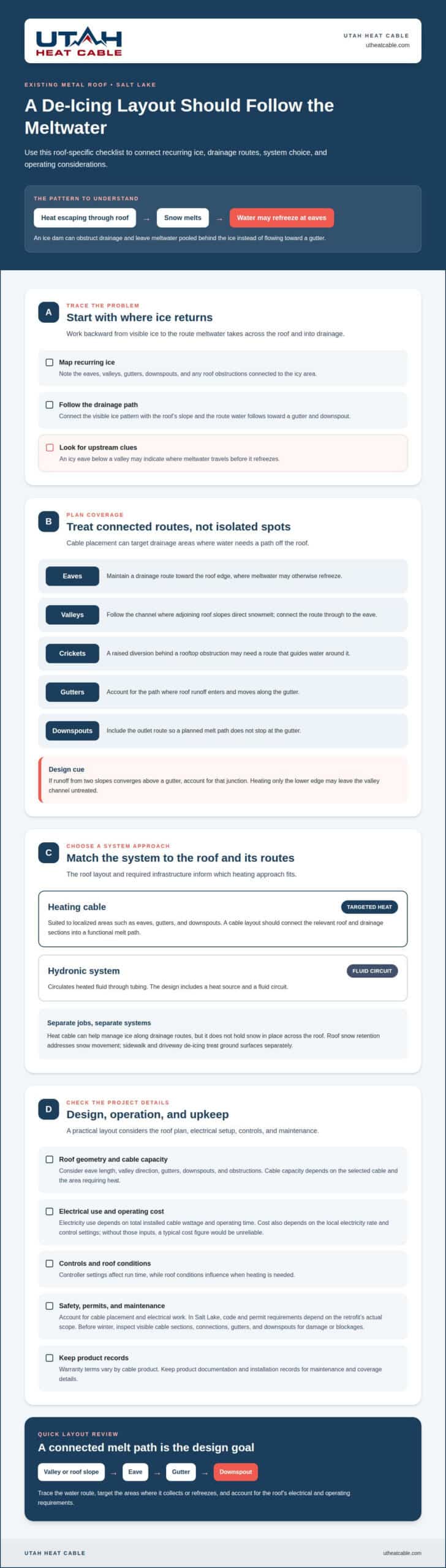
What if an ice dam on an existing metal roof calls for a planned heat-cable layout, not simply more heat at the roof edge? A custom roof de-icing design in Salt Lake City can target problem areas by directing heat along eaves, valleys, gutters, and downspouts. Heat escaping through a roof can melt snow, and the resulting water may refreeze at the eaves to form an ice dam.
It’s understandable to focus first on visible ice, but the layout matters: each roof area plays a different role in moving meltwater off the roof. This guide explains how a tailored design can address ice dams on existing metal roofs, what determines cable placement, and how eaves, valleys, gutters, and downspouts fit into the system. You’ll get a clearer picture of the decisions behind a practical, roof-specific approach.
Key Takeaways
- Understand how snowmelt can refreeze at the eaves and contribute to ice dams on existing metal roofs.
- Learn why a tailored heat-cable layout may cover eaves, valleys, gutters, and downspouts.
- See how roof shape and meltwater drainage inform a professional de-icing system design.
- Explore when de-icing services and controller options can support a roof-specific approach.
Retrofit ice-dam prevention for existing metal roofs
On an existing metal roof, start by tracing recurring ice dams back along the meltwater route. A retrofit layout can target roof edges and drainage points where refreezing obstructs runoff.
Ice and Snow Buildup Control
Heat escaping through a roof can melt snow, and that water may refreeze at the eaves, forming ice dams. For a retrofit, map the eaves, valleys, gutters, and downspouts that need to carry water away. Heat cable can help manage ice along these routes, but it does not hold snow in place across the roof. This distinction helps set realistic expectations for ice control and the roof’s broader snow-management needs.
Roof and Property Damage Prevention
An ice dam can obstruct drainage, leaving meltwater pooled behind the ice instead of flowing toward a gutter. A roof-specific retrofit focuses on places where water collects or refreezes, including eaves and valleys. During design, connect the visible ice pattern with the roof’s drainage path. For example, an icy eave below a valley may indicate where meltwater travels. This targeted approach can help reduce ice-related exposure for the roof and nearby property.
Code and Permit Considerations
In Salt Lake City, applicable building and electrical codes and permit requirements depend on the retrofit’s actual scope. The presence of heat cable alone does not establish one permit path for every metal roof. The design should account for cable placement and electrical work, then determine the requirements that apply before installation. This sequence gives property owners a clearer project plan without assuming that the same rules apply to every roof or electrical setup.
Customized heating for eaves, valleys, gutters, and downspouts
For Salt Lake City homes, a suitable system depends on roof geometry and the path meltwater takes. Heating cables provide targeted electric heat, while hydronic systems circulate heated fluid through tubing.
Heating Eaves, Valleys, and Crickets
At eaves, cable placement can maintain a drainage route toward the roof edge. In a valley, the design follows the channel where adjoining roof slopes direct snowmelt. A cricket, the raised diversion behind a rooftop obstruction, may need a route that guides water around it. Trace each water path before deciding which areas need heat.
A heated valley route runs continuously through the valley and toward the eave. For example, if runoff from two slopes converges above a gutter, the route should account for that junction. Cable placed only along the lower edge may leave the valley’s drainage channel untreated.
Roof De-Icing System Options
Heating cables suit targeted areas such as eaves, gutters, and downspouts. Hydronic systems circulate warmed fluid through tubing, so their design includes a heat source and fluid circuit. For a home that needs localized heat along existing roof drainage routes, cable may be the more direct approach. The roof layout and system infrastructure determine which option fits.
Compare the route each system must serve, from a valley through a gutter and downspout. A cable layout should connect these sections into a functional melt path, rather than heating isolated spots. Request a roof heating layout to discuss the areas that need coverage.
Heat escaping through a roof can melt snow, which may then refreeze at the eaves and form ice dams. Roof heat loss is therefore relevant to drainage planning.
Professional roof system design
A professional layout connects roof geometry, drainage routes, electrical capacity, and operating controls. For a custom roof de-icing design in Salt Lake City, these decisions shape the installed system and its energy use.
Heating Cable Layout and Capacity
Layout starts with the roof plan: eave length, valley direction, gutters, downspouts, and obstructions. Cable capacity depends on the selected cable and the area requiring heat. A roof with one problem valley, for example, needs a different route from one with several valleys and long eaves. A custom roof de-icing design in Salt Lake City should trace continuous drainage paths and match cable placement to those areas.
Electricity Use and Operating Costs
Electricity use depends on the installed cable’s total wattage and operating time. Operating costs also depend on the local electricity rate and control settings, so a typical cost figure would be unreliable without those inputs. To estimate use, calculate the system’s power draw, operating hours, and applicable rate. Controller settings affect run time, while roof conditions influence when heating is needed.
Safety, Maintenance, and Warranty
Electrical connections and cable placement are central safety considerations during installation. The layout should suit the roof surface and electrical setup. Before winter, inspect visible cable sections, connections, gutters, and downspouts for damage or blockages. Warranty terms vary by cable product, so keep the product documentation and installation records. These details make maintenance and coverage information easier to track over time.
Utah Heat Cable: De-Icing Services
Utah Heat Cable provides De-Icing Services for properties where ice repeatedly obstructs roof drainage. If a metal roof’s eaves, valleys, gutters, or downspouts need a coordinated heating approach, a tailored system can target those meltwater routes. Controller Options support system operation, while Roof Snow Retention addresses a separate concern: managing snow movement on the roof.
For properties with icy walkways or vehicle access areas, Sidewalk and Driveway Deicing Systems treat those surfaces separately from the roof. The right combination depends on which parts of the property need attention: roof de-icing does not replace snow retention or ground-surface de-icing. Contact Utah Heat Cable to discuss the roof areas and drainage paths you want to address.
Plan Your Roof’s Next Winter Protection
A custom roof de-icing design in Salt Lake City starts with the specific challenges your roof faces. Before planning the next step, note where ice returns, which roof areas are affected, and whether a system is already installed. These details help focus the discussion on your property rather than a generic layout.
Utah Heat Cable offers Self Regulating Heat Cable, Constant Wattage Heat Cable, and De-Icing Services. The right approach depends on the roof and the areas you want addressed. Sharing your observations helps identify the design considerations that matter for your home.
Planning before winter conditions arrive gives you time to consider a roof-specific approach and make informed decisions. A focused conversation can turn recurring ice concerns into a defined next step.
With a clear plan, you can approach the season with greater confidence.
Frequently Asked Questions
Which roof areas should be heated to prevent ice dams and keep gutters and drains clear?
Heat the parts of the roof drainage route where ice could interrupt meltwater flow: eaves, valleys, gutters, and downspouts. A useful design follows water from the roof surface through the gutter and downspout instead of treating each location as an isolated spot. Prioritize places where runoff converges or changes direction, since those transitions can affect drainage.
What roof conditions and snow loads are common in Salt Lake City and affect de-icing design?
Salt Lake City roofs face winter snow accumulation and freeze-thaw conditions, but snow load varies by property and roof. A design should account for the site-specific snow load, roof shape, slope, exposure, and structure. Do not infer a roof’s design load from the city name alone. De-icing addresses drainage paths; it does not replace an evaluation of the roof’s ability to support snow.
Can roof de-icing systems be installed on existing roofs, and what does the process involve?
Yes. Self Regulating Heat Cable can be custom-cut in the field for existing metal roofs and installed with roof-adhesive clips, without roof penetrations. The process starts by evaluating the roof surface and identifying where ice forms, then planning cable routes and electrical connections. The resulting design can align the installed cable with the roof’s drainage layout without requiring a full roof replacement.