
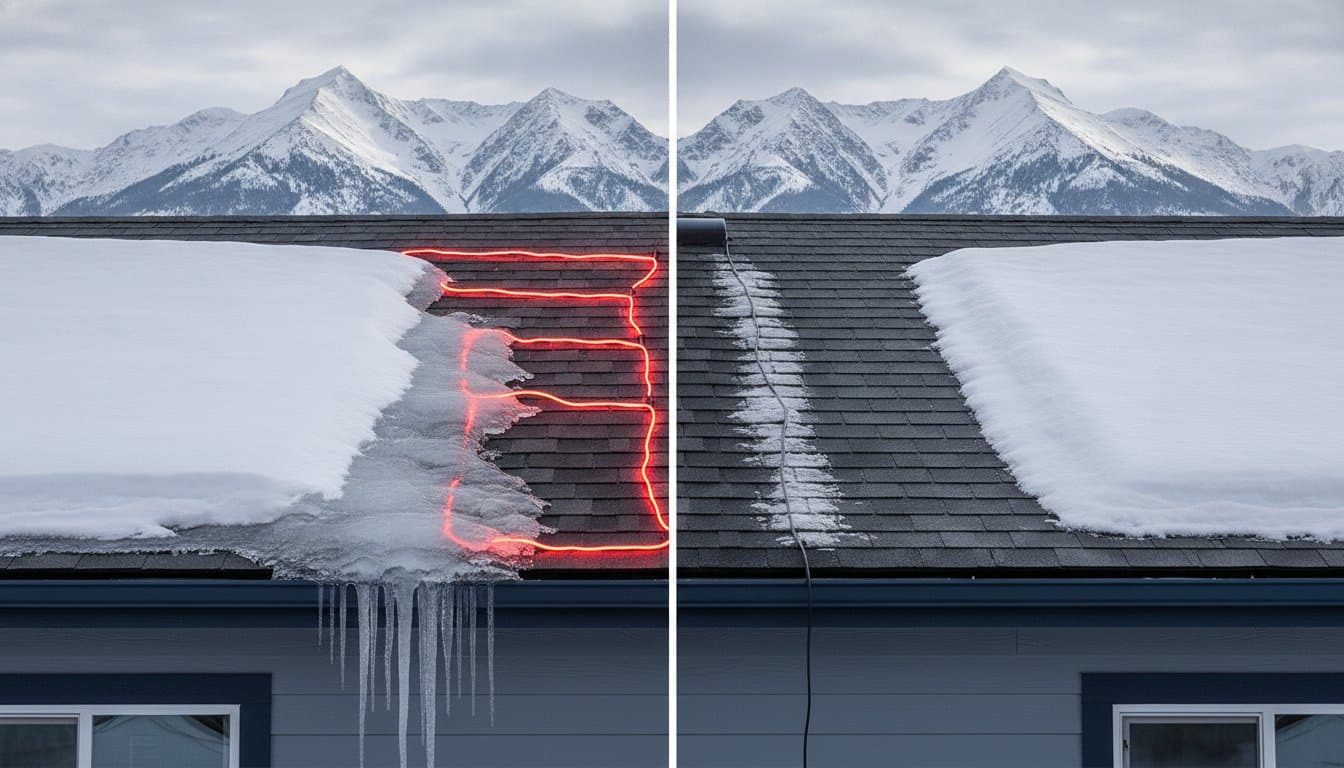
The cheapest heat cable on the hardware store shelf might be the most expensive mistake you make for your home this winter. If you’ve spent the last few seasons watching ice dams climb up your shingles or cringing at a sky-high power bill, you know that not all de-icing tools are created equal. Understanding the difference between self regulating vs constant wattage heat cable is the first step toward a permanent, professional-grade solution. While one provides a steady, unchanging stream of heat regardless of the weather, the other acts like a biological sensor, adjusting its output based on the actual temperature of your roof.
It’s understandable to feel overwhelmed by technical specs when you just want your gutters to stay clear during a heavy storm. You want a system that protects your property without becoming a fire hazard or burning out when you need it most. This guide provides a clear comparison of these two primary technologies, covering everything from energy efficiency to the latest 2026 NEC safety standards. You’ll discover which cable fits your specific roof layout and how to achieve a winter-ready home that operates reliably on autopilot, giving you the peace of mind that only expert-level protection can provide.
Key Takeaways
- Learn the critical distinction between temporary hardware store “heat tape” and professional-grade heat cable systems designed for long-term protection.
- Understand the performance trade-offs of self regulating vs constant wattage heat cable, including why self-regulating technology is often the safer, more efficient choice for residential roofs.
- Identify which technology best suits your specific property challenges, whether you are dealing with complex gutter runs or chronic ice dams on north-facing slopes.
- Discover how smart controllers and moisture sensors transform a simple heating element into an automated, energy-saving de-icing system.
- Gain insights into National Electrical Code requirements and why professional installation is necessary to prevent fire hazards and ensure system longevity.
Understanding Heat Trace Fundamentals: Definitions and Core Technology
Property owners often use the term “heat tape” to describe anything that warms a roof, but professionals distinguish between consumer-grade tape and industrial-grade cable. While tape is often a thin, fixed-length product found at big-box retailers, professional heat cable is a durable, heavy-duty solution designed for years of exposure to harsh mountain winters. The fundamental goal of any de-icing system is straightforward; it maintains a clear path for meltwater to reach the ground before it can refreeze into a destructive ice dam. To achieve this, we look at the two primary technologies. Heat tracing fundamentals dictate whether a system uses a fixed or variable output to manage snow and ice safely.
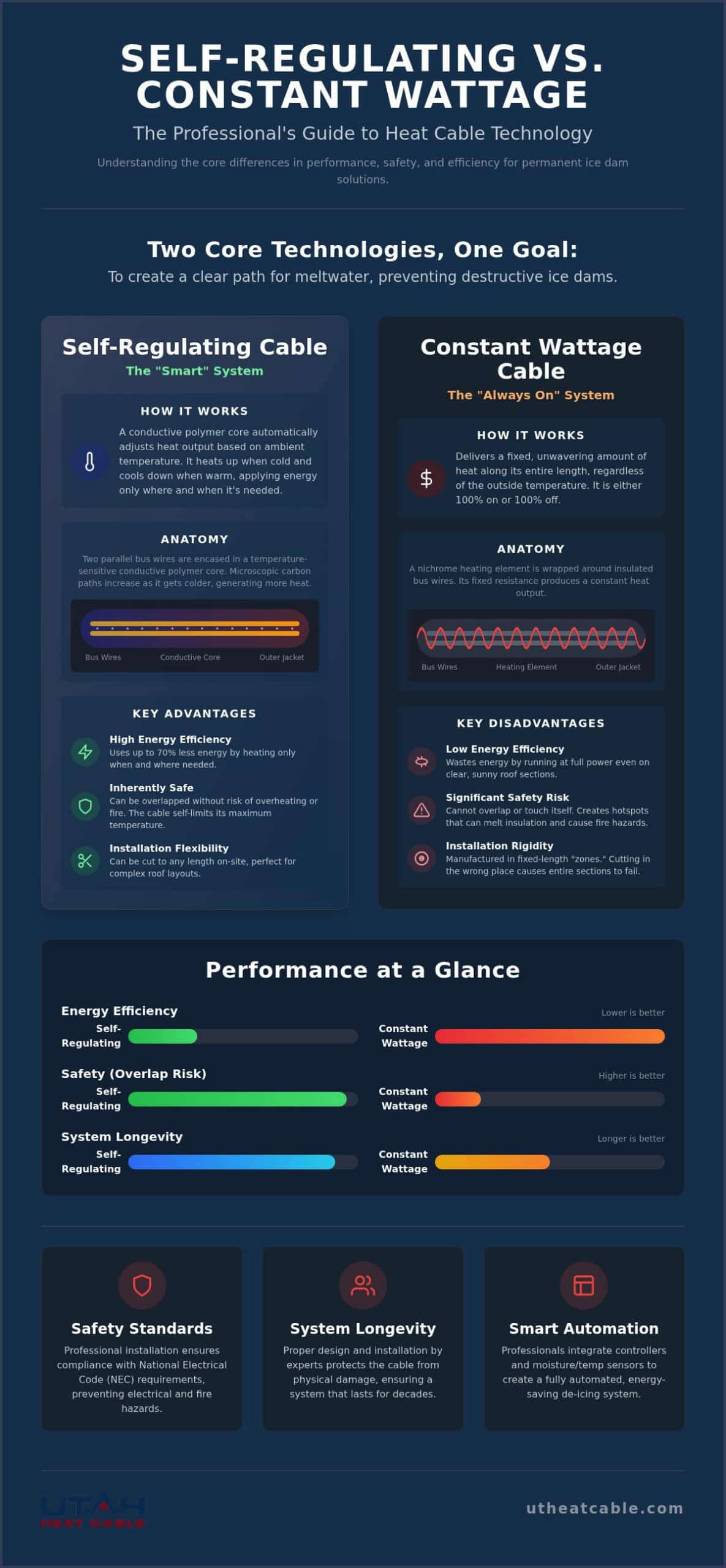
When choosing between self regulating vs constant wattage heat cable, you’re essentially deciding how the system communicates with the environment. Constant wattage systems are the traditional choice, delivering a steady, unwavering amount of heat regardless of the outside temperature. In contrast, self-regulating systems are “smart” cables that physically change their heat output based on how cold the cable itself is at any given point along its length. This means the cable can work harder in a frozen gutter while pulling back on a sunny section of the roof.
The Anatomy of Self-Regulating Heat Cable
The secret to a self-regulating system lies in its internal construction. It consists of two parallel bus wires encased in a specialized conductive polymer core. This core contains microscopic carbon particles that provide the pathway for electricity. As the temperature drops, the core material contracts, bringing those carbon particles closer together to create more electrical paths and generate more heat. When the weather warms up, the core expands, the particles move apart, and the heat output naturally decreases. The conductive core acts as a temperature-sensitive resistor that automatically modulates the flow of electricity to generate heat only where it is needed. This localized response ensures that energy isn’t wasted on parts of the roof that are already clear.
The Build of Constant Wattage Systems
Constant wattage cables operate on a much simpler principle. They use a nichrome heating element wrapped around the bus wires, separated by high-grade insulation. Because the resistance of the nichrome doesn’t change with the temperature, the cable puts out the exact same amount of heat whether it’s buried in a foot of snow or sitting in the open air. This consistency is useful for specific industrial applications, but it creates physical limitations for residential use. You can’t cut these cables to any length you want because they’re manufactured in specific “zones.” If you cut through a heating zone, that entire section will fail to warm up. Additionally, because they stay at a fixed temperature, these cables can never be overlapped. The trapped heat would eventually cause the insulation to melt or create a fire hazard.
Performance Comparison: Efficiency, Longevity, and Safety
Choosing between self regulating vs constant wattage heat cable isn’t just about the initial purchase price. It’s about how the system survives a February blizzard in the Wasatch Mountains. When a sudden snowstorm hits, a constant wattage system delivers a full, unwavering blast of heat immediately. While this raw power is effective, it lacks finesse. Self-regulating cable reacts more like a living organism. It detects the drop in temperature and increases its heat output only in the specific areas where ice is forming. This localized response ensures that your north-facing eaves get the power they need while sections in the sun stay in a low-power state.
Safety remains the most significant differentiator between these two technologies. Constant wattage cables operate at a fixed temperature, which means they can never touch or overlap. If they do, the heat becomes trapped, leading to a “hot spot” that can melt the cable’s insulation or even start a fire. Technical research into Heat tracing system design confirms that self-regulating cables are inherently safer. Because the conductive polymer core naturally limits its own temperature, these cables can be safely overlapped during installation without the risk of burnout or fire hazards. This makes them the preferred choice for complex gutter runs where cables must occasionally cross paths.
Energy Consumption and Operational Costs
Operating costs are a major concern for homeowners facing long winters. Constant wattage systems are often called “dumb” cables because they have no internal way to throttle power. Without an external sensor or controller, they pull 100% of their rated wattage the entire time they’re plugged in. This leads to significant “idle” waste during milder days. Self-regulating cables naturally throttle their power consumption as the temperature rises. In a climate like Utah’s, where tiered electricity pricing can make heavy winter usage expensive, this efficiency is vital. By only drawing the necessary current to keep a melt path open, self-regulating systems significantly reduce your monthly utility impact.
Durability in Extreme Mountain Climates
Mountain environments put immense stress on electrical components. Professional-grade cables use high-quality polyolefin or fluoropolymer jackets to resist UV degradation and the mechanical weight of heavy ice loads. Constant wattage systems often fail prematurely in gutters because they can’t handle the thermal stress of being “always on” while partially submerged in slush. Self-regulating cables are built for these cycles. They are the gold standard for persistent ice on north-facing roofs where snow might linger for months. To keep your system running for the long haul, we recommend a quick visual check every October to ensure no debris has settled on the lines. If you’re unsure which technology fits your roof’s unique orientation, our team can help you design a custom heat-trace system that balances performance with long-term reliability.
Which Cable is Right for Your Property? Application-Specific Guidance
In the high-altitude climates of Utah, Idaho, and Wyoming, the choice between self regulating vs constant wattage heat cable often depends on the architectural complexity of your building and the specific winter threat you face. For most homeowners, the primary enemy is the ice dam. These heavy ridges of ice form when snow melts on a warm roof and refreezes at the cold eaves, eventually backing up under shingles and causing interior water damage. Because residential roofs involve complex angles, valleys, and varying exposure to the sun, a one-size-fits-all heating approach rarely works. You need a system that can adapt to the specific micro-climate of your roofline.
Self-regulating technology is the preferred choice for residential applications and is often mandated by Homeowner Associations (HOAs) due to its superior safety profile. Its ability to be cut to length on-site allows for a precise fit in downspouts and around intricate dormers. Conversely, constant wattage systems find their niche in industrial settings where maintaining a specific, high temperature is a requirement for process piping or massive parking garage ramps. Professional heat tracing installation ensures these systems meet strict IEEE and NFPA standards, which is vital for commercial code compliance and long-term insurance validity.
Best Practices for Residential Roof De-Icing
Effective roof de-icing requires more than just laying a line of cable. To protect shingles, we often use a “zig-zag” or “sawtooth” pattern that extends up the roof slope. This pattern requires a cable with high flexibility and a durable outer jacket that won’t crack under the mechanical stress of shifting snow. It is also essential to run the cable into the gutters and all the way down the downspouts to the ground. If you only heat the roof, the meltwater will simply refreeze in the cold gutter, creating a heavy “ice log” that can pull the gutter right off the house. Combining your heat cable with roof snow retention systems, like snow guards, provides a total protection package by preventing large slabs of snow from sliding down and damaging the cable itself.
Commercial and Industrial Use Cases
Commercial properties often deal with flat roofs and internal drains that present unique hydraulic challenges. If an internal drain freezes, the entire roof can become a swimming pool, leading to structural failure. In these large-scale applications, custom heat trace design is necessary to keep drainage paths open. While self-regulating cable is still widely used for its efficiency, constant wattage is sometimes selected for massive snow melt systems on walkways or ramps where a high, consistent heat output is needed across hundreds of linear feet. These systems require specialized high-voltage circuits and robust controllers to manage the significant electrical load safely.
The Role of Controllers and Automated System Management
Even the most advanced cable is limited by how it is managed. The debate between self regulating vs constant wattage heat cable often centers on the cable itself, but the controller is the brain that dictates your monthly energy bill and the overall lifespan of the system. Without a reliable control mechanism, a heat cable is simply a heating element that runs blindly. While self-regulating cables naturally throttle their output, they do not turn themselves off completely when the weather warms up. A professional controller ensures the system only draws power when the environmental conditions specifically threaten to create ice dams.
There is a significant difference between basic ambient temperature sensors and “smart” moisture-sensing controllers. An ambient sensor simply triggers the system when the temperature drops below a set point, usually 35 or 38 degrees Fahrenheit. However, if the air is cold but the roof is bone dry, running the cable is a waste of electricity. Moisture-sensing controllers are far more precise; they only activate the system when they detect both freezing temperatures and the presence of water or snow. This “set and forget” automation is a major advantage for Utah business owners who cannot afford to manually monitor their roof conditions every hour of the day.
Manual vs. Automatic Control Systems
Relying on a manual flip-switch is the most common cause of system inefficiency. The hidden cost of manual control is human error. It’s easy to forget to turn the system on before a midnight snowstorm or, more commonly, to leave it running for weeks during a dry cold snap. Automatic moisture sensors prevent this “dry firing,” which preserves the integrity of the cable’s internal components. For commercial facility managers, modern systems now offer remote monitoring and mobile alerts. This allows you to verify that your de-icing system is active from your smartphone, providing an extra layer of security for large-scale properties.
Integrating Sensors into Your Heat Trace Design
Proper sensor placement is just as critical as the cable layout itself. We typically place gutter sensors at the lowest point of the drainage system to detect the very first sign of meltwater. A moisture sensor prevents ice dam formation before it starts by detecting liquid water at the gutter level and activating the cable before that water has a chance to refreeze. Calibrating these sensors for high-altitude Utah weather patterns requires an understanding of how snow behaves at 4,000 feet versus 9,000 feet. If you want to maximize your system’s efficiency, you can explore our wide range of automated controller options to find the right balance of automation and manual override for your property.
During extreme mountain freezes, a manual override remains a vital safety feature. While automation handles 95% of winter weather, there are moments when you might need to pre-heat a gutter before a predicted historic blizzard. Having a system that balances smart sensing with the ability for human intervention ensures that your property remains protected regardless of how unpredictable the mountain weather becomes.
Why Professional Installation and Design Matter for Long-Term Success
The allure of a quick fix at a local hardware store often leads homeowners to “heat tape” that is fundamentally different from professional heat trace. These consumer-grade products are typically fixed-length, thin-gauge wires that lack the durability needed for a decade of service. Choosing between self regulating vs constant wattage heat cable is only half the battle; the other half is ensuring the system is installed by a licensed electrical contractor who understands the load demands of mountain weather. A professional installation ensures that your system doesn’t just work during the first frost, but remains a reliable shield for years to come.
A general handyman might be able to clip a cable to a shingle, but they often lack the electrical expertise to handle the specific requirements of the National Electrical Code (NEC). De-icing systems are not “plug and play” appliances. They require dedicated circuits and specialized protection to prevent fire hazards and premature failure. At Utah Heat Cable, we take a master craftsman’s approach, combining David Tanner’s expertise in local climate challenges with professional-grade components that outperform anything found on a retail shelf.
Electrical Safety and Code Requirements (NEC)
Codes exist for a reason, especially when water and electricity meet on your roof. The 2026 NEC updates have clarified the scope of Article 427, emphasizing the need for specialized equipment in trace heating applications. One of the most critical requirements is the use of 30mA Ground Fault Equipment Protection (GFEP). Standard GFCI outlets, which are designed to trip at 5mA to protect humans from shocks, are often too sensitive for the capacitive leakage inherent in long heat trace runs. This leads to “nuisance tripping” that leaves your roof unprotected in the middle of a storm. A professional installer ensures your electrical panel is rated for the winter surge and that your circuits meet these life-safety standards.
Custom Design for Utah’s Unique Topography
Designing a system for a home in Salt Lake City is vastly different from protecting a property in the high-alpine environment of Park City. Wind-chill and snow-drift patterns can vary significantly even between neighboring streets. We account for these variables by identifying north-facing eaves where sun exposure is minimal and ice is most persistent. This data-driven design ensures that your Heat Cable Installation Experts in Park City provide a solution tailored to your specific roof pitch and orientation. By matching the right technology—whether that’s the raw power of constant wattage or the biological response of self-regulating cable—to your home’s unique topography, we provide a permanent solution that stands up to the harshest elements our region can deliver.
Securing Your Property Against the Next Mountain Winter
Choosing the right de-icing technology is a critical decision for any property owner in Utah, Idaho, or Wyoming. The comparison between self regulating vs constant wattage heat cable demonstrates that a successful system isn’t just about the initial cost. It’s about matching the “smart” response of self-regulating systems or the raw power of constant wattage to your home’s unique topography and energy goals. By combining high-grade materials with advanced moisture-sensing controllers, you can prevent ice dams while keeping your winter electricity bills manageable. Safety remains the highest priority, and adhering to the latest electrical codes ensures your system operates without the risk of failure or fire.
You don’t have to navigate these technical specifications alone. As a licensed electrical contractor, our team brings David Tanner’s years of specialized local experience to every project. We design custom solutions that stand up to the harshest mountain climates, providing the peace of mind that comes from professional-grade protection. If you’re ready to move past temporary fixes and invest in a permanent solution for your roof, request a professional heat trace design and quote from Utah Heat Cable today. Prepare your home now so you can enjoy the snow without worrying about what’s happening on your roof.
Frequently Asked Questions
Can self-regulating heat cable be cut to length during installation?
Yes, self-regulating heat cable can be cut to any length on-site during the installation process. This flexibility is a major advantage over constant wattage systems, which are manufactured in fixed heating zones that fail if they are severed. Because of its parallel bus wire construction, you can trim the cable to fit the exact dimensions of your gutters and downspouts, ensuring a perfect fit for complex residential rooflines.
Does self-regulating heat cable turn itself completely off when it’s warm?
No, self-regulating cable does not turn itself completely off just because the weather warms up. While it throttles its power draw to a very low level as the temperature rises, it still maintains a small idle current. To ensure the system shuts down fully and saves the most energy, you must integrate a professional controller with ambient or moisture sensors that cut power when de-icing isn’t needed.
Which type of heat cable is more energy-efficient for a Utah home?
Self-regulating cable is generally the most energy-efficient choice for Utah homes due to its ability to modulate heat output. When comparing self regulating vs constant wattage heat cable, the self-regulating version only works hard in the freezing, snow-filled sections of your gutter. This prevents the system from wasting electricity on sunny parts of the roof that don’t require active melting, significantly lowering your winter utility costs.
Is it safe to overlap self-regulating heat cable on a roof?
Yes, it is perfectly safe to overlap self-regulating cable during installation. The internal conductive core acts like a localized thermostat, reducing heat output at the specific point where the cables touch. This makes it much safer than constant wattage alternatives, which can quickly overheat, melt their insulation, or even start a fire if they are allowed to cross or touch each other during operation.
How long does a professional self-regulating heat cable system last?
A professional-grade self-regulating system typically lasts between 10 and 20 years when maintained properly. This longevity far exceeds the retail-grade products found in big-box stores, which often fail after just one or two seasons. Proper design and installation by a licensed contractor ensure the polyolefin jackets and internal components survive the harsh UV exposure and heavy ice loads common in our mountain climates.
Do I need a special electrical circuit for my roof heat cables?
Yes, your roof de-icing system requires a dedicated electrical circuit to meet National Electrical Code (NEC) standards. Specifically, these systems must use 30mA Ground Fault Equipment Protection (GFEP) rather than the standard 5mA GFCI outlets found in kitchens. This specialized protection prevents the system from nuisance tripping during heavy snow while still providing the necessary safety against electrical faults that could lead to damage.
Can I install constant wattage heat cable myself?
No, you shouldn’t attempt to install constant wattage cable as a DIY project. These cables have strict physical limitations, including the fact that they cannot be cut to length or overlapped. Any error in the layout can lead to permanent cable failure or a significant fire hazard on your roof. It is essential to hire a licensed electrical contractor to ensure the system is designed safely and meets all local codes.
What happens if my heat cable fails in the middle of winter?
If your system fails during a heavy freeze, you’ll likely notice ice dams and icicles forming along your eaves almost immediately. Rapid accumulation can lead to water backing up under your shingles and damaging your home’s interior. In these cases, you should contact a professional for de-icing services or emergency repairs to restore protection before the structural integrity of your roof or gutters is compromised by the weight of the ice.