
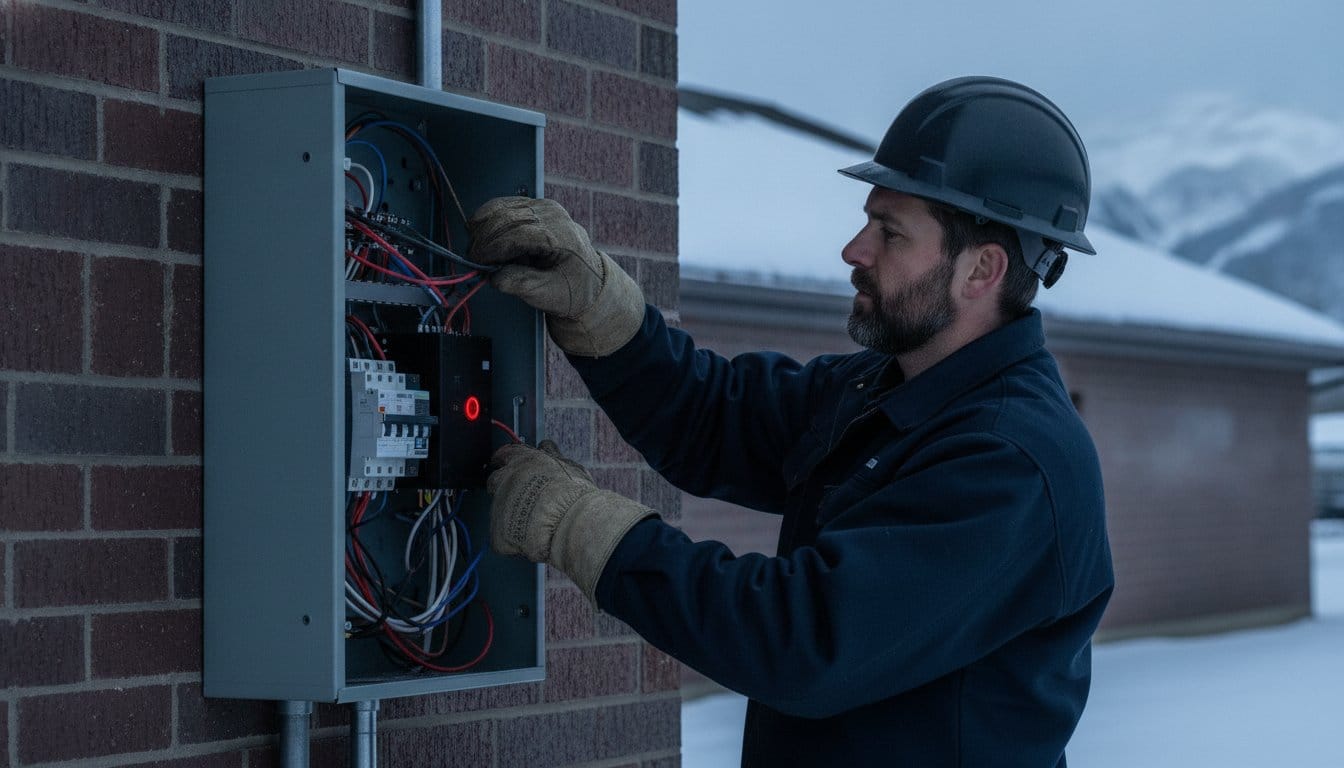
If your commercial heat trace system fails during a record-breaking Salt Lake City blizzard, is it the cable that’s the problem, or the hidden infrastructure behind it? Many property owners treat these systems as simple hardware installs, but the electrical backbone determines whether your facility stays safe or faces a catastrophic freeze. Mastering the electrical requirements for heat trace systems is the only way to move from reactive repairs to proactive protection that actually performs when the temperature drops.
It’s common to feel overwhelmed by the 2026 National Electrical Code (NEC) updates, particularly the new Part VI of Article 426 that now mandates site-specific engineered designs for conductive pavement heating. This guide provides a clear blueprint for building a code-compliant system that minimizes fire risk and liability. You’ll learn how to implement automated controls that reduce energy waste and explore the technical specs required for a reliable, high-performance installation. We’ll walk through everything from voltage limitations to the specialized circuit requirements that ensure your property remains a shield against the elements all winter long.
Key Takeaways
- Understand the critical safety standards in NEC Article 426, including the 2026 mandate for Ground Fault Equipment Protection (GFEP) to prevent fire hazards.
- Learn how to navigate the complex electrical requirements for heat trace systems, including selecting the right voltage and accounting for the massive power spikes caused by inrush current.
- Discover how dual-point automated sensors-measuring both ambient temperature and moisture-can significantly lower your energy bills and improve system ROI.
- See why treating heat trace as a specialized electrical load rather than a standard appliance is essential for preventing thermal runaway and ensuring long-term reliability.
- Gain insight into the professional commissioning process required to protect your roof warranty and ensure your system withstands harsh Utah, Idaho, and Wyoming winters.
The Foundation of Heat Trace Safety: Why Electrical Specs Matter
Many property owners view de-icing as a seasonal accessory, much like a holiday light display. However, Electric heat tracing is actually a sophisticated industrial load that requires precise engineering to function safely. Unlike a standard appliance that you simply plug into a wall, a heat trace system is an integrated part of your building’s electrical infrastructure. If the design fails to respect the technical specifications, the result isn’t just a frozen pipe; it’s a potential fire hazard.
The primary goal of following strict electrical requirements for heat trace systems is to prevent thermal runaway. This occurs when a cable draws excessive power and generates heat beyond its safety limits. In commercial environments, where systems may run for hundreds of feet across roofs and gutters, the margin for error is slim. You must account for the specific relationship between cable length, linear wattage, and the capacity of your dedicated circuits. A system that is improperly balanced will either trip breakers constantly or, perhaps worse, overheat and damage the very property it’s designed to protect.
The Legal and Safety Necessity of Code Compliance
If your facility is located in a high-snowfall region like Utah or Idaho, the legal stakes are high. Improper electrical design doesn’t just lead to cold gutters; it can void commercial property insurance policies if a fire or water damage occurs. The 2026 safety standards for industrial de-icing require more rigorous oversight than previous years. If a system is underpowered, it can lead to “ice slides,” where massive sheets of frozen debris fall from a roof, creating a significant liability for pedestrian safety and structural integrity. Following the code isn’t just about passing an inspection; it’s about maintaining a safe environment for your tenants and employees.
Commercial vs. Residential Electrical Infrastructure
Residential “heat tape” often relies on standard 15A or 20A outlets, but these are insufficient for the expansive footprints of commercial properties. Retail plug-and-play solutions have multiple failure points, including degraded insulation and inadequate ground fault protection. Professional commercial installations are hard-wired industrial systems designed for permanent protection. These systems use dedicated circuits to ensure that the high-voltage demands of a large-scale de-icing project don’t trip breakers or compromise the building’s main power grid. Relying on residential-grade hardware for a commercial building is a recipe for system failure during the peak of winter. Property owners throughout the region, from Salt Lake County to those seeking heat trace contractors Tooele residents rely on, consistently find that professional hard-wired systems outperform DIY alternatives in severe winter conditions.
- Dedicated Circuits: Essential for preventing interference with other building systems.
- Proper Grounding: A critical defense against electrical arcing and fire.
- Load Calculation: Ensuring the breaker can handle the cable’s specific amperage draw.
- Industrial Grade Insulation: Provides the durability needed for harsh mountain climates.
Voltage, Amperage, and the Reality of Inrush Current
Voltage isn’t just a technical detail; it’s the engine that drives your entire de-icing strategy. While a 120V circuit might suffice for a small residential walkway, commercial properties in Utah and Idaho require a more robust approach to handle the sheer scale of mountain winters. Selecting the wrong voltage leads to bloated installation costs and inefficient power distribution. Understanding the electrical requirements for heat trace systems begins with choosing a voltage that matches your facility’s footprint and power availability.
Voltage Selection for Large-Scale Facilities
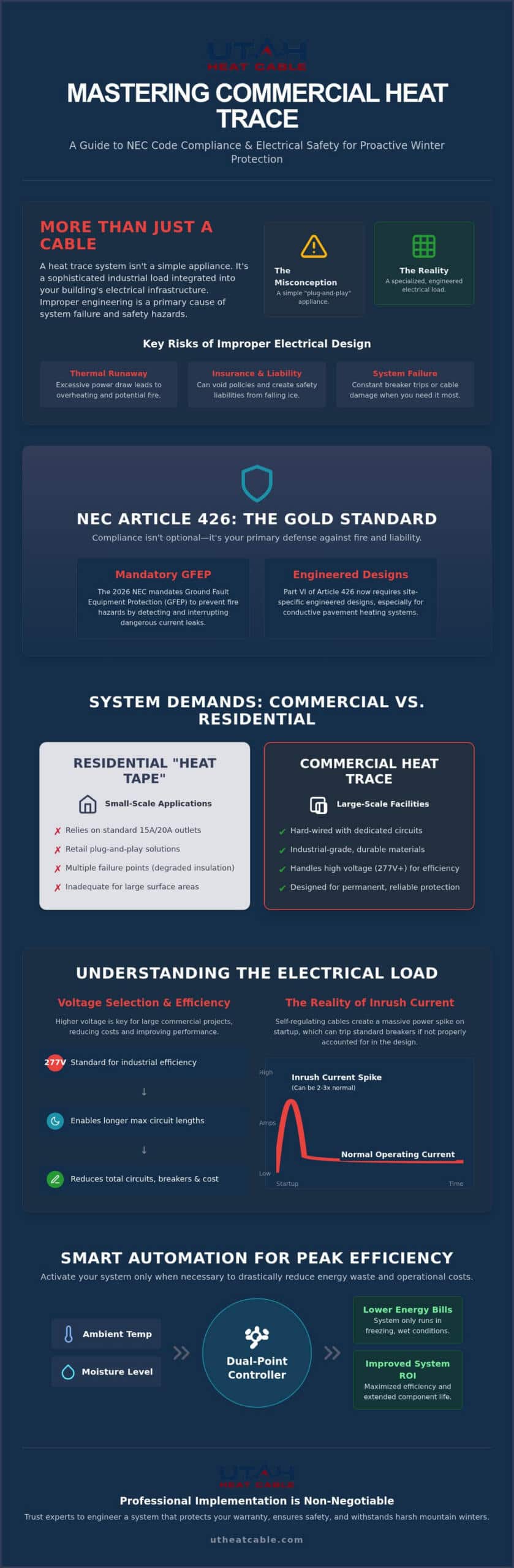
In industrial parks and large commercial warehouses, 277V systems are often the gold standard for efficiency. By utilizing higher voltage, you can significantly extend the maximum circuit length of your self regulating heat cable. This reduces the total number of circuits, breakers, and junction boxes needed for the project. Additionally, higher voltage allows for better load balancing across 3-phase power systems. This prevents any single phase from becoming overloaded, which protects your building’s main electrical grid from unnecessary stress during a heavy snow event.
The most frequent cause of system failure isn’t a broken cable; it’s a misunderstood surge. Self-regulating cables possess a unique physical property where they draw significantly more power when they are cold. This “inrush current” can reach up to three times the steady-state operating current during the first few minutes of a cold start. If your design doesn’t account for this peak, your breakers will trip the moment the temperature hits freezing, leaving your property vulnerable exactly when protection is most needed.
Sizing Breakers for Cold-Start Surges
To manage these massive initial draws, 30A breakers have become the industrial standard for commercial heat trace applications. However, the breaker’s amperage rating is only half the story. The trip curve is equally vital. We typically specify “Type D” or high-magnetic trip breakers. These are engineered to handle inductive-like start-up loads without nuisance tripping. The relationship between ambient temperature and initial power draw is direct. The colder the cable is at start-up, the higher the surge will be. A professional design calculates the total circuit load based on a “worst-case” cold start at sub-zero temperatures.
- 120V/208V: Common for smaller commercial buildings or targeted de-icing.
- 240V/277V: Preferred for large roof areas to minimize the number of required circuits.
- Type D Breakers: Essential for absorbing the 3x inrush surge without failing.
- Temperature Sensitivity: Start-up loads are significantly higher at 0°F than at 40°F.
Maximum circuit length is the final constraint. Every cable has a hard limit on how long it can be before the voltage drop prevents it from generating enough heat. Exceeding these lengths or undersizing the breakers creates a system that looks functional on paper but fails in the field. Precision in these calculations ensures your facility remains a safe, ice-free environment throughout the peak of winter.
NEC Article 426: The Gold Standard for Snow Melting Systems
NEC Article 426 serves as the definitive rulebook for Fixed Outdoor Electric De-Icing and Snow-Melting Equipment. For commercial property owners, adhering to the electrical requirements for heat trace systems as outlined in this article is not just about passing an inspection; it’s about building a defense against electrical fires and system failures. The 2026 code updates reinforce the absolute necessity of Ground Fault Equipment Protection (GFEP) for all de-icing installations. This specific type of protection is engineered to monitor the integrity of the cable’s insulation and shut down the circuit if a leak to ground is detected, preventing the arcing that often leads to property damage.
One of the most common mistakes general electricians make is installing a standard 5mA Ground Fault Circuit Interrupter (GFCI) like those found in a kitchen or bathroom. While these are excellent for human life safety, they are incompatible with industrial de-icing. Self-regulating cables naturally exhibit a small amount of capacitive leakage, especially in long runs or damp conditions. A 5mA breaker will trip instantly the moment the system powers up. The NEC requires 30mA GFEP breakers instead. These provide a higher threshold that allows the system to operate while still providing the critical equipment protection needed to prevent thermal damage.
The Critical Distinction: GFCI vs. GFEP
Standard GFCIs are designed to protect people by tripping at very low levels of current leakage. GFEP is designed specifically for equipment protection. Because self-regulating heat cable has a conductive core that can leak minute amounts of current to the outer braid, the 30mA threshold is necessary for reliability. Regular maintenance should include insulation resistance testing, often called “megger” testing. This proactive approach ensures that your ground-fault protection isn’t just a dormant component but an active shield for your facility.
Disconnects and Identification Requirements
Safety on a commercial rooftop involves more than just the cable itself. The NEC mandates that all de-icing equipment must have a visible means of disconnect. This allows maintenance personnel to safely de-energize the system before performing work on the roof or gutters. Additionally, permanent caution signs must be placed at frequent intervals. These signs alert workers that electric de-icing equipment is present beneath the snow or ice. All wiring exposed to the elements must be housed in high-UV rated conduit and junction boxes to prevent the harsh high-altitude sun in Utah and Idaho from degrading the electrical connections over time.
Advanced Controls: Automation for Efficiency and Safety
Operating a commercial de-icing system with a simple manual switch is a costly gamble in the Intermountain West. In high-elevation areas across Utah, Idaho, and Wyoming, temperatures often hover just below freezing without any precipitation. If your system runs during these dry cold snaps, you’re essentially burning budget for no reason. Modern electrical requirements for heat trace systems now emphasize automated controller options that remove human error and optimize energy consumption. These advanced systems ensure the cable only activates when both the temperature and moisture levels reach specific thresholds.
One of the most significant advancements for 2026 is the integration of “Soft Start” technology. While we previously discussed using specialized breakers to handle surge loads, Soft Start controllers address the problem at the source by gradually ramping up power over several seconds. This prevents the massive voltage dips that can flicker lights or interfere with sensitive electronics in an industrial park. It’s a critical layer of protection for the building’s infrastructure, especially when multiple large circuits activate simultaneously during a winter storm.
Sensor Placement and Logic
The success of an automated system depends entirely on the placement of its “eyes.” Moisture sensors should be installed in the “first-to-freeze” locations, such as north-facing gutters or areas shaded by adjacent structures. In our regional climate, elevation plays a major role; a sensor at the base of a building may not reflect the extreme conditions on a high-altitude roof. We also utilize “After-Run” timers. These keep the system active for a set period after the snow stops, ensuring that all meltwater reaches the ground before the cable powers down and the pipes refreeze.
Remote Monitoring and Fault Detection
Modern smart panels have transformed facility management from reactive to proactive. These controllers can integrate directly with your existing Building Management System (BMS), providing real-time analytics on energy usage and circuit health. If a breaker trips or a cable break is detected, the system sends an immediate alert to your mobile device. This level of diagnostic testing is invaluable for HOAs and commercial managers who need to track costs and identify maintenance needs before the first blizzard hits. It ensures your protective shield is always ready when the elements turn harsh.
- Dual-Point Sensing: Requires both cold and moisture to trigger power.
- BMS Integration: Centralizes de-icing control with HVAC and lighting.
- Soft Start: Eliminates grid-straining power spikes.
- Mobile Alerts: Instant notification of system faults or power loss.
Don’t leave your property’s safety to chance. Explore our advanced controller options to build a system that is as efficient as it is powerful.
Professional Implementation: The Utah Heat Cable Advantage
While any licensed electrician can pull wire, a heat trace specialist understands the complex mechanics of thermal management and code compliance. Designing a system that survives the brutal freeze-thaw cycles of the Intermountain West requires more than basic electrical knowledge. It demands an understanding of how specific electrical requirements for heat trace systems intersect with structural engineering and local weather patterns. Choosing a specialist over a general contractor ensures that your de-icing system isn’t just a collection of wires, but a professionally engineered shield for your property.
Design and Commissioning Standards
Our process begins with the creation of detailed electrical blueprints and load schedules. These documents are essential for municipal inspectors and provide a clear roadmap for your facility’s maintenance team. Before we consider an installation complete, we perform rigorous commissioning. This includes verifying insulation resistance through “Megger” testing both before and after the cable is installed. This test confirms that the cable’s protective jacket is intact and that there are no microscopic leaks that could cause a system failure later in the season. We provide as-built drawings and test logs for every project, ensuring you have a permanent record of your system’s baseline performance for future warranty claims.
Serving the Intermountain West
The challenges faced in Park City or Bear Lake are vastly different from those in the valley. High-altitude snow loads put unique physical stress on cable attachments and junction boxes. We tailor every design to account for these regional extremes, ensuring that your system can handle the weight of heavy mountain snow without sagging or breaking. On industrial flat roofs, we also account for chemical exposure from HVAC runoff or roofing materials. This specialized approach protects your investment from the environmental factors that often cause generic retail systems to fail within their first two years of service.
- Expert Load Calculation: Prevents circuit overloads during the 2026 NEC-mandated cold starts.
- Warranty Protection: Professional commissioning is often required by manufacturers to honor cable warranties.
- High-Altitude Engineering: Reinforced mounting hardware designed for heavy snow and ice accumulation.
- Long-Term Maintenance: Scheduled inspections to identify UV damage or debris buildup before winter arrives.
A reliable de-icing system is a critical component of property risk management. By adhering to the highest electrical requirements for heat trace systems, we provide the peace of mind that comes from knowing your facility is protected by a master craftsman. Don’t wait for the first major storm to discover the weaknesses in your electrical design. Request a Professional Commercial Heat Trace Design Consultation today to ensure your property remains safe, compliant, and efficient all winter long.
Securing Your Property Before the First Freeze
Building a de-icing system that lasts requires moving beyond simple hardware and focusing on the underlying electrical infrastructure. We’ve explored how selecting the right voltage and accounting for inrush current prevents nuisance tripping, while strict adherence to NEC Article 426 ensures your facility remains code-compliant and safe. By integrating automated controls, you don’t just protect your roof; you also optimize your energy costs for the long term.
Understanding the electrical requirements for heat trace systems is a complex task, but you don’t have to navigate it alone. As a licensed electrical contractor specializing in high-voltage industrial de-icing across Utah, Idaho, and Wyoming, we understand the specific regional challenges your property faces. Our team ensures that every installation meets the highest safety standards and provides the reliability you need during peak winter months.
Ready to fortify your commercial property against the elements? Contact Utah Heat Cable for Code-Compliant Commercial Design and ensure your system is engineered for professional-grade protection. Taking these steps now provides the peace of mind that your facility is ready for whatever the Intermountain West throws its way.
Frequently Asked Questions
Do I need a dedicated circuit for my commercial heat trace system?
Yes, you must use dedicated circuits for any commercial de-icing installation. Heat trace systems draw a significant amount of power, and sharing a circuit with other building loads can lead to frequent breaker trips or electrical interference. Dedicated circuits are a core part of the electrical requirements for heat trace systems to maintain long-term safety and operational reliability.
What is the difference between GFCI and GFEP for heat cable?
A GFCI is designed for human safety and trips at 5mA, while a GFEP is designed for equipment protection and trips at 30mA. Self-regulating heat cables have a natural amount of capacitive leakage that will nuisance-trip a standard 5mA GFCI immediately. NEC Article 426 specifically requires 30mA GFEP protection to allow the system to function while still preventing electrical fires.
Can I run a commercial heat trace system on 120V power?
You can use 120V for very small areas, but it’s rarely the best choice for commercial properties. Higher voltages like 208V, 240V, or 277V are much more efficient for large-scale footprints because they allow for significantly longer cable runs on a single circuit. This reduces the amount of infrastructure, such as extra breakers and junction boxes, needed to protect your facility.
How much electricity does a commercial heat trace system use?
Total electricity use depends on the linear wattage of the cable and the local climate conditions. Most industrial cables draw between 5 and 12 watts per foot when active. Without automated controllers, a system might run constantly and drive up utility costs. Using dual-point sensors ensures the system only consumes power when it’s cold enough for snow and moisture is actually present.
Is a licensed electrical contractor required for heat trace installation in Utah?
Yes, Utah law requires a licensed electrical contractor for these installations because they involve permanent connections to the building’s electrical grid. Beyond the legal mandate, a specialist understands the nuances of NEC Article 426 and regional weather challenges. Professional installation is also vital for protecting your manufacturer warranty and ensuring the system is engineered for heavy mountain snow loads.
What is inrush current and why does it trip my breakers?
Inrush current is a temporary power surge that happens when self-regulating cable is first turned on in cold temperatures. The cable can draw up to three times its normal operating power for several minutes. If your breakers aren’t sized for this peak or don’t have a “Type D” high-magnetic trip curve, the system will trip the moment it tries to start.
How often should a commercial heat trace system be electrically tested?
You should schedule an electrical inspection at least once a year before the winter season begins. A technician will perform an insulation resistance test, often called a Megger test, to ensure the cable jacket hasn’t been damaged. They also verify that the GFEP breakers and automated sensors are working correctly so the system is ready when the first blizzard hits.
Can heat trace be integrated into my Building Management System (BMS)?
Yes, modern industrial controllers can integrate directly with your BMS using protocols like Modbus or BACnet. This allows facility managers to monitor the electrical requirements for heat trace systems from a central station. You can track energy consumption in real-time and receive immediate mobile alerts if a circuit fails, allowing for proactive maintenance instead of discovering a problem after a pipe freezes.