
For industrial facilities and operations in Salt Lake, Logan, and across the Wasatch Front, a temperature shift can be an early warning, not just a gauge reading. Industrial temperature maintenance helps teams spot overheating or other abnormal changes before they disrupt equipment. Heat tracing helps maintain process temperatures in pipes and other assets that need steady warmth. Together, monitoring and properly selected heat tracing can support planned maintenance and avoid heating beyond process requirements.
It’s easy to focus on the equipment itself, but temperature control also affects operational continuity and energy use. A rising reading may point to friction, lubrication issues, or reduced airflow. This guide explains why industrial assets need temperature monitoring, what readings can reveal, and how heat tracing helps maintain required pipe temperatures. It also covers how system design and controls affect efficiency.
Key Takeaways
- Track temperature trends, not just isolated readings, to spot unusual changes that may signal friction, lubrication issues, or restricted airflow.
- Use appropriate controls to match heat output to the process and help avoid heating pipework beyond its needs.
- Account for whether pipe sections are flowing or static, since flow patterns and system layout affect heat-tracing design.
- For snow and ice concerns around Northern Utah properties, Utah Heat Cable offers de-icing services, roof snow retention, and controller options.
Reducing emergency maintenance
At industrial facilities in Northern Utah and along the Wasatch Front, temperature monitoring can reveal abnormal changes in an asset before they disrupt operations. Continuous readings help local maintenance teams plan inspections and repairs instead of relying only on failure reports.
For industrial facilities in the region, the National Electrical Code (NEC) and CEC Section 18 are identified as references for hazardous locations involving flammable gases, vapors, or dust. These references help frame temperature-control considerations in areas where fire or explosion risks exist.
Equipment costs for Northern Utah facilities depend on sensor type, measurement range, accuracy, monitoring coverage, and controller integration. Continuous monitoring across multiple assets has different equipment requirements from periodic infrared readings on accessible machinery.
Choosing Temperature Range and Control Accuracy
Choose a temperature range and control accuracy that match the process’s operating conditions at your Utah facility. Start by identifying the asset’s normal and critical temperatures, then consider the required accuracy and response time. Thermocouples suit high-temperature applications such as furnaces, while RTDs are commonly used for stable, accurate readings in motors and compressors. The right fit helps distinguish actual changes from measurement variation.
Risks of Temperature Excursions and Inaccurate Measurements
A temperature excursion is a departure from an asset’s usual or required operating range; inaccurate readings can conceal that change. For example, a gearbox rising from 65°C to 78°C in less than an hour, without a load or environmental change, may indicate abnormal friction. A 10°C rise in motor winding temperature above its rated limit roughly halves insulation life under the Arrhenius rule. Either missed warnings or false readings can lead to delayed repairs, unnecessary maintenance, or equipment failure at facilities across the Wasatch Front.
Calibration and maintenance intervals at Northern Utah industrial facilities depend on sensor drift, equipment criticality, operating conditions, and measurement history. Comparing trends from paired or redundant sensors can help identify drift. Periodic checks also keep controllers and readings aligned with process requirements.
Predictive maintenance uses temperature patterns to prioritize attention before a fault becomes an emergency. Teams at facilities in the region can combine continuous temperature monitoring with vibration, pressure, or electrical-current data in equipment-health platforms. If a reading changes unexpectedly, compare it with operating conditions and related sensor data, then schedule an inspection during a suitable maintenance window.
Energy efficiency
For industrial operations in Northern Utah and along the Wasatch Front, energy efficiency depends on supplying the heat a process needs, not simply running equipment continuously. Sensors can measure temperature changes and help controls adjust heating as operating conditions shift. For production assets, this can limit unnecessary energy use while maintaining required process temperatures.
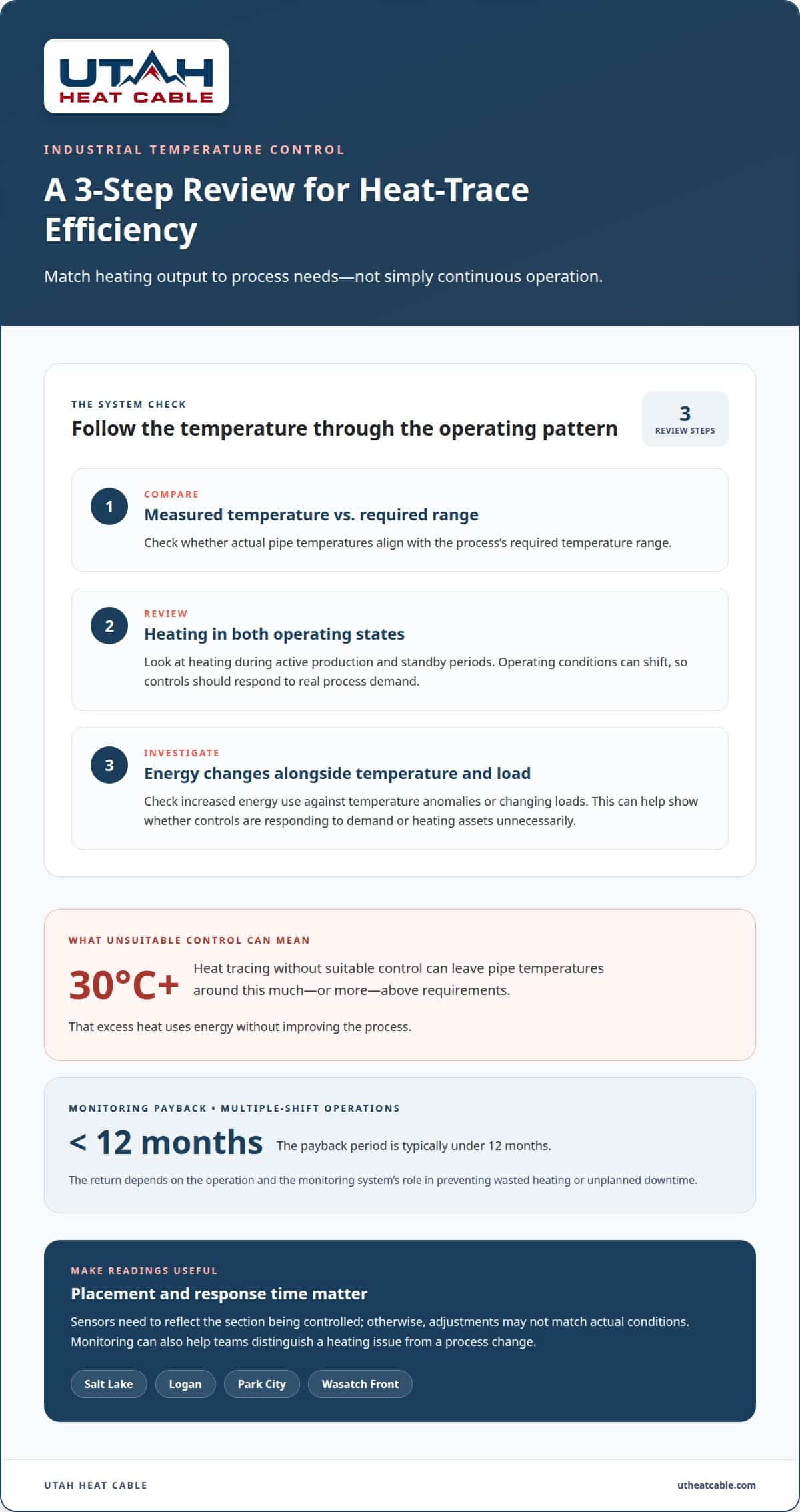
Heat tracing that runs without suitable control can leave pipe temperatures around 30°C or more above requirements. That excess heat uses energy without improving the process. Temperature monitoring helps identify where heating output and actual pipe conditions diverge, so control settings can be matched to operating needs at facilities in places such as Salt Lake, Logan, Provo, and Park City.
Use a practical review of the system’s operating pattern:
- Compare measured temperatures with the process’s required range.
- Review heating during both active production and standby periods.
- Investigate increased energy use alongside temperature anomalies or changing loads.
These checks can show whether controls are responding to real demand or heating assets unnecessarily. Sensor placement and response time matter, too. Readings must reflect the section being controlled, or adjustments may not match actual conditions.
For operations running multiple shifts, thermal monitoring’s payback period is typically under 12 months. The return depends on the operation and the monitoring system’s role in preventing wasted heating or unplanned downtime. Monitoring can also help teams distinguish a heating issue from a process change, reducing interruptions to production and avoidable wear on components.
Reviewing heat-trace controls is a useful step when pipe temperatures exceed process needs. To discuss a system’s heat-trace control requirements for an industrial facility in the service area, share the operating conditions and temperature goals.
Heat tracing for flowing and static pipe sections
Pipe flow and layout affect how heat tracing maintains process temperature at industrial facilities in Northern Utah and along the Wasatch Front. Flowing lines and static sections may need different control because their thermal conditions differ.
Temperature Maintenance Systems and Technologies
Industrial pipe temperature systems at facilities in cities such as Salt Lake, Logan, Ogden, and Provo use heating cables with controls matched to pipe conditions. For pipework shorter than 500 meters, parallel-resistance self-regulating or constant-power cables can be selected and cut to length on site. Longer heating circuits can use series-resistance cables. In complex valved systems, only one or two pumps may operate while others remain on standby, so flow alone may not reflect every pipe section’s heating needs.
Control strategy matters, too. In a complex system where pipe-surface temperature guides control, each pipe section needs independent line switching. This lets maintenance teams at Northern Utah and Wasatch Front facilities respond to thermal changes in individual sections instead of treating the entire network as one uniform asset.
Installation and Commissioning Steps
Installation and commissioning at industrial facilities across Northern Utah and the Wasatch Front involve matching the cable, controls, and electrical connections to the pipe layout and operating conditions. The installation plan first distinguishes flowing lines, static sections, valves, and standby branches. Then the cable type and circuit arrangement are selected to suit circuit length and heating requirements.
During commissioning, the system’s control response and heating across relevant sections are checked against the intended operating conditions. Accurate records give maintenance teams a baseline for later analysis. If vibration, degradation, or failure changes a pipe or nearby equipment, comparison with that baseline can help identify a developing issue and guide maintenance.
Utah Heat Cable
Utah Heat Cable helps property owners in Northern Utah address snow and ice risks with practical de-icing options. For exterior areas, its offerings include sidewalk and driveway deicing systems, roof snow retention, de-icing services, and controller options. These solutions focus on managing winter conditions around a property, rather than monitoring industrial process equipment.
Consider Utah Heat Cable when snow or ice protection is part of your property maintenance plan or when you’re selecting controls for a de-icing system. The right approach depends on the area and the conditions the system needs to address. For industrial temperature monitoring and pipe heat tracing, apply the equipment-specific selection and control principles covered above.
Contact Utah Heat Cable to discuss your property’s snow and ice protection needs.
Plan the Next Maintenance Step
A useful next step is to match process requirements with the right heating approach for each asset. Before planning changes, identify which pipes or areas need temperature protection, how their operating conditions vary, and which control approach suits the installation. This gives your maintenance team a clearer basis for coordinating system design with operational priorities.
Utah Heat Cable offers Self Regulating Heat Cable and Constant Wattage Heat Cable, along with De-Icing Services. For industrial projects, the appropriate heat-tracing approach depends on the pipe layout, operating conditions, and temperature goals. A well-defined scope helps keep the discussion practical and focused on the needs of your facility in Northern Utah or along the Wasatch Front.
Take the next step toward a considered industrial temperature maintenance plan for your site.
With clear priorities and careful planning, your facility can move forward with confidence.
Frequently Asked Questions
Why monitor the temperature of industrial assets?
Monitoring helps teams at industrial facilities in Northern Utah and along the Wasatch Front understand how an asset behaves under usual operating conditions. Comparing readings taken under similar loads can reveal a change that deserves attention, rather than a normal fluctuation tied to production. For example, a new hot spot on an electrical connection may prompt closer inspection before it affects nearby components or interrupts equipment operation.
When should each temperature monitoring method be used?
Use fixed sensors for critical or hard-to-access equipment, or where temperatures can change quickly. Portable wireless sensors and industrial thermometers suit planned rounds on accessible, lower-criticality assets. Infrared sensors or pyrometers are useful when a component is moving, rotating, hot, or difficult to reach. Choose based on access, response needs, temperature range, and required accuracy for local operating conditions.
Why is process temperature maintenance important?
Keeping process temperatures within suitable operating conditions can protect product quality and limit unnecessary equipment wear at facilities in Northern Utah and along the Wasatch Front. In food production, for example, temperature conditions can affect product properties and waste. Stable conditions also help teams recognize process changes more clearly: readings can be compared with the intended operating range instead of treated as isolated measurements.
What is industrial temperature maintenance?
Industrial temperature maintenance combines measuring temperature with managing heat to keep equipment or a process within required operating conditions. It can involve monitoring assets for unwanted temperature changes and applying heat tracing where pipework needs heat retained or maintained. For industrial facilities in Utah, including those in Salt Lake, Logan, Provo, and Park City, Utah Heat Cable installs heat-trace systems for pipe temperature control, designed around the needs of the equipment.