
Electric heat tracing isn’t automatically off-limits for fire sprinkler piping. NFPA 13 allows a listed heat-tracing system in certain locations subject to freezing, with the piping maintained above 40°F and below 120°F. A heat trace system for fire suppression systems must be listed for that specific use, not simply approved for another type of pipe.
It’s reasonable to want a clear answer before planning work on a life-safety system. This article explains what UL certification means for sprinkler trace heating, why the installation requires insulation, and how the rules affect systems exposed to freezing conditions. You’ll also learn what makes this approach different from other freeze-protection methods, so you can understand the requirements before discussing a professional installation for a property in Northern Utah or the Wasatch Front.
Key Takeaways
- NFPA 13 allows electric heat tracing for sprinkler piping in certain freeze-prone locations when the system is listed for that purpose and keeps pipe temperatures within the required range.
- UL certification is specific to fire sprinkler trace heating; approval for another type of piping doesn’t establish suitability for sprinkler use.
- Branch-line installations have specific listing requirements, and the system must be arranged to protect against freezing without obstructing sprinkler discharge.
- Insulation and its protective covering are part of the system design, helping retain heat while withstanding exposure to sprinkler discharge water.
Does NFPA 13 allow electric heat tracing on fire sprinkler piping?
Yes, NFPA 13 permits listed electric heat tracing for sprinkler piping in certain locations subject to freezing. A heat trace system for fire suppression systems must be designed for that specific use, with its controls and piping arrangement suited to the sprinkler installation.
Freeze Protection for Sprinkler Piping
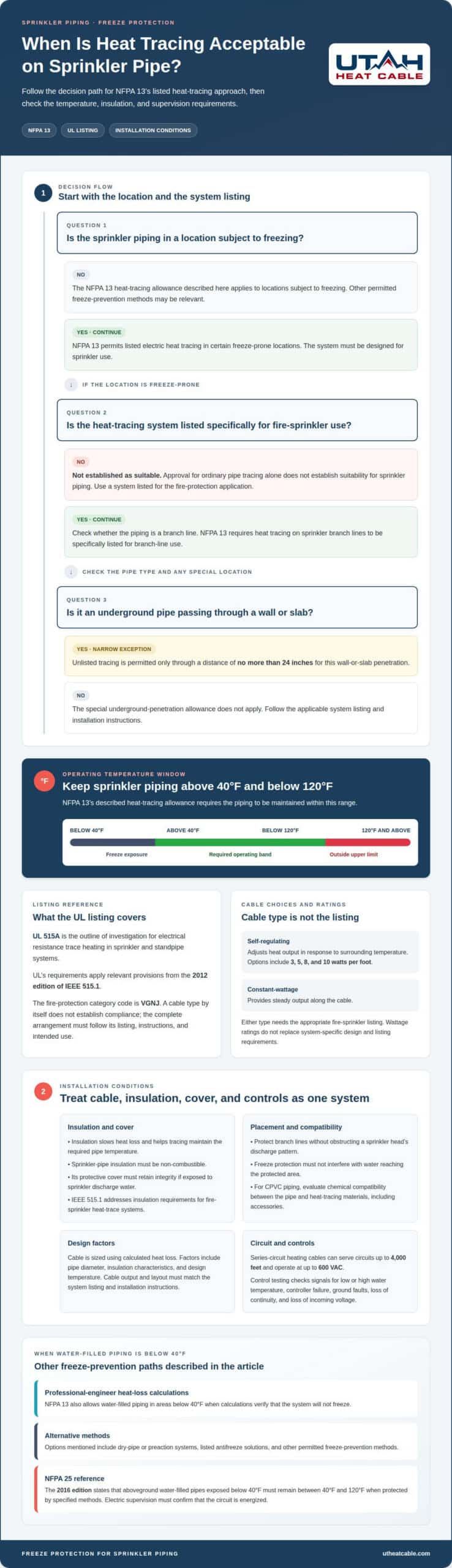
Heat tracing uses an electric cable to help keep vulnerable sprinkler pipes from freezing. NFPA 13 permits a listed system where this method is appropriate, provided the piping stays above 40°F and below 120°F. Branch lines require equipment specifically listed for branch-line use. For an underground pipe passing through a wall or slab, unlisted tracing is permitted only through a distance of no more than 24 inches.
Freeze Risks in Wet-Pipe Systems
Wet-pipe sprinkler systems contain water in their pipes, so freezing can obstruct or damage them. Freezing can damage or obstruct water-filled sprinkler piping, particularly in exposed sections. Alternatives include dry-pipe or preaction systems, listed antifreeze solutions, and other permitted freeze-prevention methods. NFPA 13 also allows water-filled piping in areas below 40°F when a professional engineer’s heat-loss calculations verify that the system won’t freeze.
NFPA 13 and NFPA 25 Requirements
NFPA 13 permits listed heat tracing as a freeze-prevention method, with specific listing required for branch-line use. NFPA 25’s 2016 edition states that aboveground water-filled pipes exposed below 40°F must remain between 40°F and 120°F when protected by specified methods. Electric supervision must confirm the circuit is energized. A professional can assess the design, circuit supervision, and operating temperatures for a heat trace system for fire suppression systems.
UL certification for fire sprinkler trace heating
UL certification evaluates trace-heating equipment for fire sprinkler use, including its cable and associated controls. UL 515A is the outline of investigation for electrical resistance trace heating in sprinkler and standpipe systems. UL’s requirements apply relevant provisions from the 2012 edition of IEEE 515.1. The fire-protection category code is VGNJ, so approval for ordinary pipe tracing alone doesn’t establish sprinkler suitability.
For wet-pipe sprinkler systems, equipment must be listed for the fire-protection application. NFPA 13 requires heat tracing on sprinkler branch lines to be specifically listed for branch-line use. The cable type alone doesn’t determine compliance: a heat trace system for fire suppression systems must be installed as a complete listed arrangement, following its instructions and intended use.
Self-regulating cable adjusts its heat output in response to surrounding temperature, while constant-wattage cable provides a steady output along the cable. Either type needs the appropriate fire-sprinkler listing. Self-regulating options include 3, 5, 8, and 10 watts per foot, but those ratings don’t replace system-specific design and listing requirements.
Series-circuit heating cables can serve circuits up to 4,000 feet and operate at up to 600 VAC. Control testing checks whether the system can signal low or high water temperature, controller failure, ground faults, loss of continuity, and loss of incoming voltage. For a heat trace system for fire suppression systems, these tests help show whether monitoring can identify specified faults.
Why is insulation required with a heat trace system?
Insulation slows heat loss from sprinkler piping, helping heat tracing maintain the required pipe temperature. IEEE 515.1 addresses insulation requirements for fire-sprinkler heat-trace systems. Without suitable insulation, the cable must compensate for greater heat loss, so the professional’s design considers the pipe, surrounding conditions, and the listed system’s instructions.
For sprinkler piping, insulation must be non-combustible, and its protective cover must retain integrity if exposed to sprinkler discharge water. Insulation and tracing must also be positioned to protect branch lines without obstructing a sprinkler head’s discharge pattern. Freeze protection must not interfere with water reaching the protected area during operation.
Professionals size cable by calculating heat loss, using factors such as pipe diameter, insulation characteristics, and design temperature. They then select cable and controls capable of maintaining the required temperature under those conditions. The cable output and layout must match the system’s listing and installation instructions. A general pipe-heating design alone does not establish suitability for sprinkler piping.
Material compatibility matters too. For CPVC piping, a professional evaluates chemical compatibility between the pipe and heat-tracing materials, including accessories, using the relevant manufacturers’ information. Insulation, cover construction, cable placement, and temperature control work together as one design. If a component changes, the professional assesses how that affects the listed system rather than treating insulation as a separate finish.
Utah Heat Cable: Sidewalk and Driveway Deicing Systems
Utah Heat Cable helps property owners address a related winter hazard with Sidewalk and Driveway De-Icing Systems. While sprinkler-pipe heat tracing protects fire-suppression piping from freezing, these systems address ice on walkways and driveways. Each is designed for a different part of the property and a distinct cold-weather concern.
For Northern Utah and Wasatch Front properties, sidewalk and driveway deicing may be useful where recurring ice affects access around a building. Utah Heat Cable also offers De-Icing Services, Roof Snow Retention, and Controller Options. The right option depends on the surface or snow-related concern you need to address.
Contact Utah Heat Cable to discuss your property’s deicing needs.
Plan the Next Step for Cold-Weather Protection
A heat trace system for fire suppression systems should be considered as part of a broader cold-weather plan. Start by identifying the piping exposed to freezing, the building conditions, and the system requirements that shape professional installation. Clear project details help align the design with the site’s needs.
Utah Heat Cable installs Self-Regulating Heat Cable and Constant Wattage Heat Cable for heat-cable projects, and provides de-icing services for other winter hazards. For sprinkler-pipe protection, the system must be selected and installed to meet the applicable listing and requirements. For icy access areas, Utah Heat Cable’s sidewalk and driveway de-icing systems address a different need.
Planning before cold weather arrives can help you understand the requirements and next steps.
Frequently Asked Questions
What control and monitoring features are required for these systems?
Controls must provide electric supervision that positively confirms the heat-tracing circuit is energized. For example, NFPA 13 (2019), section 16.4.1.4.2, requires this supervision. UL testing examines whether the system signals conditions such as abnormal water temperature, controller failure, ground faults, circuit discontinuity, or loss of incoming voltage. These signals help identify an electrical or control issue before cold conditions threaten sprinkler piping.
Why do fire sprinkler systems need freeze protection?
Freeze protection helps prevent water-filled sprinkler piping from freezing, becoming obstructed, or being damaged. In a building with wet-pipe sprinklers, exposed piping in an unheated space can be especially vulnerable during cold weather. If ice blocks the pipe, water may not reach sprinkler heads as intended during a fire. Protecting vulnerable sections helps preserve the system’s ability to deliver water where it is needed.
When are fire sprinkler pipes required to have heat tracing instead of conventional freeze protection?
Heat tracing isn’t automatically required instead of every other method. Under NFPA 13 (2019), a dry-pipe or preaction system is required when any sprinkler-system part faces freezing and temperatures can’t reliably be maintained at or above 40°F (4°C), unless an allowed alternative freeze-prevention method applies. Listed heat tracing is one permitted option; it also can’t replace a heated valve enclosure room.
What installation steps and best practices do professionals follow when heat tracing fire suppression pipes?
Professionals match listed equipment to the pipe location, including branch lines, and follow its installation instructions. They consider how the cable, controls, insulation, and protective covering work together while ensuring the arrangement does not block sprinkler discharge. For example, the cover must retain its integrity if sprinkler water reaches it. The completed system also needs electrical supervision and testing appropriate to its listed design.
What are common heat trace system failures and fire sprinkler freeze-protection risks?
Potential problems include a de-energized circuit, controller fault, ground fault, loss of continuity, or loss of incoming power. If a system cannot maintain its intended freeze protection, water-filled piping may remain exposed to freezing. Ice can obstruct or damage piping and compromise water delivery. Monitoring can reveal electrical or control problems, while a professional assessment can identify vulnerable pipe sections and evaluate the freeze-protection arrangement.