
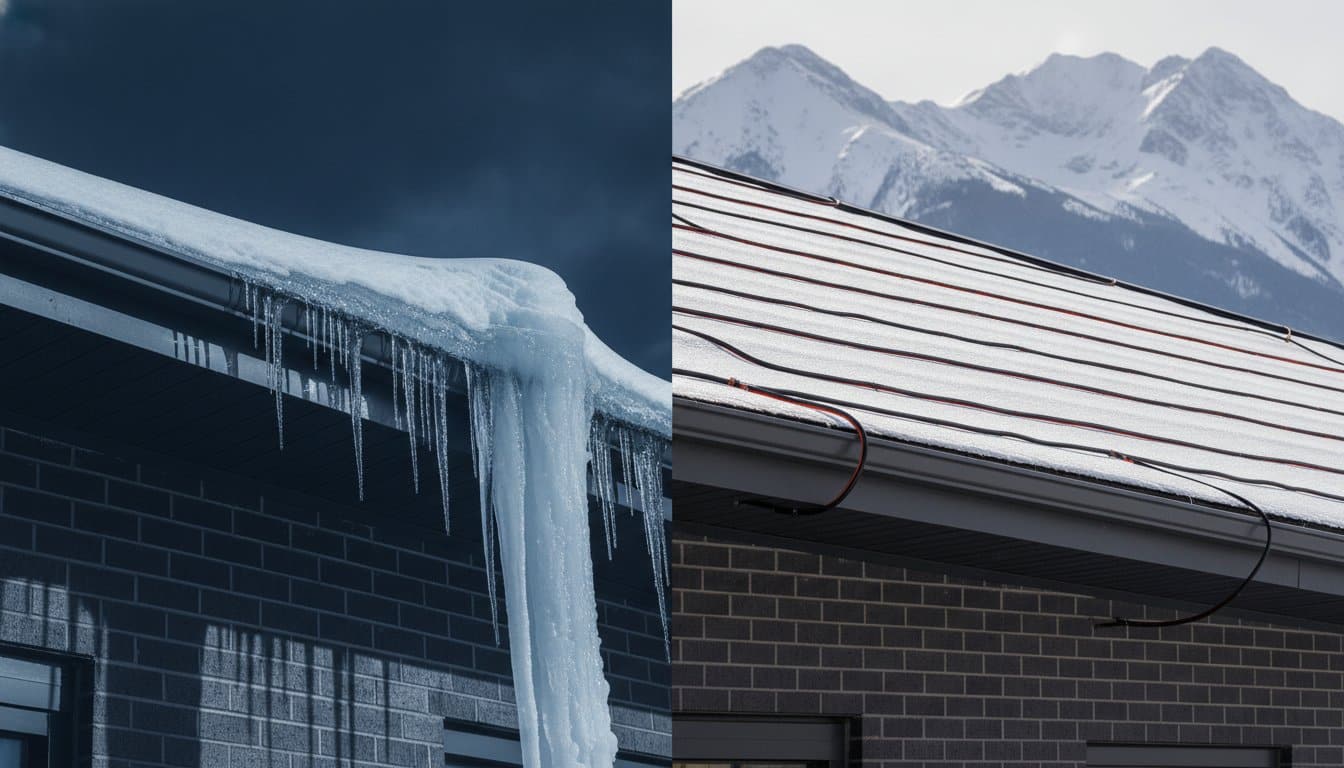
What if the system designed to protect your building is actually the reason you’re still dealing with ice dams every January? Many facility managers realize too late that retail-grade heat tape isn’t built for the heavy snow loads of the Intermountain West. When you invest in commercial grade roof de-icing, you’re not just buying a cable; you’re commissioning an engineered shield for your property. We know the frustration of watching dangerous icicles form over main entryways or dealing with recurring leaks despite having a system in place. It’s exhausting to manage seasonal repairs that should’ve been prevented by professional-grade equipment from the start.
This guide will show you how to transition from reactive maintenance to a reliable, “set it and forget it” solution. You’ll learn the technical differences between self-regulating and constant wattage cables, and why a custom design-build approach is the only way to ensure long-term structural safety. We’ll also cover critical updates for 2026, including how Wyoming’s adoption of the 2026 National Electrical Code on July 1 affects your next installation. By the end, you’ll have a clear roadmap to protect your investment and eliminate the winter labor that drains your maintenance budget every year.
Key Takeaways
- Understand why standard retail products fail and how to select commercial grade roof de-icing systems that handle the unique thermal demands of large-scale properties.
- Discover the technical advantages of self-regulating heat cable and why 8W/ft output is often the necessary standard for high-altitude environments.
- Learn how custom-engineered heat-trace maps protect complex architectural features, such as internal drains and flat roof transitions, from structural damage.
- Ensure your property remains code-compliant and insurable by following professional installation standards and the latest NEC requirements.
- Gain peace of mind with a reliable solution designed specifically to withstand the intense Lake Effect snow and high-altitude conditions of the Intermountain West.
Why Retail Heat Tape Fails Commercial Roofs
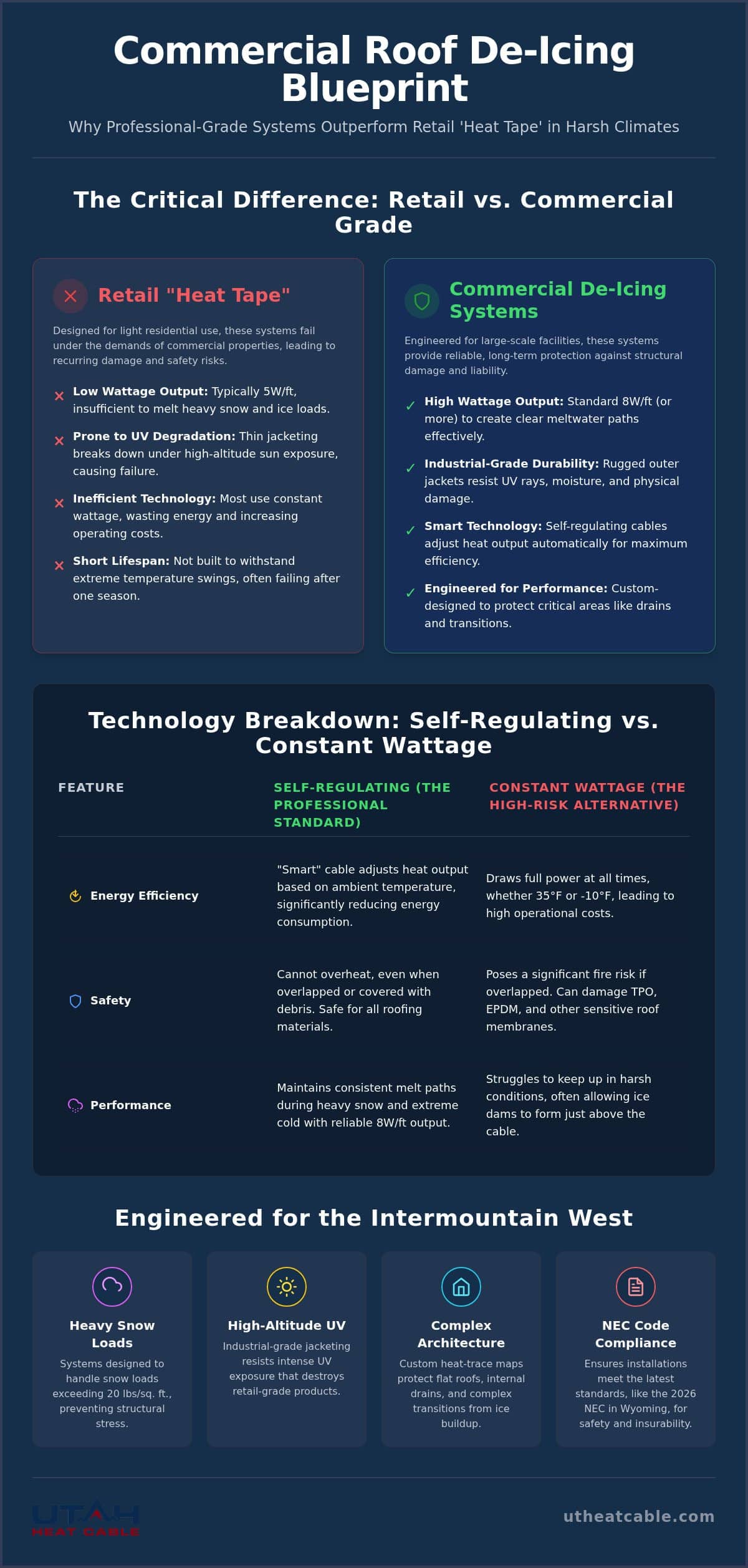
If you walk into a local hardware store, you’ll likely find rolls of thin, consumer-grade “heat tape” marketed as a quick fix for ice dams. For a residential gutter, these might suffice for a season. However, applying these products to a warehouse, retail center, or industrial facility is a recipe for failure. Effective commercial grade roof de-icing requires industrial-strength heat cable designed to withstand the extreme temperature swings and high-altitude UV exposure common in the Intermountain West. Retail products often lack the rugged outer jacketing necessary to prevent UV degradation and moisture ingress, leading to internal wire fatigue and system failure after just one harsh winter.
The physics of a commercial roof are fundamentally different from a home. Larger roofs collect massive volumes of snow. This requires a higher wattage output to maintain a clear path for meltwater. While a 5W/ft residential cable might struggle to keep a small channel open, industrial systems often utilize self-regulating heat tracing technology that can provide 8W/ft or more when needed. Without this increased power, ice dams simply form higher up the roof or around internal drains, leading to the very leaks you’re trying to avoid. The hidden costs of using “cheap” retail systems quickly manifest in emergency ice removal fees and expensive structural repairs. With commercial roof replacement costs often ranging from $7 to $12 per square foot, a failed de-icing system can lead to a financial burden far exceeding the initial cost of professional installation.
The Limitations of Constant Wattage in Commercial Settings
Many entry-level systems use constant wattage technology, which delivers a fixed amount of heat regardless of the ambient temperature. In a commercial environment, this lack of flexibility is a significant drawback. These cables can easily overheat if they overlap or become buried under heavy debris, which can damage sensitive roofing materials like TPO or EPDM. They’re also remarkably inefficient; they draw the same amount of power on a 35-degree day as they do at sub-zero temperatures. This makes it difficult for facility managers to meet modern energy efficiency standards or control seasonal operating costs.
Commercial Liability: Icicles and Falling Snow
Liability is a primary concern for any property owner. Heavy icicles forming over loading docks, public walkways, or main entrances represent a direct safety risk to employees and the public. Professional de-icing systems focus on these high-traffic zones to prevent the formation of “snow slides,” which are particularly dangerous on metal roofs. When snow loads exceed 20 pounds per square foot, the structural integrity of the building is put at risk. A custom-engineered system acts as a protective shield, ensuring that meltwater reaches the ground safely rather than refreezing into a liability.
Commercial Grade Technology: Self-Regulating vs. Constant Wattage
Choosing the right hardware for a facility is a matter of building science, not just budget. While residential kits often rely on low-output cables, high-performance commercial grade roof de-icing systems utilize specialized technology to handle the extreme thermal demands of large structures. Understanding the causes of ice dams on commercial roofs is the first step in selecting between self-regulating and constant wattage cables. Each has a specific role in a professional de-icing strategy.
Self-regulating cables are the modern standard for most commercial applications. These cables feature a conductive polymer core that expands or contracts at a microscopic level based on the temperature. When it’s cold, the core contracts, creating more electrical paths and increasing heat output. As the temperature rises, the core expands and reduces power consumption. This “smart” behavior makes them incredibly energy efficient. In the Intermountain West, we typically recommend 8W/ft cables over the 5W/ft versions found in retail stores. This higher output ensures the system can maintain a clear drainage path even during sub-zero cold snaps or heavy Lake Effect snow events. To ensure these systems last their expected 15 to 25 year lifespan, they are wrapped in high-grade Fluoropolymer outer jackets, providing essential resistance to UV rays and the harsh chemicals often found in commercial roofing environments.
When to Use Self-Regulating Heat Cable
This technology is ideal for complex rooflines where different sections receive varying amounts of sun exposure. Because self-regulating cable adjusts its output locally, a section in the shade will run hotter than a section in the sun, even on the same circuit. This prevents localized overheating and extends the life of the cable. These systems are also “cut-to-length” during installation. This allows for a precise fit around gutters, downspouts, and ornate architectural features without the risk of “burnouts” if the cable needs to cross over itself. If you are looking for the most reliable long-term protection, you can request a custom heat-trace design that utilizes these advanced self-regulating components.
Industrial Applications for Constant Wattage
Constant wattage cables deliver a fixed amount of heat regardless of the ambient temperature. While they lack the internal “brain” of self-regulating cables, they are exceptionally effective in massive industrial snow melt systems where high, consistent heat is required to clear large surface areas quickly. Because they do not self-regulate, these systems must be paired with sophisticated external controllers and sensors to manage power usage. Professional design is non-negotiable here; without precise engineering, these high-output circuits can pose a fire risk or cause significant damage to the roofing substrate if left unmonitored.
Custom Heat-Trace Design for Complex Architecture
Designing a high-performance system for a commercial facility requires more than just high-quality parts. It demands a comprehensive design-build approach that accounts for the building’s specific geometry and thermal footprint. Every professional commercial grade roof de-icing project begins with a custom heat-trace map. This map identifies exactly where snow accumulates and where meltwater must travel to exit the roof safely. Without this level of precision, you risk leaving critical areas unprotected while wasting power on sections that don’t need it.
Our engineering process involves a delicate balance between “heat loss” and “melt rate.” Heat loss refers to the energy escaping through the roof deck, while the melt rate is the power required to convert snow into water at a given ambient temperature. On flat roofs or complex industrial structures, these variables change by the foot. We calculate these numbers to ensure the system provides enough wattage to keep drainage paths open without overtaxing your facility’s electrical infrastructure. This isn’t a task for a simple online calculator; it requires a professional site assessment to understand how wind patterns and building heat affect snow accumulation.
Managing power distribution is equally critical. Large-scale systems require careful planning of circuit lengths and breaker capacities to prevent voltage drops that can diminish performance. We ensure every installation adheres to the National Electrical Code requirements for heat trace, which include specific mandates for equipment protection and ground-fault settings. This technical oversight is what separates a reliable industrial system from a potential insurance liability. Proper electrical design ensures that your system remains operational when you need it most, without tripping breakers during heavy storms.
Regional factors play a massive role in our design strategy. In Utah’s mountain climate, north-facing roof sections are notorious for holding ice long after the sun has cleared the south side. We adjust our heat-trace maps to provide extra protection in these shadow zones, ensuring that commercial grade roof de-icing systems perform consistently across the entire building footprint. By anticipating these micro-climates on your roof, we provide a more durable and effective solution.
Flat Roof De-Icing and Internal Drain Protection
Internal drains are the lifeblood of a flat commercial roof. If these drains freeze, water begins “ponding,” which adds thousands of pounds of structural strain to the building. We trace these internal drains several feet below the roofline to ensure water stays liquid until it reaches the heated interior of the building. We also focus on protecting rooftop HVAC units. Ice buildup around these units can lead to vibration damage and restricted airflow, causing expensive mechanical failures in mid-winter. Protecting these assets is a core part of our total property care philosophy.
Snow Retention Integration for Metal Roofs
Metal roofs are prone to sudden “snow slides,” where massive sheets of ice drop without warning. We integrate heat cable with architectural snow guards to break up these sheets and melt them gradually. Strategic placement is key; we prioritize “eyebrow” protection over entryways, loading docks, and public walkways. This dual-layered approach protects your roof’s structural integrity while ensuring the safety of everyone walking below. Our designs focus on precision and community service, keeping your property safe and accessible throughout the winter months.
Professional Installation and NEC Code Compliance
Installing a commercial grade roof de-icing system is a specialized electrical task that goes far beyond simple property maintenance. Because these systems draw significant power and operate in wet, outdoor environments, they must strictly adhere to the National Electrical Code (NEC). Compliance isn’t just a safety preference; it’s a legal requirement that varies by state. For instance, Wyoming officially adopted the 2026 NEC on July 1, 2026, which includes expanded requirements for Ground Fault Circuit Interrupter (GFCI) protection. Meanwhile, Idaho continues to operate under the 2023 NEC, and Utah follows the 2020 standards. Working with a team that understands these regional nuances ensures your system is both safe and legal.
Hardwiring is the absolute gold standard for any commercial application. While residential kits often use simple plug-in connections, professional systems are permanently integrated into the building’s electrical panel. This approach is often a prerequisite for commercial property insurance compliance. Insurance providers view hardwired, code-compliant installations as a lower risk compared to temporary “plug-and-play” solutions that can be easily damaged or improperly used. A permanent installation also allows for the integration of Ground Fault Equipment Protection (GFEP), which is designed to trip the circuit if a leak in the cable’s insulation is detected, preventing potential fire hazards.
Before any system is commissioned for the winter, we perform rigorous testing to ensure insulation integrity. This includes Megger testing, a process that applies a high-voltage, low-current charge to the cable to measure its resistance. It’s a critical step that identifies microscopic cracks or manufacturing defects that a standard multimeter would miss. By catching these issues during the installation phase, we prevent system failures during the first sub-zero cold snap when you need the protection most.
Automated Controllers and Smart Sensors
Modern de-icing shouldn’t rely on a manual “on/off” switch. We utilize advanced controller options that include moisture and temperature sensors to automate the entire process. These sensors ensure the system only draws power when both freezing temperatures and moisture are present. This level of automation provides a significant ROI by preventing the system from running on dry, cold days, which drastically reduces seasonal energy costs. For facility managers overseeing multiple properties, we can even integrate remote monitoring systems that provide real-time status updates and alerts.
Selecting a Licensed Electrical Contractor
It’s a common mistake to assume a general roofing contractor can handle a heat-trace installation. While they understand the roof’s surface, they lack the specialized training required to design and balance complex electrical circuits. You should always ask your installer for proof of their electrical license, bonding, and specific experience with industrial-scale heat-trace projects. If you want to ensure your property is protected by a team that prioritizes precision and code compliance, contact us for a professional consultation today.
Regional Expertise for Utah, Idaho, and Wyoming
High-altitude environments like Park City and Brian Head present unique challenges that standardized, national solutions often overlook. At these elevations, the combination of intense UV radiation and rapid temperature drops can cause standard materials to become brittle and fail. A reliable commercial grade roof de-icing system in these regions must be engineered with heavy-duty Fluoropolymer jacketing to resist solar degradation. Similarly, businesses along the Wasatch Front must prepare for the unpredictable intensity of Lake Effect snow. These storms can drop several inches of heavy, wet snow in a matter of hours, quickly overwhelming underpowered heating cables. We design our systems to handle these specific regional “surges,” ensuring your drainage paths remain clear even during the most aggressive winter cycles.
For Homeowners Associations (HOAs) and commercial residential complexes, we focus on balancing high-performance protection with clean aesthetics. We understand that while safety is the priority, the visual integrity of the property matters to your tenants and board members. Our custom-engineered designs use low-profile mounting hardware and strategic cable placement to provide a “hidden” shield against ice dams. This approach ensures structural safety without compromising the architectural appeal of the development. Scheduling your assessment in late summer or early fall is the best way to ensure your property is ready before the first Utah freeze locks in.
Industrial Solutions for Remote Facilities
Remote industrial warehouses and utility buildings in Wyoming face some of the harshest conditions in the country. These facilities often deal with extreme wind speeds and sub-zero temperatures that can persist for weeks. We provide ruggedized commercial grade roof de-icing systems specifically designed for these isolated environments, focusing on durability and redundant safety features. Because these locations are difficult to access during a blizzard, a proactive maintenance plan is essential. We help facility managers verify their systems are fully operational long before the “Big One” hits, providing the peace of mind that comes from knowing your infrastructure is protected.
The Utah Heat Cable Advantage
When you partner with us, you gain direct access to David Tanner and a team of master craftsmen who’ve spent over a decade protecting Intermountain West properties. We aren’t just installers; we’re a licensed electrical contractor that understands the underlying mechanics of heat-trace technology. Our local track record is built on precision, community service, and a deep familiarity with the specific codes and climates of Utah, Idaho, and Wyoming. We take pride in delivering elite-level skill with a down-to-earth attitude. Property owners throughout the region, including those seeking heat trace contractors in Tooele who can handle severe Climate Zone 5B conditions, trust our team to deliver permanent, code-compliant solutions. Schedule your professional commercial roof assessment today.
Secure Your Property Before the First Freeze
Transitioning from reactive winter maintenance to a proactive, “set it and forget it” system is the most effective way to protect your building’s structural integrity. We’ve explored how commercial grade roof de-icing relies on specialized self-regulating technology and custom heat-trace maps to address the specific thermal demands of large facilities. Relying on a licensed electrical contractor ensures that your installation isn’t just functional, but fully compliant with the evolving 2026 NEC standards in Wyoming and the current codes in Utah and Idaho. Professional design-build services provide the peace of mind that comes from knowing your entryways are safe and your roof is shielded from the weight of extreme snow loads.
Utah Heat Cable stands as a dedicated local specialist with over a decade of experience in the high-altitude mountain climates of the Rockies. We take pride in delivering elite-level precision with a down-to-earth, helpful attitude for every client. If you’re ready to eliminate the seasonal stress of ice dams and recurring roof leaks, we’re here to help you prepare. Get a Custom Heat Trace Design for Your Property today and ensure your facility is ready for whatever the Intermountain West winters have in store. You don’t have to face the elements alone.
Commercial De-Icing Frequently Asked Questions
Is commercial-grade heat cable more energy-efficient than residential tape?
Yes, commercial grade roof de-icing systems are significantly more efficient because they utilize self-regulating technology. Unlike basic residential tape that draws constant power regardless of the weather, these industrial cables adjust their heat output based on the ambient temperature. This prevents the system from wasting electricity when temperatures rise, ensuring you only pay for the energy necessary to keep your drainage paths clear.
How long does a professional commercial de-icing system typically last?
A professionally designed and installed system typically lasts between 15 and 25 years. This longevity is due to the high-grade Fluoropolymer outer jacketing, which protects the conductive core from intense UV radiation and the harsh chemicals often found on industrial roofs. Regular seasonal maintenance and annual insulation testing help ensure the system reaches its full service life, providing a much higher return on investment than retail alternatives.
Does my commercial roof warranty cover the installation of heat cables?
Most commercial roof warranties remain intact as long as the commercial grade roof de-icing system is installed by a licensed professional using industry-approved mounting methods. We use non-penetrating clips and specialized adhesives designed specifically for sensitive membranes like TPO and EPDM. It’s always a good practice to consult your roofing manufacturer’s guidelines to ensure the installation method aligns with their specific requirements for maintaining coverage.
Can I install commercial heat cable on a flat EPDM or TPO roof?
You can safely install heat cable on flat EPDM or TPO roofs, provided the system is engineered to prevent localized overheating. We focus on tracing the internal drains and low points where water naturally collects during a thaw. This prevents “ponding” and ice buildup that can lead to structural strain, ensuring that meltwater has a clear, liquid path off the building even in sub-zero conditions.
What is the electrical load requirement for a large commercial de-icing system?
Electrical requirements vary based on the total linear footage and the wattage of the cable used, which is typically 8W/ft for commercial applications in the Intermountain West. Large systems require dedicated circuits and specialized Ground Fault Equipment Protection (GFEP) breakers to meet safety standards. During our custom design phase, we calculate the total amperage to ensure your facility’s existing electrical infrastructure can safely handle the startup and running loads.
How do automated snow sensors reduce my commercial operating costs?
Automated sensors reduce costs by ensuring the system only activates when both moisture and freezing temperatures are detected simultaneously. This prevents the cables from running on dry, sub-zero days when no melting is actually required. By eliminating unnecessary operation, these smart controllers often pay for themselves through significant energy savings within the first few seasons of use.
Are there specific Utah electrical codes for roof heat-trace systems?
Utah currently operates under the 2020 National Electrical Code (NEC), which mandates specific grounding and wiring methods for outdoor de-icing equipment. As a licensed electrical contractor, we ensure every installation meets these statewide standards, including the necessary equipment protection. Compliance is critical not only for safety but also for passing local inspections and maintaining the validity of your commercial property insurance policy.