
Could a few snow guards leave the most dangerous landing zone unprotected? In Utah, snow and ice sliding from a metal roof can threaten entrances, walkways, parked vehicles, and landscaping. Choosing snow guards for metal roofs Utah properties need starts with more than adding guards where they’re easiest to install. The roof profile, local snow conditions, and areas below all matter.
Snow retention manages how snow releases; it doesn’t remove snow from the roof or reduce its structural load. This guide explains what a coordinated system can and can’t do, how roof design and site conditions shape the plan, and why scattered individual guards may not address the risks. You’ll learn what to assess before planning roof snow retention to help protect people and property.
Key Takeaways
- Snow guards manage how snow releases from a metal roof; they don’t melt snow or reduce the roof’s structural load.
- Choosing snow guards for metal roofs Utah properties need starts with identifying the roof profile and a compatible attachment approach.
- Map where roof snow could land, then factor in local conditions and property priorities to shape a coordinated retention plan.
- Roof snow retention and heat-trace de-icing address different concerns, so the right plan depends on the roof and its ice-management needs.
Why Utah Metal Roofs Need a Snow Guard Plan, Not Just Individual Guards
Snow guards are roof-mounted components that help manage how snow moves and releases; they don’t melt accumulated snow. Snow can slide off a smooth metal surface in a slab, putting people and property below the roof edge at risk. For a basic overview of guard types and how they work, see What are snow guards?
Snow retention manages snow release from a roof to reduce the risk of sudden slides onto people and property below. It’s a safety measure, not a way to remove snow or reduce the roof’s structural load. A few isolated guards may leave parts of the roof unprotected or fail to account for where snow will travel and land.
Where sliding snow creates risks around a Utah property
Start below each roof edge. Check entrances, walkways, parking areas, lower roofs, and shared access areas that could sit in a snow’s path. Consider which areas people use regularly and where a sudden slide could damage property. A useful assessment looks at roof pitch, exposure, elevation, and vulnerable landing zones rather than relying on a one-size-fits-all layout.
Conditions vary between valley and mountain properties in Utah, and a plan suited to one location may not fit another. Snow guards for metal roofs Utah homes and buildings need should be selected with both the roof and its surroundings in mind. Utah Heat Cable designs and installs roof snow retention systems based on roof conditions and the areas exposed to snow release, creating a coordinated plan rather than placing guards without considering the landing zones.
Matching Metal-Roof Snow Guards to Profile and Conditions
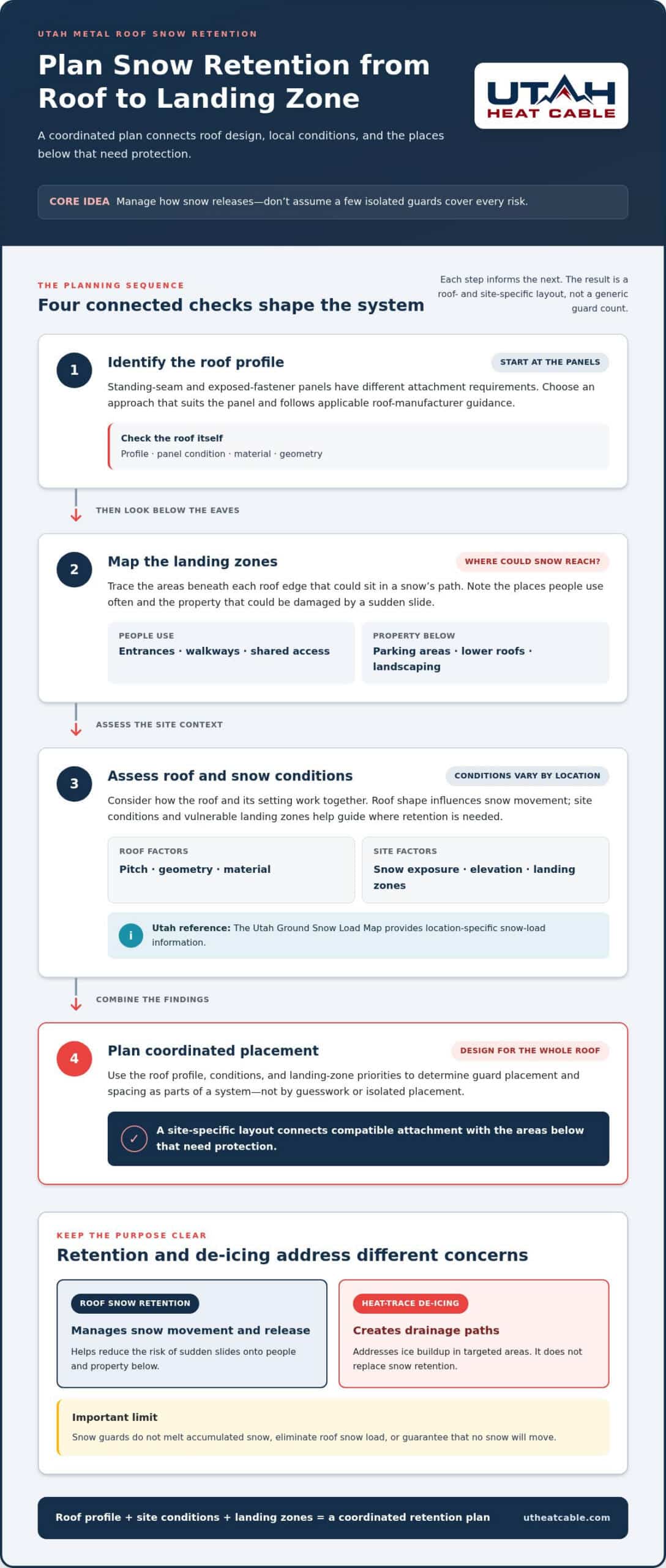
A suitable retention system starts with the roof, not a generic guard count. Use this sequence to shape a plan for snow guards for metal roofs Utah properties may need:
- Identify the roof profile. Standing-seam and exposed-fastener panels have different attachment requirements. The approach must suit the panel and follow applicable roof-manufacturer guidance.
- Map landing zones. Mark doors, paths, parking areas, lower roofs, and other places beneath the eaves that need protection. Include shared or frequently used areas.
- Assess conditions. Consider roof pitch and geometry, material, snow exposure, and site elevation. The Utah Ground Snow Load Map provides location-specific snow-load information for Utah.
- Plan installation. Determine guard placement and spacing as parts of a coordinated system, not by guesswork or isolated placement.
What a roof and site assessment should account for
Snow guard placement should reflect the roof profile, geometry, material, snow exposure, and the areas beneath the eaves. These factors work together: roof shape influences snow movement, while site conditions and vulnerable landing zones help guide where retention is needed. A layout that overlooks any of them may leave key areas exposed or fail to account for how snow is held across the roof.
Guards manage snow release, but they don’t eliminate roof snow load or guarantee that no snow will move. The system needs to suit the roof and its conditions, including compatible attachment methods and installation details. Utah Heat Cable designs and installs roof snow retention systems to suit project conditions. Explore roof snow retention services to learn more.
Planning Snow Guard Installation for a Utah Metal Roof
Professional planning connects the roof’s construction to the places below that need protection. Utah Heat Cable assesses roof characteristics, likely snow-release areas, and property priorities such as protecting entrances, walkways, or parking spaces. Those details help shape a site-specific roof snow retention system instead of a universal guard layout.
Roof snow retention and roof de-icing solve different problems. Retention helps manage snow movement across the roof; heat-trace de-icing creates drainage paths to address ice buildup in targeted areas. One doesn’t replace the other. If a property faces both sudden snow release and ice-related drainage concerns, the plan can address each need separately. Learn more about roof snow retention guidance.
What to expect from a professionally planned system
Planning considers the metal-roof profile, panel condition, roof geometry, snow exposure, and the landing zones identified around the property. These details inform the system design and installation approach. Installation should respect roof-manufacturer guidance and applicable requirements, so the selected approach suits the specific roof rather than treating all metal panels alike.
For snow guards for metal roofs Utah properties can use as part of a considered safety plan, Utah Heat Cable designs and installs roof snow retention systems tailored to project conditions. Explore roof protection services.
Plan a Safer Roof Before the Next Snowfall
The right snow retention plan starts with the roof profile and the places snow could reach below. For snow guards for metal roofs Utah properties need, a coordinated design should account for site conditions and protection priorities rather than relying on a few isolated guards. Remember, retention manages snow release; it doesn’t remove roof snow or address ice buildup. De-icing may help with a separate ice-management concern, but it isn’t a substitute for snow retention.
Utah Heat Cable installs roof snow retention systems and is a licensed electrical contractor serving Utah, Idaho, and Wyoming. A site-specific plan can help you take practical steps to protect people and property around your roof. Explore Utah Heat Cable’s roof snow retention services and plan for winter.
Frequently Asked Questions
Do snow guards work on metal roofs in Utah?
Yes, snow guards can work on metal roofs in Utah when the system suits the roof profile and site conditions. Snow guards for metal roofs Utah properties use should be planned around panel type, roof geometry, snow exposure, and the areas below the eaves. Conditions vary across Utah, Idaho, and Wyoming, so a site-specific design is more useful than a universal layout.
Can snow guards stop all snow from sliding off a metal roof?
No. Snow guards help manage the release of snow, but they don’t guarantee that no snow or ice will move off the roof. They also don’t melt snow or reduce the roof’s structural load. A coordinated system is designed to help reduce sudden slides and direct protection toward vulnerable areas, such as entrances, walkways, and parking spaces.
How are snow guards attached to a standing-seam metal roof?
Standing-seam systems may use clamps that grip the seams without penetrating the roof panels. The suitable attachment depends on the seam and panel design, and installation should follow roof-manufacturer guidance. Snow guards must be compatible with the specific roof; an attachment approach intended for another metal-roof profile may not be appropriate. A professional assessment helps plan the system and installation details.
Do snow guards prevent ice dams on a metal roof?
No. Snow guards manage snow movement, while ice dams form when melting and refreezing obstruct water drainage at the roof edge. Heat-trace systems can create drainage paths to address ice buildup in targeted areas, but they don’t replace snow retention. If a property in Utah, Idaho, or Wyoming faces both concerns, each calls for its own part of a coordinated roof protection plan.