
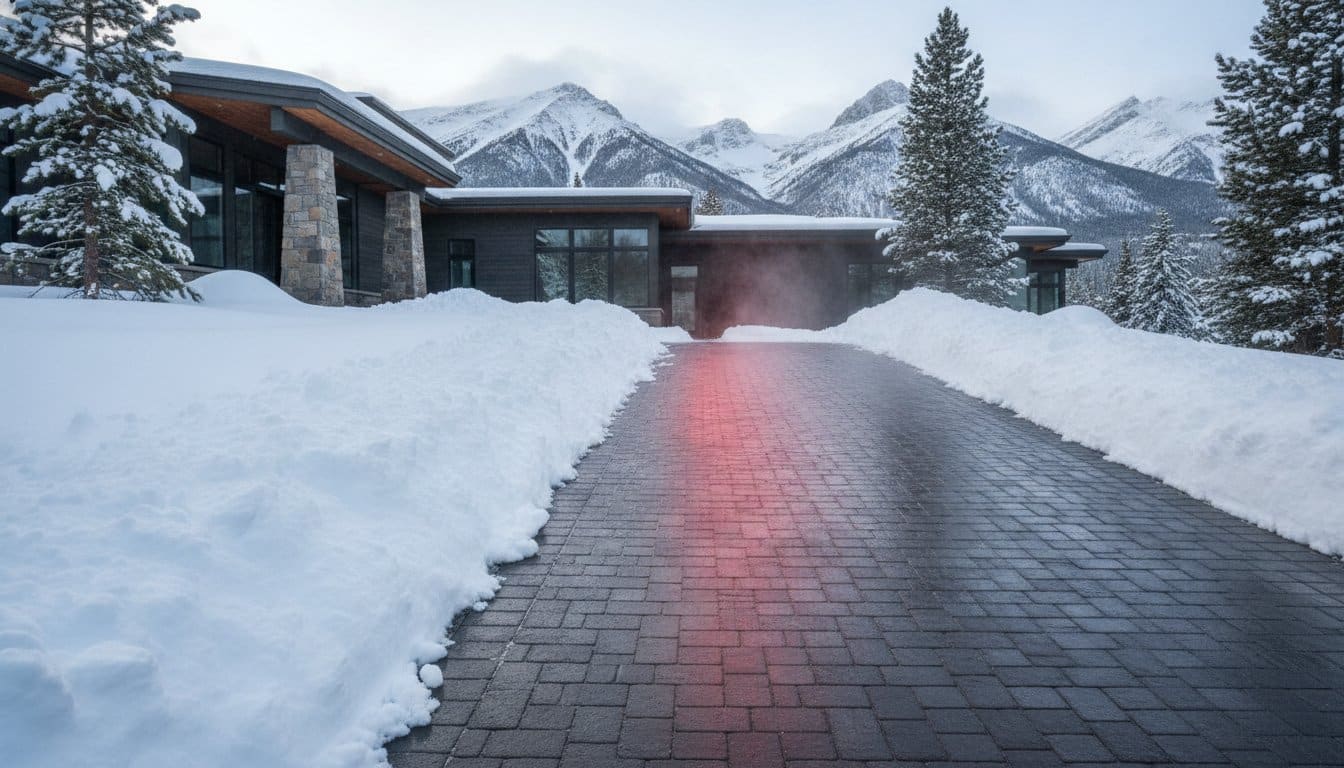
A reliable Utah snow melt system is an electrical engineering project first and a construction project second. While many homeowners view these systems as a luxury, anyone who has faced a 12 inch “lake effect” storm knows the reality of the physical strain and property damage that follows. You’ve likely felt the frustration of shoveling heavy powder only to see salt and chemicals slowly destroy your expensive pavers or concrete. Managing a steep, icy driveway isn’t just a chore; it’s a significant liability risk for your family and guests. Finding a permanent solution for heated driveway installation Utah is about more than convenience. It’s about long term property protection and safety.
We understand that you want a driveway that stays clear without the constant maintenance. This guide provides everything you need to choose, design, and install a radiant system tailored for our unique mountain climate. We’ll walk through the technical differences between electric and hydronic systems, explain how to comply with the 2024 International Residential Code, and show you how a custom-designed heat cable layout can increase your property value while providing total peace of mind all winter long.
Key Takeaways
- Understand how a radiant snow melt system acts as an automated insurance policy, protecting your property from the intense “lake effect” snow common along the Wasatch Front.
- Compare the mechanical differences between electric and hydronic technologies to determine why electric systems are the preferred choice for most heated driveway installation Utah retrofits.
- Learn the critical importance of custom heat density mapping to ensure your system is powerful enough to handle local snow loads without wasting energy.
- Discover how to evaluate long-term value by breaking down installation cost drivers and estimating the monthly operating impact on your power bill.
- Identify the essential qualifications to look for in a specialist, emphasizing why licensed electrical expertise is required for a safe, code-compliant installation.
Why Heated Driveway Installation is a Game-Changer for Utah Properties
Utah winters are famously unpredictable. While the “Greatest Snow on Earth” is a badge of honor for skiers, it’s a structural threat to your property. Investing in heated driveway installation Utah is best viewed as a proactive insurance policy for your home. Along the Wasatch Front, the unique “Lake Effect” can dump several inches of heavy, wet snow in a matter of hours. Manual removal often fails because the rate of accumulation outpaces the physical ability to clear it. When you rely on a shovel or a blower, you’re always playing catch-up with the weather.
Beyond the physical labor, there’s a significant structural toll to consider. A professional Snowmelt system prevents the destructive freeze-thaw cycle that ruins local driveways. When snow melts during the day and refreezes at night, water expands within the pores of your concrete or pavers. This repeated pressure leads to spalling, scaling, and deep cracks that eventually require a full replacement. By keeping the surface temperature consistently above freezing, these systems ensure moisture evaporates rather than turning into ice.
Safety and Liability: Protecting Your Family and Guests
Slip-and-fall accidents are a constant concern, particularly on steep or north-facing driveways that rarely see direct sunlight. If you manage an HOA or a commercial property, an automated system provides a reliable layer of protection against liability claims. It’s about more than just comfort; it’s about security. These systems also ensure that emergency vehicles have clear, immediate access to your property during heavy mountain snowfalls when every second counts. A well-engineered heated driveway installation Utah project pays for itself through reduced risk and improved accessibility.
Preserving Your Investment: Salt-Free Snow Removal
Rock salt and chemical de-icers are highly corrosive agents. They leach into your soil, killing expensive landscaping, and they accelerate the oxidation of the rebar inside your concrete. A radiant system eliminates the need for these chemicals entirely, preserving the structural integrity of your surfaces for decades. In high-value markets like Park City, a heated driveway is a sought-after feature that significantly increases property resale value. It transforms a seasonal burden into a long-term asset that protects your vehicles, your masonry, and your peace of mind.
Comparing Snow Melt Technologies: Electric Cables vs. Hydronic Systems
When planning a heated driveway installation Utah homeowners typically choose between two primary technologies: hydronic and electric. Hydronic systems rely on a boiler to heat a mixture of water and glycol, which is then pumped through flexible tubing embedded in the driveway. Electric systems, conversely, use high-durability heating cables connected directly to your home’s electrical panel. Each has its place, but the mechanical differences dictate how well they perform in our specific mountain environment.
The mechanical difference is significant. Hydronic systems are complex. They require pumps, manifolds, and a dedicated boiler, which adds multiple points of potential mechanical failure. Electric systems are solid-state. They have no moving parts and no risk of fluid leaks. For most residential properties in Utah, electric is the preferred choice because of its faster response time. When a sudden storm rolls off the Great Salt Lake, electric cables reach operating temperature almost immediately. A hydronic system must first heat the fluid in the boiler before it can begin warming the slab, which can lead to snow accumulation during the initial phase of a storm.
Engineering standards for Heated Pavement Systems emphasize the importance of thermal performance and structural integrity. While airport-grade systems are larger in scale, the same principles apply to your home. Electric systems offer a more precise level of control, allowing for “zoned” heating where you only activate the areas you need most, such as steep inclines or high-traffic walkways. This targeted approach is often more efficient than heating an entire massive slab when only specific paths are required for safety.
Electric Heat Cables: Precision and Reliability
Self-regulating heat cables are a specific specialty of ours. These cables are designed to adjust their heat output based on the ambient temperature. As the air gets colder, the cable draws more power to compensate; as it warms up, the cable naturally throttles back. This prevents energy waste and ensures the system operates at peak efficiency. Because there are no boilers to service or pumps to replace, the long-term maintenance requirements for an electric system are virtually non-existent. It’s a set-it-and-forget-it solution that provides peace of mind throughout the season.
Retrofitting Existing Driveways: The Saw-Cut Method
Many homeowners believe they have to tear out their entire driveway to install heat. That isn’t always the case. If your existing concrete is in good structural condition, we can use a “saw-cut” method. This involves cutting precise channels into the surface, laying the cables, and then sealing them with a specialized, high-strength epoxy or joint filler. It’s a surgical approach that provides the benefits of a snow melt system without the cost of a full demolition and repour. If you’re wondering if your current surface is a candidate for this, a custom heat-trace design consultation can provide the answer.
The Professional Installation Process: From Design to Power-On
A successful heated driveway installation Utah project begins with precise engineering rather than simple labor. Because Utah faces high snow loads, a “one-size-fits-all” approach to cable spacing often leads to system failure during peak winter months. We start by mapping heat density, calculating exactly how many watts per square foot are required to overcome the cold sink of the ground and the rapid accumulation of a mountain storm. This level of planning aligns with FAA standards for heated pavement systems, which emphasize that thermal performance is only as good as the underlying design.
Site preparation is the next critical phase. If the sub-base isn’t properly compacted and stable, the weight of vehicles combined with natural ground shifting will eventually snap the embedded heating elements. We ensure a solid foundation is in place before any cable is laid. Once the base is ready, we secure the heating cables with precise spacing to avoid “cold spots” where ice could still form. Every foot of cable is tested for resistance and insulation integrity multiple times: before the pour, during the pour, and after the surface has cured.
The technical complexity of these systems is why you should always work with a licensed electrical contractor. As of July 1, 2026, Utah has adopted the 2024 International Residential Code (IRC), and compliance is mandatory for all new snow melt projects. We handle the specialized power runs and panel upgrades necessary to support the system’s load safely. This isn’t just about making the snow melt; it’s about ensuring your home’s electrical infrastructure remains protected and up to code for the long term.
Sensors and Controllers: The Brains of the System
A smart system is an efficient system. For the Wasatch Front, we often recommend aerial snow sensors. These devices detect moisture and temperature before the snow even hits your driveway, allowing the system to pre-heat the slab. In-ground sensors are also an option for detecting when the surface actually becomes wet. Many modern setups now include smart-home integration, giving you the ability to monitor your system or manually override it from a smartphone app if you see a storm approaching while you’re away from home.
Surface Compatibility: Concrete, Asphalt, and Pavers
Your choice of driveway material changes how the heat is delivered. Concrete is an excellent thermal conductor, but asphalt requires specialized cables that can withstand the high heat of the installation process. If you prefer stone or brick pavers, the cables are typically embedded in a bed of sand or fine gravel beneath the stones. This requires careful spacing to ensure even heat distribution across the different material densities, preventing some pavers from staying icy while others clear. Regardless of the surface, a custom heated driveway installation Utah ensures the heat reaches the top layer efficiently.
Evaluating the Cost and Long-Term Value of a Radiant System
Investing in a heated driveway installation Utah project is a decision that balances upfront capital with decades of predictable safety. The primary cost drivers for these systems include the total square footage, the specific power requirements of your electrical panel, and the type of surface material being used. A large paver driveway requires a different cable density and labor intensity than a standard concrete pour. Understanding these variables helps you move past the initial sticker shock and toward a realistic view of property management. It’s a significant investment, but it’s one that fundamentally changes how you interact with your home during the winter months.
Operating costs are the most common concern for homeowners. In Utah, running a standard 20 by 20 foot driveway system during a typical six hour snowstorm costs approximately $19.51 in utility fees. Depending on the severity of the winter, most residents see an annual operating impact between $120 and $600. When you compare these utility costs to the price of professional plow services or the cost of replacing a salt-damaged driveway every 10 years, the radiant system often emerges as the more economical choice. It’s about trading variable, high-stress expenses for a controlled, automated utility.
Operational Efficiency: When and How to Run Your System
The “Idling” versus “Cold Start” debate is central to maximizing your efficiency. Idling keeps the slab just below freezing so it can react instantly, while a cold start waits for the storm to begin. For most Utah properties, a cold start paired with high-performance sensors is the most cost-effective approach. Automated moisture and temperature sensors ensure the system only draws power when active precipitation is detected. Automated sensors can reduce energy waste by up to 30% by preventing the system from running during dry, cold spells. This precision ensures you aren’t paying to heat a dry driveway.
Long-Term ROI: More Than Just a Clear Driveway
The return on investment extends far beyond a clear path to the garage. In high-demand markets like Park City or Bear Lake, a snow melt system is a premium feature that directly boosts home resale value. Buyers in these regions prioritize safety and low-maintenance living. Furthermore, you’ll see significant savings over a 15 year period by eliminating the need for professional snow removal and chemical de-icers. By avoiding the high cost of concrete repair caused by salt and ice expansion, you’re effectively doubling the lifespan of your driveway surface. If you are ready to see how these numbers apply to your specific property, you can request a customized snow melt design to get started.
Choosing the Right Utah Heat Cable Specialist for Your Project
Selecting the right team for your heated driveway installation Utah is the final, most critical step in securing your property. While a general laborer or a landscaping crew might offer a lower initial bid, these systems are complex electrical engineering projects that require a specialist’s touch. A radiant snow melt system becomes an integrated part of your home’s infrastructure. If it’s installed incorrectly, it’s not just an inconvenience; it’s a potential safety hazard and a waste of your investment. You need a partner who understands the nuances of the National Electrical Code and the specific environmental demands of the Wasatch Front.
When you interview potential installers, ask them about their testing protocols and warranty coverage. A reliable specialist will test the cable’s insulation resistance at multiple stages of the project to guarantee there’s no damage before the concrete or pavers are finalized. At Utah Heat Cable, we take pride in being the experts who teach the experts. We’re committed to providing systems that are safe, code-compliant, and built to withstand our local climate for decades. Our commitment to quality means your system won’t just work during the first storm; it will protect your property for the long haul.
Why Electrical Licensing Matters for Snow Melt
Outdoor heating systems are governed by strict National Electrical Code (NEC) requirements. These standards exist to ensure proper grounding and to protect your home from under-powered circuits that can lead to equipment failure. A licensed electrical contractor understands how to calculate the total load on your panel and ensure the system is safely integrated. Without this expertise, you risk premature cable burnout or a system that trips your breakers every time it snows. Professional electrical design ensures that the current flowing through your driveway is handled with the same precision as the wiring inside your walls.
Custom Solutions for Utah’s Toughest Properties
Every property in Utah presents its own set of challenges. A north-facing driveway that never sees the winter sun requires a significantly different heat density than a south-facing one. Similarly, managing a steep grade in mountain communities requires a specialized layout to prevent melt-water from refreezing at the bottom of the slope. We don’t believe in “one-size-fits-all” kits. Our approach involves a detailed site analysis to identify these environmental risks before we ever lay a single foot of cable. If you’re ready to secure your property against the next winter season, we invite you to Request a custom snow melt design from Utah Heat Cable.
Secure Your Property for the Next Utah Winter
Transitioning from the physical strain of manual snow removal to a fully automated radiant system is a significant step toward long-term property protection. By choosing an electric system designed for our specific mountain climate, you’re not just buying convenience; you’re investing in a solution that prevents structural damage and eliminates the need for corrosive salts. A successful heated driveway installation Utah project relies on precise engineering and a deep understanding of local snow loads to ensure reliability when the next storm hits the Wasatch Front.
As a licensed electrical contractor, we specialize in custom designs for Utah snow loads that work across all surface types, including concrete, asphalt, and pavers. Our approach prioritizes safety, code compliance, and operational efficiency, giving you peace of mind throughout the coldest months of the year. If you’re ready to protect your home and your family from icy hazards, it’s time to talk to a local specialist who understands the mechanics of mountain living.
Get a Free Snow Melt System Consultation from David Tanner and start planning your path to a safer, maintenance-free winter today.
Frequently Asked Questions
How much does it cost to run a heated driveway in Utah?
Operating costs typically range between $120 and $600 per season for most Utah homeowners. For a standard 20 by 20 foot driveway, you can expect to pay approximately $3.25 per hour of operation. These costs depend heavily on your local utility rates and how often you experience heavy accumulation. By using automated sensors that only activate during active snowfall, you can keep these expenses predictable and manageable throughout the winter.
Can you install a heated system under an existing driveway?
Yes, you can retrofit an existing surface using the saw-cut method if the concrete is in good structural condition. We cut precise channels into the surface, lay the heating cables, and seal them with high-strength epoxy or specialized joint filler. This allows you to enjoy the benefits of a snow melt system without the expense of a full demolition and repour. It’s an excellent option for homeowners who want to upgrade their property’s safety without a total reconstruction.
How long do radiant snow melt systems typically last?
A professionally installed electric system can last 20 to 30 years or more with minimal maintenance. Because there are no moving parts, boilers, or corrosive fluids involved, the heating elements themselves are highly durable. Most systems will last as long as the driveway surface they are embedded in, provided the sub-base was correctly prepared. This longevity makes it a sound long-term investment that protects your property for decades rather than just a few seasons.
Does a heated driveway add value to my Utah home?
Heated driveways significantly increase property appeal and resale value, particularly in high-snow regions like Park City or Bear Lake. Potential buyers prioritize the safety and convenience of a clear path during the winter. Beyond the market price, you also gain value by extending the lifespan of your concrete. Avoiding the use of harsh chemical de-icers prevents surface spalling and cracks, ensuring your driveway remains in top condition for much longer than a standard installation.
Will the system work during a massive Utah “Lake Effect” storm?
Yes, our systems are custom-designed to handle the specific snow loads found during intense “Lake Effect” events. By calculating the correct heat density during the design phase, we ensure the cables generate enough wattage to overcome rapid accumulation. Automated sensors help by activating the system as soon as moisture is detected, allowing the slab to pre-heat. This proactive approach ensures that snow melts on contact rather than piling up and becoming unmanageable.
What happens if a cable breaks under the concrete?
If a cable is damaged, we use specialized fault-locating equipment to identify the exact point of the break beneath the surface. This technology allows us to perform a surgical repair by removing only a small section of the concrete or asphalt rather than tearing up the entire driveway. These repairs are uncommon when the system is installed correctly with proper expansion joints. Most cable issues are preventable through professional design and careful testing during the initial installation process.
Do I need to upgrade my electrical panel for a heated driveway?
Most heated driveway installation Utah projects require a dedicated circuit and may necessitate an electrical panel upgrade. These systems draw a significant amount of amperage to generate the heat levels required for our cold climate. We evaluate your current electrical capacity during the initial consultation to ensure your home can safely handle the additional load. Ensuring your electrical infrastructure is up to code is a vital part of a safe, reliable installation.
Is electric or hydronic better for a Utah residential driveway?
Electric systems are generally superior for Utah residential applications due to their faster response times and lower maintenance requirements. They reach operating temperatures quickly, which is vital during sudden mountain storms that drop heavy snow in minutes. While hydronic systems are an option for very large commercial spaces, electric cables offer better reliability and easier installation for most homeowners. You won’t have to worry about boiler repairs, pump failures, or fluid leaks over the system’s lifespan.