
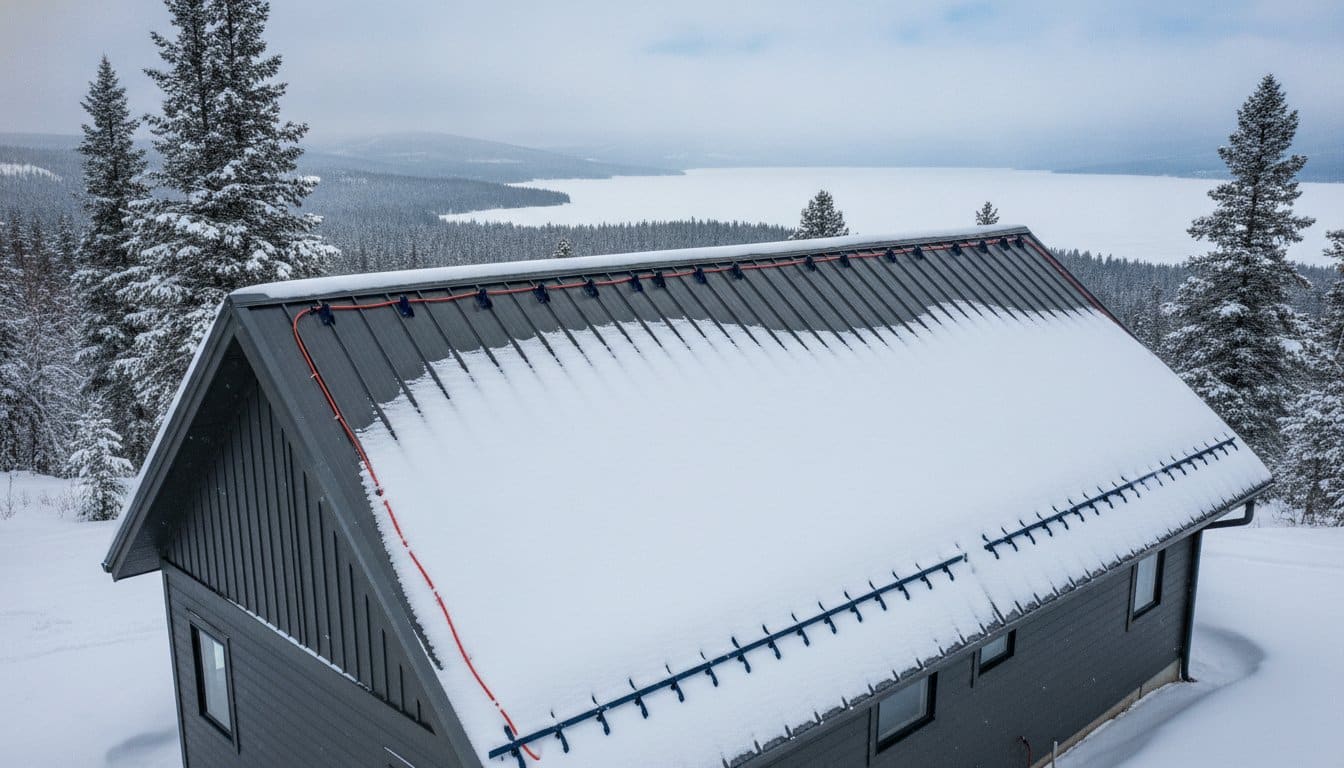
A sudden, thunderous roar echoes across the deck as several tons of heavy snow slide off your metal roof in a single second. For property owners in Garden City and Fish Haven, these “roof avalanches” are a terrifying reality that can crush entryways and destroy expensive landscaping. You understand that the lake-effect snow in our region is uniquely heavy; in fact, areas like Sweetwater Hill require structures to handle roof snow loads of 60 lbs per square foot. Finding effective Bear Lake roof snow protection is no longer a luxury, it’s a necessity for anyone looking to avoid structural damage and dangerous ice dams.
You shouldn’t have to spend your winter worrying about the next big storm or the weight pressing down on your gutters. This 2026 guide promises to show you how a professional-grade dual-defense system can secure your home. We’ll explore the technical differences between site-specific snow retention and self-regulating heat cables that adjust to ambient temperatures. By the end, you’ll understand how to achieve a safe, maintenance-free roof that offers total peace of mind throughout the harshest Bear Lake winter.
Key Takeaways
- Learn how the unique weight of lake-effect snow impacts your property and why local building codes require higher load capacities in the Bear Lake Valley.
- Differentiate between snow guards and snow fences to determine which structural barrier is best suited for your cabin’s roof pitch and entryway layout.
- Understand the technical advantages of self-regulating heat cables and how they prevent ice dams by creating permanent melt paths for drainage.
- Discover why the most effective Bear Lake roof snow protection involves a hybrid approach that combines structural retention and professional de-icing systems.
- Recognize the importance of custom design and licensed installation to ensure your winter protection system is code-compliant and built for high-altitude extremes.
Why Bear Lake Roofs Need Specialized Snow Protection
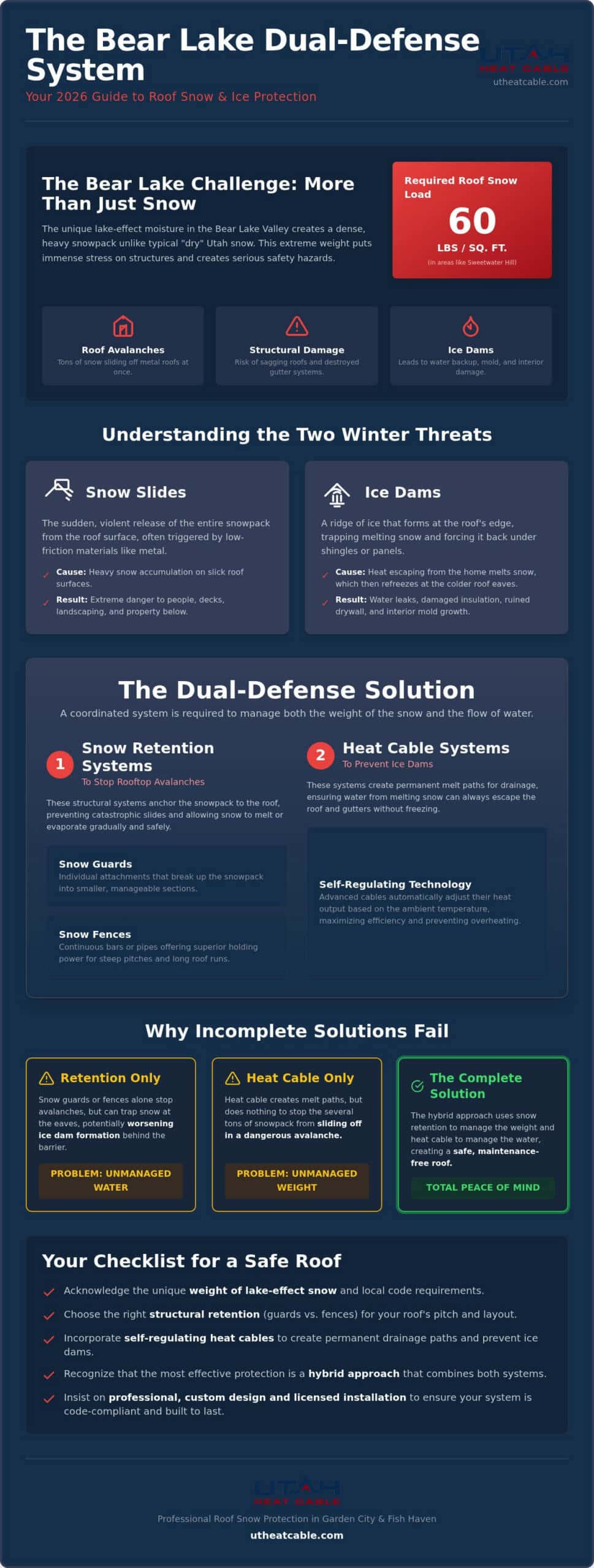
The Bear Lake Valley presents a unique set of meteorological challenges that standard building practices often overlook. While valley snow in other parts of Utah might be light and “dry,” the lake-effect moisture coming off Bear Lake creates a much denser, heavier snowpack. This increased weight places immense stress on residential structures. In communities like Sweetwater Hill and Swan Creek Village, the building code reflects this reality by requiring a roof snow load capacity of 60 lbs per square foot. Without a tailored strategy for Bear Lake roof snow protection, this weight can lead to structural sagging or the total destruction of your gutter systems.
High-altitude winds in Garden City and Fish Haven exacerbate the problem. These gusts don’t just blow snow around; they create significant drifting on leeward roof slopes. A roof that appears safe on one side might be carrying double the intended weight on the other. For properties with metal roofing, this accumulation is particularly volatile. Metal panels are designed to shed moisture, but when they shed several tons of snow at once, the resulting “rooftop avalanche” becomes a major liability. These slides can crush decks, destroy hot tubs, and pose a severe safety risk to anyone standing near the eaves.
The Anatomy of a Bear Lake Winter
The orientation of your home dictates its specific risks. North-facing roofs often struggle with constant snow accumulation because they lack the solar heat needed for natural melting. Conversely, south-facing roofs undergo a rapid freeze-thaw cycle. This cycle is the primary driver of ice dams. If you ignore these patterns, the financial impact can be staggering. Water backup from ice dams often leads to interior mold and ruined drywall, while heavy snow slides can rip gutters clean off the fascia, requiring expensive structural repairs.
Ice Dams vs. Snow Slides: Understanding the Difference
It’s helpful to understand exactly what an ice dam is and why it differs from a simple snow slide. An ice dam occurs when heat escaping from your home melts the bottom layer of snow, which then refreezes at the cold roof edge. This creates a literal dam that traps liquid water, forcing it under your shingles or metal panels. A snow slide, however, is a physical release of the entire snowpack. Solving one problem without addressing the other can be counterproductive. For example, installing snow guards without heat cables can actually trap more snow and accelerate ice dam formation. Effective Bear Lake roof snow protection requires a coordinated approach that manages both the weight and the water.
Snow Retention Systems: Stopping Rooftop Avalanches
A snow retention system acts as a structural anchor for the heavy winter blanket on your roof. Rather than allowing snow to shed in a single, violent motion, these systems increase the friction between the snowpack and the roof surface. This keeps the snow in place, allowing it to melt or evaporate gradually. In the Bear Lake region, where building codes in areas like Sweetwater Hill demand a 60 lbs per square foot roof snow load capacity, the math behind your system is vital. A few scattered guards aren’t enough; you need a calculated grid designed to hold back several tons of pressure. While these systems manage the physical weight, they’re also part of a broader strategy for preventing ice dams by keeping the snow distributed evenly across the roof surface rather than letting it pile up dangerously at the eaves.
Choosing between snow guards and snow fences depends on your roof’s pitch and the volume of snow you expect. Snow guards are individual attachments that break up the snowpack into smaller, manageable sections. Snow fences, on the other hand, provide a continuous bar or pipe that offers superior holding power for steep pitches or long “rafter runs” where snow gains momentum as it slides. Professional Bear Lake roof snow protection focuses on securing critical zones like entryways, garage doors, and expensive landscaping. If you’re unsure about the load requirements for your specific elevation, consulting a specialist for custom-designed snow retention ensures your system won’t fail when the next big storm hits.
Snow Guard Solutions for Metal Roofs
Metal roofs in Garden City and Fish Haven require specialized attachment methods. For standing seam roofs, we use high-strength clamps that grip the seam without piercing the metal, preserving your warranty. For through-fastened roofs, mechanical fasteners with EPDM washers provide a leak-proof seal. We strongly advise against adhesive-only “glue-on” guards; the extreme temperature swings and heavy moisture of a Bear Lake winter frequently cause these to fail. Modern color-matching technology also allows these guards to blend perfectly with your roof’s finish, making them virtually invisible from the street.
Snow Fences for High-Load Zones
When you’re dealing with the massive snow accumulations typical of Bear Lake County, bar-style or pipe-style snow fences are often the only way to ensure safety. These systems are designed to withstand the lateral force of a heavy snowpack on steep inclines. Many homeowners associations (HOAs) in the valley now require architectural snow retention that complements the cabin’s aesthetic. We design these systems to meet the rigorous 2026 building codes while ensuring they look like an intentional part of your home’s design rather than a bulky afterthought.
Advanced Heat Cable Solutions for Ice Dam Prevention
If snow retention is the shield that stops the avalanche, heat cables are the precision tool that manages the aftermath. In the Bear Lake Valley, the heavy moisture content of lake-effect snow means that even a well-insulated roof can develop dangerous ice buildup. These systems work by creating “melt paths” through the snowpack, ensuring that liquid water has a clear route to flow off the roof and through the gutters. Without these paths, water traps behind snow banks, leading to the exact conditions described in the National Weather Service guide to preventing ice dams. For residents in Garden City and Fish Haven, high-quality Bear Lake roof snow protection must include a strategy for keeping eaves and downspouts clear of solid ice.
Efficiency is the primary concern for most property owners. Professional-grade self-regulating heat cables are designed with a conductive carbon core that adjusts its power output based on the surrounding temperature. When the air is colder, the cable generates more heat; as it warms up, the cable automatically throttles back. This prevents the system from wasting electricity during milder days. It also eliminates the risk of the cable overheating if it happens to cross over itself, which is a common failure point for cheaper alternatives.
Self-Regulating vs. Constant Wattage Cables
Many homeowners are tempted by “heat tape” found at local hardware stores, but these products rarely survive more than one or two harsh winters. These constant-wattage cables run at full power regardless of the weather, which is both inefficient and prone to burnout. In contrast, our professional-grade self-regulating systems are built for durability and often boast a lifespan of 10 years or more. As a licensed electrical contractor, we ensure these systems are installed to code, providing a level of safety and reliability that store-bought kits simply cannot match.
Smart Controllers and Automation
Modern Controller Options take the guesswork out of winter maintenance. Rather than manually flipping a switch and hoping for the best, automated sensors detect both temperature and moisture. The system only activates when both conditions are met, drastically reducing utility costs. This is an essential feature for vacation home owners who may not be on-site to monitor their property. You can even opt for remote monitoring systems that allow you to check the status of your roof from your smartphone, ensuring your Bear Lake cabin remains protected even when you’re miles away.
The Bear Lake Hybrid Approach: Why You Need Both
Many property owners in Garden City and Fish Haven view snow retention and heat cables as separate choices, but in our extreme climate, they are two halves of a single solution. Relying on just one system often creates a “perfect storm” of property damage. For example, if you install a heavy-duty Roof Snow Retention system without heat cables, the snow stays safely on the roof, but it also provides the raw material for massive ice dams. As heat escapes through your attic, the bottom layer of that trapped snow melts, runs down to the cold eaves, and freezes into a solid block. Without a heated path to the ground, that water has nowhere to go but under your roofing material.
Conversely, installing heat cables without snow guards leads to what we call the “waterfall effect.” On a steep metal roof, a heavy snowpack can suddenly lose its grip and slide. As this mass of snow and ice accelerates toward the edge, it can catch on your heat cables, ripping them out of the gutters or even tearing the gutters off the fascia entirely. This “launching” ice poses a significant threat to anything below. A true Bear Lake roof snow protection strategy integrates both systems to ensure that snow stays put while the meltwater drains away safely.
A typical defense layout for a Garden City cabin involves a hybrid design that protects both the structure and the occupants. By keeping the roof surface dry and preventing the violent movement of snow, you significantly increase the lifespan of your roofing panels and fasteners. Constant expansion and contraction from ice buildup can back out screws and compromise seals over time. A hybrid system stabilizes these conditions, preserving your investment for decades. If you are ready to secure your property against the next winter cycle, you can request a custom hybrid system design from our team of specialists.
Designing Your Custom Defense Layout
Precision is required when mapping out a hybrid system. We place snow guards strategically above the heat cable zig-zag patterns to ensure the weight of the snowpack doesn’t crush the cables. It is also vital to heat the downspouts all the way to the frost line. If a downspout remains frozen at the bottom, an “ice plug” will form, causing the entire gutter system to back up and overflow. Professional design is necessary to ensure these electrical and structural components work in harmony rather than interfering with one another.
Maintenance and Winter Readiness
Even the best systems require a quick check-up before the heavy lake-effect snow arrives. Pre-winter inspections should focus on removing leaves and debris from the gutters, as even a small amount of organic matter can trap moisture and trigger ice formation. We also check the integrity of the cable jackets to ensure no rodents have damaged the insulation during the summer. The optimal time for system testing is typically in October before the first hard freeze. This proactive approach ensures that when the first storm hits, your home is already under a protective shield.
Professional Roof Snow Protection in Garden City & Fish Haven
Choosing a partner for your Bear Lake roof snow protection is a decision that impacts your property’s safety for the next decade. While many handymen offer to “hang heat tape,” hiring a licensed electrical contractor is non-negotiable for these systems. Heat cables are high-voltage electrical components that require precise circuit loading and specialized grounding to prevent fire hazards and premature failure. As a licensed team, we ensure every installation meets the 2026 National Electrical Code and local building requirements. This professional oversight provides the durability needed to withstand the relentless moisture of a Bear Lake winter without tripping breakers or burning out after a single season.
Our local expertise in the Bear Lake Valley and Rich County allows us to account for the specific microclimates that outsiders often miss. We know that a cabin in Fish Haven face different wind-driven snow patterns than a home in Laketown. Because we specialize in custom-designed systems, we don’t use one-size-fits-all kits. Instead, we perform site-specific load calculations to determine exactly how many Roof Snow Retention points are needed and where Self Regulating Heat Cable must be routed to ensure a clear path for meltwater. This tailored approach is the only way to meet the rigorous snow load standards required for our region’s high-elevation properties.
The design process begins with a detailed assessment of your roof’s architecture and historical snow accumulation. We look at everything from the pitch of your metal panels to the location of your propane tanks and entryways. Once the design is finalized, we handle the installation with a focus on longevity and aesthetics. Every system we install comes with professional support and a clear warranty, giving you total peace of mind before the first lake-effect storm hits the valley.
Our Bear Lake Service Area
We are dedicated to serving the entire Bear Lake region, including Garden City, Fish Haven, St. Charles, and Laketown. Our team has extensive experience working with local HOAs and architectural review boards to ensure that snow retention systems meet aesthetic guidelines without compromising safety. We often coordinate directly with local roofers and general contractors during new construction or re-roofing projects. This collaboration ensures that your snow protection is integrated seamlessly into the building envelope, protecting your roof warranty and your structure simultaneously.
Get Your Bear Lake Roof Ready
Preparation is the key to a stress-free winter. We provide free, load-calculated layout and design quotes to help you understand the specific needs of your property. The ideal timeline for installation is during the summer and fall months when the roof surface is dry and safe for our technicians. Waiting until the first freeze in October often means dealing with a backlog of emergency requests. By acting now, you ensure your home is protected well before the heavy snow arrives. Protect your Bear Lake home—Contact Utah Heat Cable today to schedule your consultation and secure your property for the 2026 season.
Securing Your Home Before the First Storm
The extreme conditions of a Bear Lake winter demand more than a one-size-fits-all approach. The most effective strategy involves a custom-designed hybrid system that combines structural snow retention with self-regulating heat cables. By managing both the weight of the snowpack and the drainage of meltwater, you prevent the dangerous avalanches and costly ice dams that plague properties in Garden City and Fish Haven. It’s the only way to ensure your cabin remains safe whether you’re on-site or away for the season.
When you work with a Licensed Electrical Contractor, you ensure that your Bear Lake roof snow protection is installed to code and built for the long term. Our team specializes in Custom Load-Calculated Designs that account for your specific elevation and roof pitch. Taking action during the milder months allows for a precise, stress-free installation that protects your investment for decades. Request Your Free Bear Lake Roof Protection Quote today and enjoy the peace of mind that comes with a professionally shielded home. We’re ready to help you prepare for a safe and worry-free winter.
Common Questions About Bear Lake Roof Snow Management
Do I really need snow guards on a metal roof at Bear Lake?
Yes, snow guards are essential for metal roofs in this region because the smooth surface provides almost no friction to hold heavy snowpack. Without these structural barriers, several tons of snow can shed in a single second. This creates a dangerous “roof avalanche” that can crush your deck, landscaping, or anyone standing near the entryway. In the Bear Lake Valley, where snow is exceptionally heavy, these guards are a critical safety requirement.
How much does it cost to run roof heat cables in Garden City?
The monthly operating cost depends on the total linear footage of your system and current local utility rates. Using self-regulating technology significantly reduces these costs compared to older systems. Because these cables only draw maximum power when temperatures are near freezing and moisture is detected, they operate with high efficiency. Adding a smart controller ensures the system only activates when necessary, preventing wasted energy during dry winter days.
Can snow guards be installed in the middle of winter?
Installation is generally not possible once a significant layer of ice or snow has accumulated on the roof. For a secure and code-compliant attachment, the roof surface must be clear and dry so that fasteners or clamps can be properly torqued. Attempting a mid-winter installation is dangerous for the technicians and often results in a compromised system. It’s much better to schedule your Bear Lake roof snow protection project during the summer or autumn months.
Will heat cables prevent my gutters from falling off?
Heat cables protect your gutters from being pulled down by the weight of solid ice, but they don’t stop the force of sliding snow. If a massive snowpack slides off the roof, it can physically rip the gutters off the fascia regardless of how clear the ice is. This is why we recommend a hybrid approach. Snow retention holds the heavy weight in place, while the heat cables ensure that meltwater drains away safely without refreezing.
What is the difference between snow guards and snow fences?
Snow guards are individual cleats or pads that we install in a staggered grid pattern across the roof surface. Snow fences consist of continuous horizontal pipes or bars that provide a more robust barrier for steep pitches or long rafter runs. While guards are often sufficient for smaller cabins, snow fences offer the superior holding power required for high-accumulation zones in Fish Haven and other high-elevation areas of the valley.
Are self-regulating heat cables safe for all roof types?
Self-regulating heat cables are safe and effective for almost every roofing material, including metal panels, asphalt shingles, and membrane roofs. Unlike constant-wattage tape, these cables adjust their internal temperature based on the outside air. This prevents them from overheating or damaging sensitive roofing materials. They’re a versatile and durable solution for any property owner looking for long-term protection against ice dams and gutter damage.
How long do professional snow retention systems last?
A professionally designed system made from high-quality materials like stainless steel or aluminum can last 20 years or more. These components are built to withstand the intense UV rays and heavy moisture common in the Bear Lake region without rusting or becoming brittle. When you invest in a custom-designed layout, you’re choosing a solution that is meant to last for the remaining lifespan of your roofing material.
Can I install these systems myself to save money?
Professional installation is highly recommended because it involves complex load calculations and high-voltage electrical work. If snow guards aren’t spaced correctly, they can be ripped out by the weight of the snow, causing even more damage to your roof panels. Furthermore, heat cables must be installed by a licensed electrical contractor to ensure they meet modern safety codes. Professional oversight guarantees that your system will actually perform when the heavy lake-effect snow arrives.