

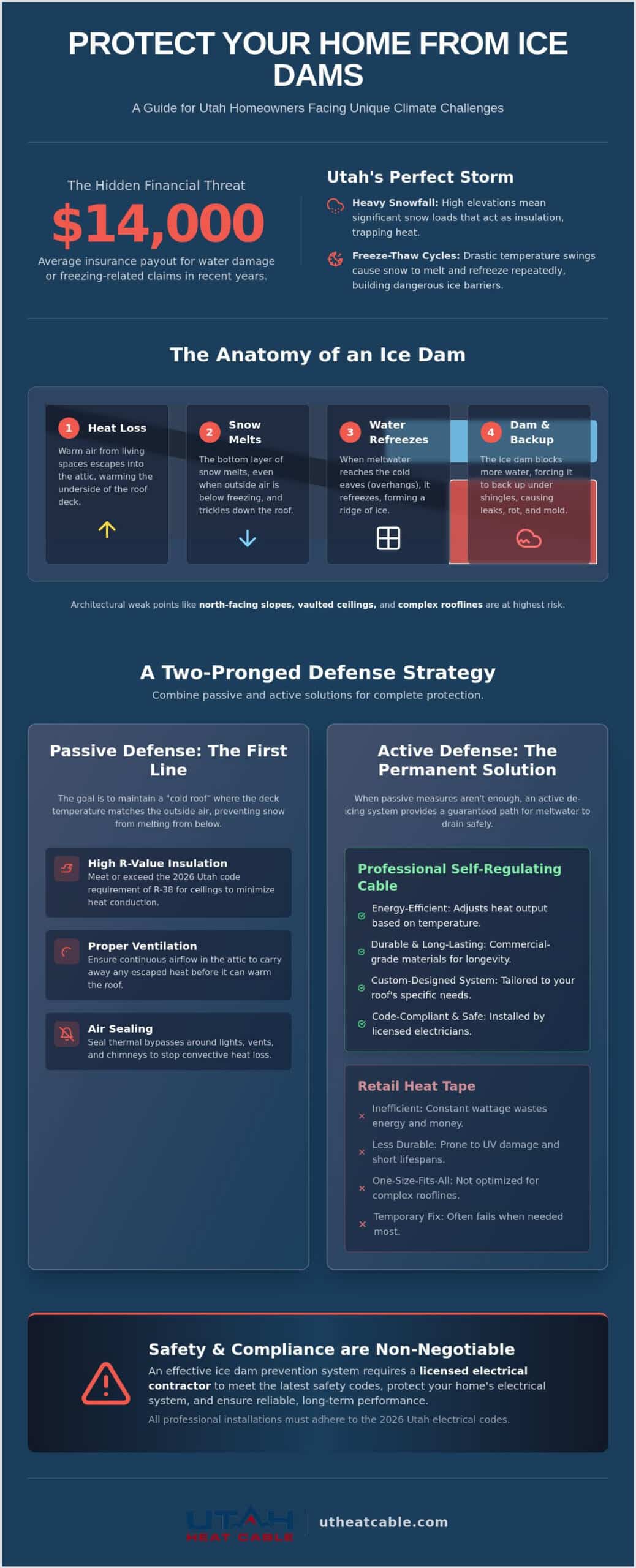
Did you know the average insurance payout for water damage or freezing-related claims reached nearly $14,000 in recent years? In our state, where high elevation and heavy snowfall meet frequent freeze-thaw cycles, roof damage from ice dams Utah homeowners face is more than just a nuisance; it’s a significant financial risk. You’ve likely spent winters watching massive icicles form over your entryway or worrying that the next leak will finally find its way through your ceiling. It’s exhausting to pay for emergency steaming every year only to have the same ridge of ice return after the next storm.
We understand that you want a home that stands strong against the elements without the constant fear of structural issues or recurring leaks. This guide will show you how to move past temporary fixes and secure your property with permanent solutions. You’ll discover how to protect your Utah property using professional-grade de-icing systems and proven prevention strategies that meet the 2026 Utah electrical codes. We’re going to walk through the technical advantages of self-regulating heat cables, the importance of proper insulation, and how a custom-designed snow melt system provides the peace of mind you deserve.
Key Takeaways
- Learn why Utah’s unique high-alpine climate creates structural risks that extend far beyond simple cosmetic icicles.
- Understand the 2026 R-value requirements for attic insulation and why passive ventilation is only the first line of defense.
- Discover how professional-grade self-regulating heat cables prevent roof damage from ice dams Utah homeowners experience, offering a more durable solution than retail heat tape.
- Explore why effective ice dam prevention requires a licensed electrical contractor to meet the latest safety codes and protect your home’s electrical system.
- Identify the ideal seasonal timeline for custom system design to ensure your property is fully protected before the winter freeze begins.
Why Utah Architecture and Climate Create the “Perfect Storm” for Ice Dams
Utah’s high-alpine environment is uniquely harsh on residential structures. Our state experiences a specific combination of heavy annual snowfall and drastic temperature swings that few other regions encounter. In 2026, shifting climate patterns have led to more frequent “micro-thaws” during the day followed by deep freezes at night. This cycle is the primary driver of roof damage from ice dams Utah homeowners struggle with every season. When snow melts and refreezes repeatedly, it creates a physical barrier that compromises the integrity of even the most well-built roofs.
Many people mistake these ridges of ice for simple cosmetic issues. However, understanding What is an Ice Dam? reveals why they are actually structural threats. When ice builds up at the edge of your roof, it creates a reservoir. This trapped water has nowhere to go but up, eventually seeping under shingles and into your home’s framing. This leads to rot, mold, and ruined insulation that can cost thousands to remediate.
The Anatomy of a Utah Ice Dam
The process starts when heat escapes your living space and warms the underside of the roof deck. This causes the bottom layer of snow to melt, even while the air outside is freezing. As this water trickles down to the cold eave, it refreezes into a solid ridge. Heavy snow loads act as a thick blanket, insulating this ice and allowing the water pool behind it to stay liquid and destructive. An ice dam is a blockage of ice at the edge of a roof that prevents melting snow from draining, forcing water to back up under the shingles.
Common Architectural Weak Points in Local Homes
Modern Utah homes often feature complex rooflines with deep valleys and decorative crickets. While these look beautiful, they act as natural funnels for snow and ice. These intersections require specialized protection because they accumulate more volume than a flat plane. Other common vulnerabilities include:
- North-Facing Slopes: These areas rarely see direct sunlight. Without the sun’s help to melt snow naturally, shaded eaves become permanent ice traps where ice can linger for weeks.
- Vaulted Ceilings: These architectural features often lack the necessary space for adequate insulation, creating “hot spots” that trigger the melting process directly above living areas.
- Thermal Bypasses: These are hidden gaps around chimneys, vent pipes, or recessed light fixtures where warm air leaks into the attic.
Identifying these vulnerabilities is essential for any homeowner who wants to avoid roof damage from ice dams Utah winters frequently cause. When you combine complex roof geometries with the state’s significant snow load, the risk of a leak becomes a matter of “when” rather than “if.” Specialized planning is the only way to ensure these architectural funnels don’t become the source of a major interior flood.
The Passive Defense: Insulation and Ventilation as Your First Line of Protection
Building a “cold roof” is the gold standard for property preservation in the Wasatch Front. The primary goal of a passive defense strategy is to ensure the temperature of your roof deck remains as close to the outdoor air temperature as possible. When the roof stays cold, snow doesn’t melt from underneath, which significantly reduces the risk of roof damage from ice dams Utah homeowners experience during the peak of winter. However, achieving this balance requires more than just tossing extra batts of insulation into your attic.
As the University of Minnesota Extension explains, the strategy for preventing ice dams must address heat loss through conduction, convection, and radiation. In Utah, new energy codes effective July 1, 2026, raise the bar for residential protection. These standards now require a minimum R-value of R-38 for ceiling and roof insulation. While this high thermal resistance is a critical starting point, it often fails in high-alpine zones if it isn’t paired with a continuous air barrier and proper ventilation. If your home still struggles with ice buildup after these upgrades, exploring professional de-icing services can provide that final layer of security.
Insulation and Air Sealing: The Passive Defense
Traditional fiberglass insulation is effective at slowing heat conduction, but it cannot stop air movement. Thermal bypasses, such as unsealed “can lights,” attic hatches, and plumbing stacks, allow warm air to gush into the attic space. This convective heat quickly warms the roof deck, regardless of how much insulation you have. A professional approach involves sealing these gaps with foam or caulk before installing insulation. This ensures that the R-38 barrier actually performs as intended, keeping your living heat inside and your roof deck cold.
Ventilation: Keeping the Roof Deck Cool
Effective ventilation acts as a cooling system for your roof. A combination of soffit vents at the eaves and ridge vents at the peak creates a natural “chimney effect” that flushes out any residual heat. It’s common to find blocked soffit vents where insulation has been pushed too far into the eaves, cutting off airflow and creating localized hot spots. Using baffles to keep these channels clear is essential. Even with perfect ventilation, record-breaking snow years in Utah can bury ridge vents under several feet of snow, effectively “choking” the system. In these extreme scenarios, passive measures reach their limit, and active intervention becomes necessary to prevent roof damage from ice dams Utah weather patterns can trigger.
Active De-Icing Systems: Comparing Self-Regulating Cable vs. Retail Heat Tape
Even when your attic meets the latest R-38 insulation standards, Utah’s high-alpine weather can still push passive systems to their breaking point. When passive defense isn’t enough, active de-icing systems become the necessary second line of protection. Many homeowners try to save costs by purchasing retail “heat tape” from big-box stores, but these Constant Wattage Heat Cable products often provide a false sense of security. Because they lack the ability to adjust their heat output, they consume excessive electricity and frequently burn out within five to ten years. These basic systems don’t offer the durability required to prevent the long-term roof damage from ice dams Utah properties face during heavy snow cycles.
Following MSU Extension ice dam prevention tips can help you manage attic heat, but once that heat reaches the roof deck, you need a reliable way to clear drainage paths. This is where professional-grade Self Regulating Heat Cable proves its value. It’s a specialized tool built for the specific architectural challenges of our region, ensuring that valleys and eaves stay clear even when the thermometer drops into the negatives.
The Superiority of Self-Regulating Heat Cable
Unlike retail heat tape, professional self-regulating cables feature a specialized core that adjusts its power output based on the ambient temperature. When it’s freezing, the cable works harder; as the air warms, it naturally dials back its energy consumption. This makes it the efficiency standard for 2026. A critical safety advantage is that these cables won’t overheat or short-circuit if they overlap in a valley or gutter. This “intelligent” design allows for a lifespan of 15 to 25 years, providing a much higher return on investment than cheaper, constant-wattage alternatives.
Advanced Controller Options for Automation
To maximize the efficiency of your system, choosing the right Controller Options is essential. While a manual on-off switch is a basic starting point, it relies on human memory and often leads to wasted energy during dry cold snaps. Modern systems utilize smart moisture and temperature sensors that only activate the cables when melting snow is actually present. For property owners in Park City or Bear Lake, remote monitoring options allow you to check your system’s status from anywhere. This automation ensures your home stays protected from roof damage from ice dams Utah winters produce without inflated utility bills.
Professional Heat Cable Installation and Utah Electrical Code
Many homeowners assume that preventing ice buildup is strictly a roofing concern. In reality, a permanent de-icing system is a high-voltage electrical installation that requires specialized knowledge of load calculations and moisture protection. If you rely on a roofing crew to simply tack up some cables, you risk system failure or a significant fire hazard. A professional installation ensures that your home is truly protected from the long-term roof damage from ice dams Utah winters are known for. This process moves the solution from a temporary patch to a permanent part of your home’s infrastructure.
Why a Licensed Electrical Contractor is Non-Negotiable
The 2026 Utah electrical standards, which align with the latest National Electrical Code (NEC), mandate specific safety protocols for outdoor heat trace systems. These regulations require Ground-Fault Circuit Interrupter (GFCI) protection and Arc-Fault Circuit Interrupter (AFCI) protection for all heating cables. Only licensed electricians can legally install permanent heat-trace circuits in Utah. This legal requirement exists to ensure that high-wattage systems don’t overload your home’s electrical panel or create dangerous shorts in wet conditions. Proper grounding is the difference between a system that works for twenty years and one that fails during the first heavy blizzard.
Custom Design-Build for Complex Roofs
Every property along the Wasatch Front presents unique architectural challenges. A “one-size-fits-all” approach usually results in “gutter-only” systems that keep the downspouts clear but leave the eaves vulnerable to massive ice accumulation. To stop roof damage from ice dams Utah homes often need a comprehensive eave-to-valley layout. Our professional installation follows a five-step protocol: site evaluation and thermal mapping, electrical load calculation, precision cable fastening, sensor calibration, and final commissioning. This ensures every valley and cricket is protected.
- Zig-Zag Patterns: These provide effective coverage for standard eaves and are the most common residential application.
- Eave Panels: These are ideal for high-alpine zones where snow volume is too great for standard cables alone.
- Snow Retention: Integrating Roof Snow Retention is critical to prevent heavy snow packs from sliding and shearing off your cable investment.
If you’re ready to secure your property with an expert-level installation, consult with the specialists at Utah Heat Cable to design a system that meets 2026 safety standards.
Taking Action: Strategic Planning for Your Utah Property
The most effective way to prevent roof damage from ice dams Utah winters cause is to adopt a proactive mindset during the warmer months. Attempting to install a permanent de-icing system in the middle of a January blizzard is not only dangerous for the installers but often technically impossible due to ice accumulation and sub-zero temperatures. The ideal window for strategic planning is during the summer and fall. This timing allows for a dry, safe environment to address electrical needs and ensures your home is fully protected before the first snowflake hits the shingles.
Securing your property with a professionally engineered system offers a level of security that temporary steaming or DIY heat tape simply cannot match. When you move from reactive emergency removals to a permanent prevention strategy, you eliminate the seasonal anxiety of watching icicles grow over your gutters. You gain the confidence that your roof’s structural integrity is preserved and that your home’s interior is safe from the hidden threat of water intrusion.
Commercial and HOA Ice Prevention
Managing multi-family residential complexes or large commercial office parks involves a unique set of challenges. For HOA boards and property managers, ice dams represent a significant liability risk. Massive snow slides from unheated eaves can damage parked vehicles or, more importantly, cause serious injury to residents on walkways below. We specialize in designing scaleable solutions that address these large-scale drainage requirements. By implementing custom-designed heat-trace and snow melt systems, commercial owners can significantly reduce long-term property damage and lower the frequency of expensive insurance claims related to winter weather.
The Utah Heat Cable Difference
Our commitment to excellence is reflected in our use of high-quality, self-regulating technology and our status as a licensed electrical contractor. We understand the specific environmental challenges of the Utah, Idaho, and Wyoming climates. We don’t offer generic fixes; we provide custom-tailored protection designed for the specific architecture of your building. This local expertise ensures that your system is built to withstand heavy snow loads while remaining energy efficient. Our goal is to provide elite-level skill delivered with a helpful, neighborly attitude that prioritizes your peace of mind.
The first step toward a leak-free winter is a comprehensive roof de-icing evaluation. During this walkthrough, we identify your property’s specific vulnerabilities and map out a permanent solution that stops roof damage from ice dams Utah weather patterns frequently trigger.
Schedule your professional ice dam prevention consultation with Utah Heat Cable to secure your property and enjoy the security of a professionally engineered system.
Secure Your Home Before the First Snowfall
Navigating Utah’s winters shouldn’t involve a constant fear of structural leaks or falling ice. While passive measures like high R-value insulation provide a necessary foundation, they often fall short during record-breaking snow years. By transitioning to a custom-engineered system, you address the root cause of roof damage from ice dams Utah homeowners face. You’re not just installing a cable; you’re implementing a long-term strategy that protects your eaves, valleys, and gutters with professional-grade technology.
As a licensed electrical contractor and custom heat-trace design expert, we understand the nuances of high-alpine architecture. We take pride in serving properties across Utah, Idaho, and Wyoming with systems that meet the latest 2026 safety standards. Don’t wait until the next freeze-thaw cycle begins to address your property’s vulnerabilities. You deserve the peace of mind that comes from a durable, automated solution that works as hard as you do.
Request a Professional Heat Cable Installation Quote to ensure your home is protected for many winters to come.
Frequently Asked Questions
What is the most effective way to prevent ice dams in Utah?
The most effective strategy combines passive defenses, such as R-38 attic insulation, with active self-regulating heat cable systems. This dual approach ensures your roof deck stays cool while providing a guaranteed drainage path for snowmelt during extreme freeze-thaw cycles. Relying on just one method often leaves vulnerabilities in our unique high-alpine climate.
Do roof heat cables actually work for heavy snow in Park City?
Professionally installed heat cables are highly effective in heavy snow areas like Park City when they are part of a custom-designed system. Because these systems use self-regulating technology, they adjust their heat output to maintain drainage channels even under a deep snowpack. To protect your investment, we often integrate roof snow retention to prevent sliding snow from damaging the cables.
How much does it cost to run a roof de-icing system in the winter?
The operational cost depends on the system’s total wattage and the specific controller options you choose for your home. Systems equipped with automated moisture and temperature sensors only activate when melting conditions are present, which significantly reduces energy waste. While utility rates vary, smart controllers are designed to maximize your ROI by preventing the system from running during dry cold snaps.
Can I install heat cable myself or do I need a licensed electrician?
You need a licensed electrical contractor to install permanent de-icing circuits to comply with 2026 Utah state codes. Permanent heat-trace systems require dedicated circuits with specific GFCI and AFCI protection to ensure safety and prevent fire hazards. DIY installations often fail to meet these rigorous standards, which can lead to system failure or dangerous electrical shorts in wet conditions.
Will new attic insulation stop my ice dams permanently?
Upgrading to R-38 insulation is a critical first step, but it doesn’t always stop ice dams permanently on complex rooflines. Architectural features like north-facing slopes, vaulted ceilings, or complex valleys can still create “hot spots” that trigger melting regardless of insulation thickness. Insulation is a powerful passive defense, but active heat cable is often required to fully eliminate the risk of roof damage from ice dams Utah winters provide.
What is the difference between cheap heat tape and self-regulating heat cable?
The primary difference lies in core technology, energy efficiency, and total lifespan. Constant wattage “heat tape” runs at full power regardless of the temperature, which leads to higher energy bills and a shorter five to ten-year lifespan. Self-regulating heat cable automatically adjusts its heat output based on the cold, is much more energy-efficient, and typically lasts fifteen to twenty-five years.
How long do professional roof heat cables typically last?
Professional self-regulating cables are built for extreme durability and typically last between 15 and 25 years when properly maintained. In contrast, retail-grade constant wattage cables often need replacement every five to ten years. Investing in professional-grade materials ensures long-term protection against roof damage from ice dams Utah properties face every season.
Does my north-facing roof need a special de-icing design?
North-facing roofs require a more robust de-icing design because they receive very little direct sunlight to assist with natural melting. These areas often stay frozen for weeks, allowing ice to accumulate much faster than on south-facing slopes. We customize these layouts with more frequent cable passes to ensure these permanent “shadow zones” stay clear of dangerous ice buildup throughout the winter.