
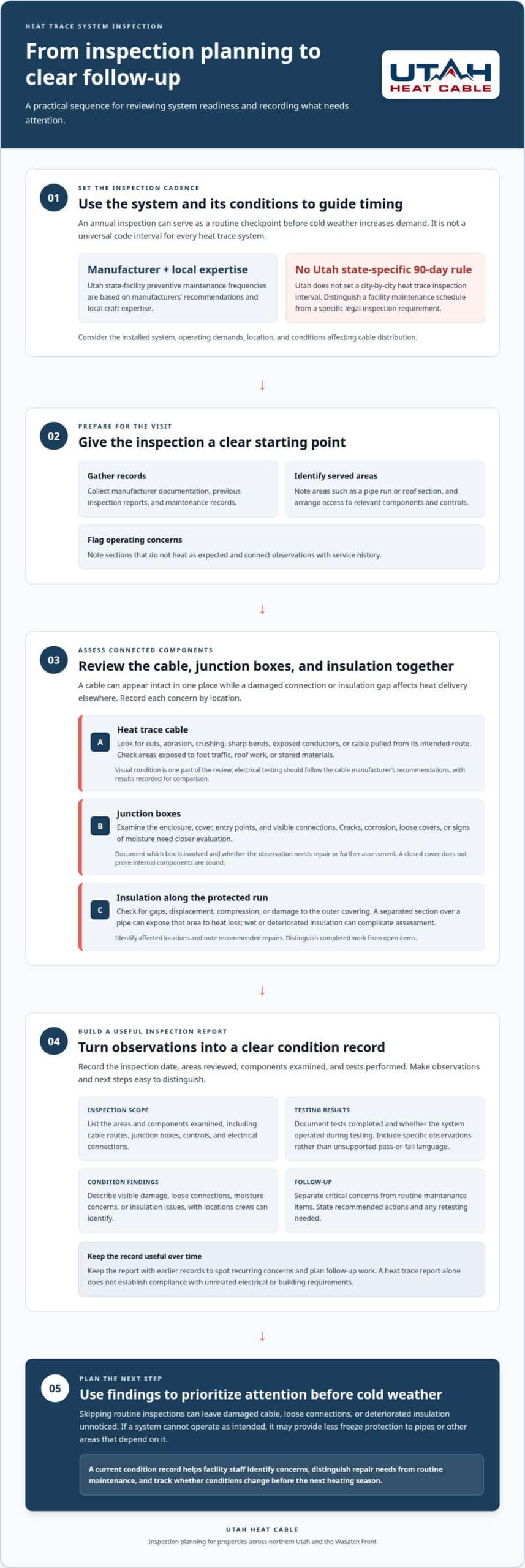
A single statewide inspection interval doesn’t fit every heat trace system. In Utah, state-facility preventive maintenance frequencies are based on manufacturers’ recommendations and local craft expertise, and Utah has no state-specific 90-day inspection requirement like California. An annual heat trace system inspection in Utah can provide a practical checkpoint, with the system’s recommendations and condition guiding the maintenance schedule.
It’s sensible to look beyond whether the cables switch on: weather exposure, damaged connections, or insulation problems can affect how reliably heat reaches the areas it’s meant to protect. This guide explains how to think about inspection timing, what an annual report can document, and how cable, junction box, and insulation condition are assessed. You’ll also see how a careful review can help identify concerns before cold weather puts the system to work across the Wasatch Front and northern Utah.
Key Takeaways
- Set inspection timing around the system manufacturer’s recommendations and local conditions, rather than assuming one interval fits every Utah property.
- Use an inspection report to capture observed condition, issues that need attention, and recommended follow-up.
- Assess cable, junction boxes, and insulation as connected parts of the system, since problems in any of them can affect reliable operation.
- For snow and ice concerns on walkways or driveways, Utah Heat Cable’s Sidewalk and Driveway Deicing Systems offer a relevant next step.
Annual inspection cadence
In Utah, inspection timing should reflect the manufacturer’s recommendations and local conditions. A scheduled review helps facility teams assess system readiness before cold weather increases demand.
Inspection Timing
An annual inspection is a routine checkpoint, not a universal code interval for every heat trace system. Utah has no state-specific 90-day heat trace inspection requirement. For Utah state facilities, preventive maintenance frequencies are based on manufacturers’ recommendations and local craft expertise. That approach aligns the schedule with the installed system, its operating demands, and conditions affecting cable distribution.
Local Inspection Requirements
Utah does not set a city-by-city heat trace inspection interval. Facility maintenance frequencies are based on manufacturer recommendations and local expertise, so the location and role of the installation matter when scheduling a review. Requirements do not establish a separate heat trace interval for each county or city. For compliance planning, distinguish a facility’s maintenance schedule from a specific legal inspection requirement.
Risks of Skipping Inspections
Skipping routine inspections can leave damaged cable, loose connections, or deteriorated insulation unnoticed. If a heat trace system cannot operate as intended, it may provide less freeze protection to pipes or other areas that depend on it. A missed review can also leave facility staff without a current condition record. These risks make an annual assessment a useful planning checkpoint, even when recommended maintenance frequencies vary.
Preparing for an Inspection
Before the scheduled visit, gather the manufacturer’s documentation, previous inspection reports, and maintenance records. Identify the areas served, such as a pipe run or roof section, and arrange access to relevant cables, junction boxes, and controls. Note operating concerns, including sections that do not heat as expected. This preparation gives the inspection a clear starting point and connects observed conditions with service history.
Annual inspection reports
A useful report turns inspection findings into a clear record of system condition. Records from an annual heat trace system inspection in Utah should identify the inspection date, areas reviewed, components examined, and tests performed. This context helps maintenance teams understand the scope and compare findings with earlier records.
Reports are most useful when observations and next steps are easy to distinguish. For example, a note about damaged cable should identify its location and explain recommended follow-up. A general statement such as “system checked” gives facility staff little direction for scheduling repairs or tracking recurring concerns. A report for an annual heat trace system inspection Utah maintenance teams conduct should make those details easy to locate.
- Inspection scope: Record the areas and components examined, including cable routes, junction boxes, controls, and electrical connections.
- Testing results: Document tests completed and whether the system operated during testing. Include specific observations rather than unsupported pass-or-fail language.
- Condition findings: Describe visible damage, loose connections, moisture concerns, or insulation issues, with locations crews can identify.
- Follow-up: Distinguish critical concerns from routine maintenance items, then state recommended actions and any retesting needed.
For compliance records, distinguish maintenance documentation from formal inspections required by regulations that apply to the facility. A heat trace report alone does not establish compliance with unrelated electrical or building requirements. Keep it with earlier records so staff can spot recurring concerns and plan follow-up work.
If a report identifies electrical concerns, request an electrical assessment from Utah Heat Cable. Clear findings can help direct the next step without treating every observation as an immediate repair.
Cable, junction box, and insulation condition
A useful evaluation examines the heat trace cable, its junction boxes, and the surrounding insulation as connected parts. A cable may appear intact in one spot while a damaged connection or insulation gap affects heat delivery elsewhere. Record each concern by location so future inspections can determine whether its condition has changed before the next heating season.
On the cable, look for cuts, abrasion, crushing, sharp bends, exposed conductors, or sections pulled away from their intended route. Pay attention to areas where foot traffic, roof work, or stored materials could cause damage. Visual condition is only one part of the review. Electrical testing should follow the cable manufacturer’s recommendations, with results recorded for comparison.
At each junction box, examine the enclosure, cover, entry points, and visible connections. Cracks, corrosion, loose covers, or signs of moisture call for closer evaluation because they may affect the connection. Document which box is involved and whether the observation needs repair or further assessment. A closed cover does not prove that internal components are sound.
Check insulation along the protected run for gaps, displacement, compression, or damage to its outer covering. For example, a separated section over a pipe may expose that area to heat loss, while wet or deteriorated insulation can complicate the assessment. The report should identify affected locations, note recommended repairs, and distinguish completed work from open items. These records help maintenance teams compare findings across seasons and prioritize follow-up.
Utah Heat Cable: Sidewalk and Driveway Deicing Systems
Utah Heat Cable offers Sidewalk and Driveway Deicing Systems for properties where snow and ice affect pedestrian routes or vehicle access. A system can be considered when recurring winter buildup on a walkway or driveway creates a maintenance concern. Its role is distinct from inspecting an existing heat trace installation: deicing addresses surface areas, while an inspection evaluates the condition and operation of installed equipment.
For properties in northern Utah and along the Wasatch Front, planning before winter allows the surface area and its use to guide the deicing approach. Utah Heat Cable also offers De-Icing Services, Roof Snow Retention, and Controller Options for related snow and ice needs. Contact Utah Heat Cable to discuss a sidewalk or driveway deicing system for your property.
Plan the Next Cold-Weather Season
An annual heat trace system inspection in Utah can turn maintenance observations into a considered plan for the next cold season. Use the findings to decide whether the current setup still suits its role, needs focused repairs, or calls for a different installation approach. This provides a practical opportunity to align maintenance decisions with the facility’s future needs.
When a system change is appropriate, Utah Heat Cable offers Self Regulating Heat Cable, Constant Wattage Heat Cable, and De-Icing Services. Matching a solution to the property’s intended use helps keep planning grounded in real needs. Across northern Utah and the Wasatch Front, early planning can help teams prepare before winter weather puts systems to work.
A clear next step can make cold-weather preparation more manageable.
Frequently Asked Questions
What is included in an annual heat trace system inspection?
An inspection reviews the installed system’s condition, operation, and maintenance needs. The scope can cover system identification, control settings, accessible cable routes, connections, and the areas served. For example, a roof system and a pipe freeze-protection system have different layouts to assess. Comparing the installation with its records helps clarify what equipment is present and which areas it protects.
How often should heat trace systems be inspected and tested?
Use the manufacturer’s maintenance recommendations and local conditions to set the inspection and testing schedule. An annual review is a useful planning point, but the appropriate frequency depends on the system and its operating environment. For example, a system exposed to roof work or repeated physical disturbance may need attention after an event rather than waiting for its next scheduled review.
What tests are performed on heat trace cables, controls, and insulation?
Testing should match the heat trace system’s design and the manufacturer’s recommendations. An evaluation can include visual cable checks, appropriate electrical measurements, and a functional check of controls to confirm their expected response. Assess insulation for gaps, displacement, or damage rather than treating it as an electrical component. The inspection record should identify the tests performed and the results for each relevant area.
What are common heat trace system failures and warning signs?
Common concerns include visible cable damage, loose or corroded connections, damaged junction-box covers, and insulation that has shifted or deteriorated. Operational clues include a control that does not respond as expected or a protected area that remains cold while the system is operating. For instance, uneven thawing along a roof edge can signal an area that needs evaluation, though it does not identify the cause on its own.
Which Utah contractors provide heat trace system inspection services?
Utah Heat Cable provides inspection, evaluation, and detailed reporting for multi-unit, condominium, HOA, and commercial sites. The company also installs heat-trace systems, so its work can address inspection findings that relate to system design or installation. For a property in northern Utah or along the Wasatch Front, this is a relevant option for documented heat-trace assessment.