
If you’re asking, “Why do i need GFEP breakers for heat cable?” the key point is that ground-fault equipment protection is intended to help protect the heat-cable equipment and its circuit. A GFCI has a different protective role, and neither device should be selected simply because it fits the panel. The correct protection depends on the cable, its installation requirements, and the electrical code that applies at the project address.
It’s reasonable to want clear answers before adding a device to your electrical panel. This article explains what GFEP protection does, how it differs from GFCI and overcurrent protection, and what to check before energizing a fixed outdoor de-icing system. Start with the cable’s model, listing, and manufacturer instructions, then ask a licensed electrician to verify the circuit and locally adopted code requirements. Use this information to ask informed questions, not as a substitute for a qualified electrician’s review.
Key Takeaways
- A GFEP detects ground-fault current to help protect heat-cable equipment and its circuit when current leaves its intended path.
- GFEP, GFCI, and overcurrent protection serve different purposes. One does not automatically replace the others.
- Identify the heat-cable model and review its listing and manufacturer instructions before confirming the protection setup.
- Ask a licensed electrician to verify requirements for the project address. Electrical codes and local amendments can vary across Utah, Idaho, and Wyoming.
Why a Heat Cable Circuit May Need a GFEP Breaker
Ground-fault equipment protection (GFEP) detects ground-fault current to help protect electrical equipment and its circuit. Heat cable operates outdoors, where damaged insulation, moisture, or an installation problem can create an unintended path for current. Because the cause may not be visible, circuit protection should be considered as part of the system design, not chosen as an afterthought.
If you’re asking, “Why do i need GFEP breakers for heat cable?” the specific answer depends on the cable and the requirements for its installation. The locally adopted electrical code, the equipment listing, and the manufacturer’s instructions all matter. Don’t assume one breaker type is suitable for every heat cable or location. Have a qualified electrician check the requirements for the project address.
What does equipment ground-fault protection detect?
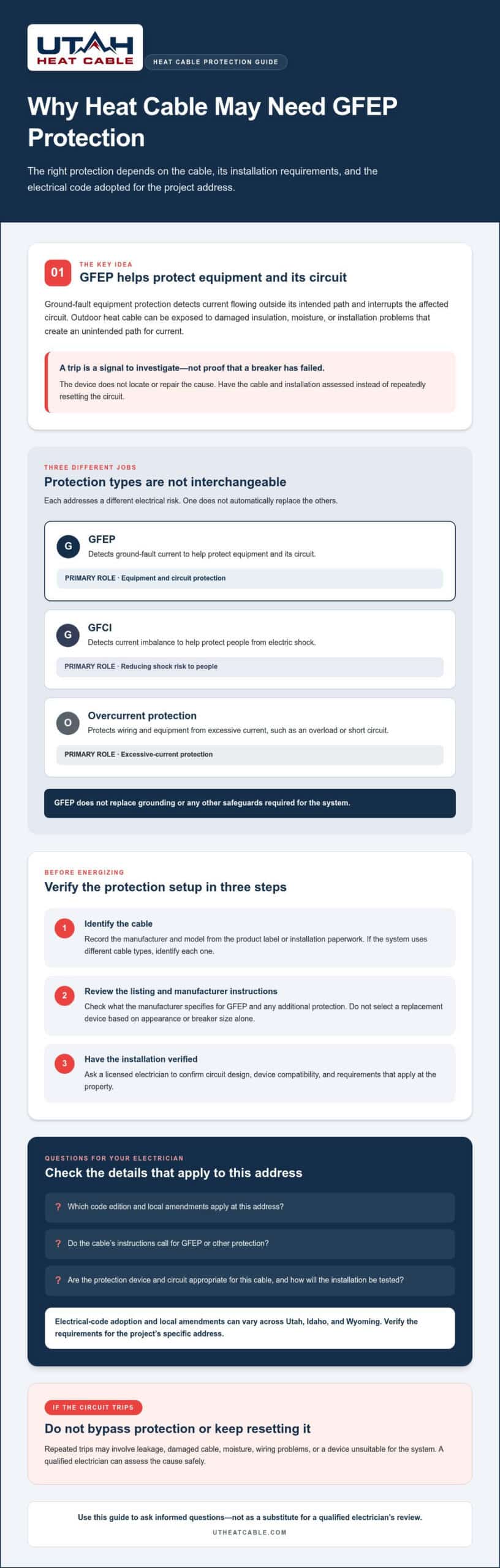
A ground-fault device responds when it detects current flowing outside its intended path and interrupts the affected circuit. It does not identify the source of the leakage or repair the underlying issue. If the circuit trips, have the cable and installation assessed instead of repeatedly resetting the device.
A GFEP works on the same basic current-imbalance principle as other residual-current devices. For background, Residual-current device (RCD) describes how these devices detect an imbalance. The protection type and settings still need to suit the specific heat-cable system.
GFEP detects ground-fault current to help protect heat-cable equipment and its circuit, but it doesn’t replace inspection or other required safeguards.
GFEP vs. GFCI: Which Protection Does Heat Cable Need?
These devices address different electrical risks, so their names aren’t interchangeable. The appropriate protection for a heat-cable system depends on the cable’s listing, manufacturer instructions, adopted code, and installation details.
| Protection | Primary role |
|---|---|
| GFEP | Detects ground-fault current to help protect equipment and its circuit. |
| GFCI | Helps protect people from electric shock by detecting current imbalance. |
| Overcurrent protection | Protects wiring and equipment from excessive current, such as an overload or short circuit. |
Grounding and any other safeguards required for the system still matter. GFEP doesn’t replace them. For additional context on the distinct roles of GFEP and GFCI, see Electrical Contractor Magazine’s GFCIs vs. GFPE. The practical answer to “Why do i need GFEP breakers for heat cable?” is that protection needs to match the equipment and its application, not just fit the panel.
Why a breaker that trips is not automatically defective
A trip is a signal to investigate, not proof that the breaker has failed. Repeated trips may involve leakage, damaged cable, moisture, wiring problems, or a device that is unsuitable for the system. An electrician can assess the cause safely.
GFEP is intended to protect equipment, while GFCI protection is intended to reduce shock risk to people. Don’t bypass protection or repeatedly reset a tripping circuit. Ask a qualified electrician to inspect the system and check the device against the cable’s instructions. For broader installation information, review heat cable safety guidance.
How to Verify GFEP Protection for a Heat Cable System
Confirm the protection setup before energizing the heat cable. Gather the system documentation, then have a licensed electrician check how the cable, circuit, and protective devices work together.
- Identify the cable. Record the manufacturer and model from the product label or installation paperwork. If the system includes different cable types, such as self-regulating or constant wattage cable, identify each one.
- Review the listing and instructions. Check what the manufacturer specifies for GFEP and any additional protection. Don’t choose a replacement device based on appearance or breaker size alone.
- Verify the installation. Ask a licensed electrician to confirm the circuit design, device compatibility, and requirements that apply at the property.
Electrical-code adoption and local amendments can vary by jurisdiction. Ask which code edition applies to the project’s specific address in Utah, Idaho, or Wyoming. The professional discussion of NEC 427.22 ground fault protection requirements can provide background, but it doesn’t replace checking the locally adopted code, the cable listing, and manufacturer instructions.
What to ask your electrician before energizing the system
- Which code edition and local amendments apply at this address?
- Do the cable’s instructions call for GFEP or other protection?
- Are the protection device and circuit appropriate for this cable, and how will the installation be tested?
- If the circuit has tripped, what should be checked to identify the cause before it’s reset?
Don’t bypass a protective device or substitute a breaker yourself. Utah Heat Cable designs and installs heat-cable and snow-melt systems, so a site-specific assessment can help connect cable selection with circuit protection. Explore heat cable products and services to learn more.
Make Your Heat-Cable Protection a Planned Decision
GFEP protection helps safeguard heat-cable equipment and its circuit, while GFCI, grounding, and overcurrent protection serve distinct roles. The right setup depends on the cable’s listing and instructions, the circuit design, and the electrical code adopted for the project address.
Still asking, “Why do i need GFEP breakers for heat cable?” Check the specific system rather than swapping breakers based on general advice. Utah Heat Cable is a licensed electrical contractor that designs custom heat-trace and snow-melt systems for properties in Utah, Idaho, and Wyoming.
For a site-specific review of your heat-cable system and its protection requirements, talk with a heat-cable specialist. Utah Heat Cable can help you plan heat-trace installation and protection before the system is energized.
Frequently Asked Questions
Why do heat cables need GFEP protection?
Heat cables may need GFEP protection because it detects ground-fault current that leaves its intended path and interrupts the affected circuit. This can help protect the equipment and circuit, but a trip doesn’t identify or repair the underlying problem. Why do i need GFEP breakers for heat cable? Exact protection requirements depend on the cable, its instructions, and the electrical code adopted for the project address.
Is a GFEP breaker the same as a GFCI breaker?
No. GFEP and GFCI devices have different protective roles: GFEP is intended to help protect equipment and its circuit, while GFCI protection is intended to reduce the risk of electric shock to people. They aren’t automatically interchangeable, and GFEP doesn’t replace grounding, overcurrent protection, or any other required safeguard. Have a licensed electrician verify the system’s requirements for your Utah, Idaho, or Wyoming address.
Can I use a regular breaker instead of a GFEP breaker for heat cable?
Not without confirming the installation requirements. A standard breaker may provide overcurrent protection, but that alone doesn’t establish that the heat-cable system has the required ground-fault protection. Suitability depends on the cable listing, manufacturer instructions, circuit design, and locally adopted electrical code. Before installing or changing a breaker, ask a licensed electrician to check those details for the project address in Utah, Idaho, or Wyoming.
What should I do if my heat cable GFEP breaker keeps tripping?
Leave the protective device in place and stop repeatedly resetting it. Don’t bypass it or substitute another breaker to keep the cable running. Repeated tripping may relate to leakage, moisture, damaged cable, wiring issues, or an incompatible device; the cause can’t be diagnosed from the symptom alone. Arrange for a licensed electrician to inspect the cable and circuit and identify the cause before restoring operation.