
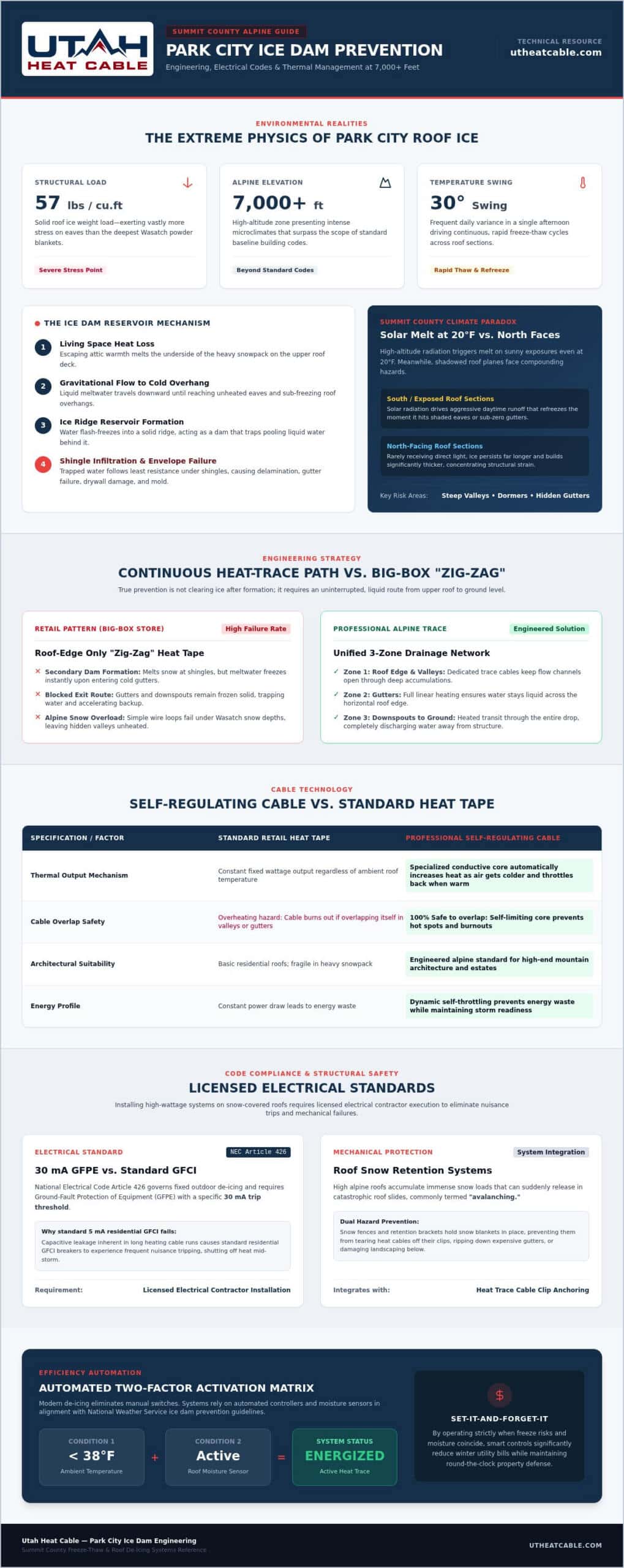
Did you know that solid roof ice weighs up to 57 pounds per cubic foot, putting far more stress on your eaves than the deepest Wasatch powder? Living in Park City means embracing world-class snow, but it also means managing the relentless freeze-thaw cycles that turn mountain homes into targets for leaks and dangerous snow slides. You’ve likely felt the frustration of watching a massive ice dam grow, knowing a costly emergency steam service is often the only temporary fix available. It’s a cycle that feels as inevitable as the winter itself.
Effective Park city ice dam prevention requires more than just basic heat tape. It demands an engineered approach tailored to our unique alpine climate. This guide explores how professional-grade, self-regulating heat trace systems and smart controllers can protect your architecture. You’ll learn to implement a permanent solution that lowers energy costs while providing total peace of mind all winter.
Key Takeaways
- Learn why the unique freeze-thaw cycles of Summit County require an engineered approach to prevent water ingress and protect your home’s structural integrity.
- Discover how professional Park city ice dam prevention creates a dedicated “heat-trace” path to move meltwater safely from your roof to the ground.
- Understand the critical performance and safety advantages of using self-regulating cables installed by a licensed electrical contractor over standard DIY heat tape.
- Find out how automated controllers and moisture sensors can significantly lower your winter utility bills while providing a reliable, set-it-and-forget-it solution.
Why Park City Homes Are Prime Targets for Ice Dams
At an elevation of 7,000 feet and above, Park City homes face environmental pressures that standard building codes don’t always fully address. An ice dam occurs when heat escaping from your living space melts the underside of the snowpack. This meltwater flows toward the unheated eaves, where it hits sub-freezing temperatures and hardens into an icy ridge. This ridge acts as a reservoir, trapping liquid water behind it. Because water follows the path of least resistance, it often finds its way under your shingles. Understanding the mechanisms of roof ice dams is essential for any homeowner. Complex architectural features like steep valleys, dormers, and hidden gutters act as magnets for these formations. Without a strategy for Park city ice dam prevention, these areas become structural weak points.
The Impact of Summit County’s High-Altitude Freeze-Thaw Cycles
Our region’s intense high-altitude sun creates a deceptive environment. It’s common for solar radiation to melt snow even when the thermometer reads twenty degrees. This “solar melt” is particularly dangerous on North-facing roof sections that rarely see direct light. Here, ice persists longer and builds significantly thicker than on other parts of the home. If left unmanaged, the resulting pressure can cause shingle delamination and gutter failure. The moisture eventually penetrates the building envelope, leading to interior mold and ruined drywall. You can find more details on these risks in our ultimate guide to ice dam prevention in Utah. Protecting your investment requires a system that accounts for these aggressive local cycles.
Engineering Effective Park City Ice Dam Prevention
True Park city ice dam prevention isn’t about clearing ice after it forms. It’s about engineering a continuous “heat-trace” path. This path ensures that meltwater originating from the upper roof has a clear, liquid route all the way to the ground. Many homeowners rely on generic “zig-zag” patterns from big-box stores, but these often fail in our deep alpine snow. A professional system treats the roof edge, gutters, and downspouts as a single drainage network. If you only heat the roof edge, water will simply refreeze in the cold gutter, creating a secondary dam that’s even harder to clear. For those researching preventing and dealing with ice dams, the focus must always be on maintaining this unobstructed exit route.
Why Self-Regulating Heat Cables are the Alpine Standard
In Summit County, the temperature can swing thirty degrees in a single afternoon. Self-regulating cables are the professional choice because they feature a specialized conductive core. This core increases its heat output as the air gets colder and throttles back as things warm up. Unlike standard retail “heat tape,” these professional cables don’t burn out if they overlap. This makes them significantly safer and more durable for high-end mountain architecture. You can learn more about this technology in our professional guide to self-regulating heat cable. For large estates, this efficiency is vital. It prevents energy waste while ensuring the system is ready for the next storm. If you want to protect your property, investing in professional de-icing systems is the most reliable long-term strategy.
Professional Installation and Long-Term System Management
Installing a high-wattage electrical system on a snow-covered roof isn’t a job for a general handyman. A licensed electrical contractor ensures your system meets National Electrical Code (NEC) standards, specifically Article 426. This code requires Ground-Fault Protection of Equipment (GFPE) with a 30 mA trip threshold. Standard residential GFCI breakers often lead to nuisance tripping because of capacitive leakage in long cable runs, but a professional installation avoids these common failures. Beyond safety, specialized installation protects your mountain architecture. We often integrate roof snow retention systems alongside heat cables. This prevents “avalanching”, where heavy snow blankets slide off all at once, which can rip cables right off the clips and damage expensive gutters and landscaping below.
Modern de-icing isn’t about leaving a manual switch on all winter. It relies on automated controllers and moisture sensors. These devices only energize the system when temperatures are below 38°F and moisture is actually present on the roof. This “set-it-and-forget-it” approach aligns with National Weather Service ice dam prevention guidelines regarding temperature management. It ensures your Park city ice dam prevention system is active only when necessary, which significantly reduces your monthly utility costs while maintaining total property protection.
Navigating Local Codes and Maintenance in Park City
Staying compliant with Summit County building codes requires more than just high-quality cables. You must ensure your system is permitted and inspected to meet local safety requirements. We recommend a “pre-winter check” every October. This protocol involves testing the sensors and checking for cable abrasions before the first major storm hits. You can find a full list of maintenance steps in our essential de-icing knowledge base. By monitoring your smart controller’s performance, you can optimize energy usage and guarantee your home remains a protective shield against the elements throughout the season.
Secure Your Mountain Home Before the Next Storm
Managing the weight and water of a Summit County winter requires more than reactive measures. Effective Park city ice dam prevention is a matter of precision engineering. By combining self-regulating heat trace systems with automated moisture sensors, you create a dedicated path for meltwater that functions reliably even in our extreme high-altitude environment. This proactive approach prevents structural damage and eliminates the need for expensive emergency removals. As a licensed electrical contractor, Utah Heat Cable specializes in custom heat-trace designs specifically built for our local alpine challenges. We ensure every system is code-compliant and ready for the deepest powder. Don’t wait for the first leak to compromise your home. Request a Custom Ice Dam Prevention Quote from Utah Heat Cable today. You’ll gain the security and peace of mind that only professional-grade protection can provide.
Frequently Asked Questions
Is it better to remove an ice dam or prevent it with heat cables?
Prevention is significantly better for your roof’s health and your long-term budget. While emergency steaming removes existing ice, it’s a reactive and expensive service that doesn’t stop the next dam from forming during the next storm. Professional Park city ice dam prevention systems create a permanent solution that protects shingles and prevents interior water damage before it starts.
How much electricity does a Park City roof heat cable system use?
Your electricity usage depends on the total cable length and the type of controller you choose. Commercial-grade self-regulating cables typically draw 6 to 8 watts per linear foot at freezing temperatures. By using automated controllers with moisture and temperature sensors, you ensure the system only runs when necessary, preventing high utility bills during dry, cold spells.
Can I install heat cables myself on a metal roof?
We don’t recommend DIY installation on any roof, especially metal surfaces. Metal roofs require specialized mounting hardware and often need integrated snow retention to prevent heavy snow slides from shearing the cables off. As a licensed electrical contractor, we ensure all outdoor circuits meet NEC safety standards for ground-fault protection, which is difficult for a non-expert to navigate safely.
What is the difference between heat tape and self-regulating heat cable?
Standard heat tape is a constant-wattage product that stays at one temperature and can pose a fire risk if it overlaps. Self-regulating heat cable uses a specialized conductive core that automatically adjusts its heat output based on the surrounding air temperature. This technology is more energy-efficient and far more durable, making it the recognized standard for challenging alpine environments in Utah.