
Heat-trace installation requirements can vary across Northern Utah and the Wasatch Front. Building code requirements depend on the codes adopted for the project’s jurisdiction and the rules in effect when the work is installed. Relevant codes may include the 2024 International Building Codes and the National Electrical Code; local jurisdictions may adopt or amend different editions, such as the 2023 edition.
Before planning work in places such as Salt Lake, Park City, Logan, or Provo Canyon, it’s reasonable to want a clear answer: building code requirements for heat trace depend on the project’s location and the system being installed. This guide explains how adopted codes and local rules shape a project, which electrical and building-code considerations matter, and how to plan with safety and compliance in mind.
Key Takeaways
- Identify which codes apply to the project’s Northern Utah or Wasatch Front jurisdiction, such as Salt Lake, Logan, Park City, or Provo, and when installation will take place; local adoption can affect the requirements.
- Understand how heat trace and insulation work together to help protect water-filled pipes from freezing.
- Consider the pipe’s exposure and installation conditions when planning protection for aboveground piping.
- Learn when Utah Heat Cable’s de-icing services, roof snow retention, controller options, or sidewalk and driveway deicing systems may fit your property’s needs.
Wyoming-adopted National Electrical Code requirements
Wyoming heat-trace projects must follow the codes adopted for the project’s location, including any local amendments. The governing code edition can depend on where and when the installation takes place.
NEC Article 427 System Requirements
NEC Article 427 is the code section to consult for electric heat-tracing systems. For a project, document the cable’s listing, installation method, and control arrangement, then compare them with the locally adopted NEC edition. This review helps identify whether the chosen equipment and design align with the requirements that apply at that site.
Improper installation can create fire hazards, damage piping, or result in code violations. Avoid treating a cable’s listing or controls as interchangeable: confirm that the system components and planned use match the project design. The specific Article 427 requirements depend on the adopted edition.
Permits and Inspections
The project’s jurisdiction administers permits and inspections. Identify the local building department and establish the permit and inspection process before work begins. Wyoming’s code-adoption rules do not create one statewide permit requirement for every heat-trace installation.
Keep the system description, equipment information, and installation plan organized for the applicable review. In Laramie County, the 2024 International Codes took effect January 1, 2025, so the project date matters when determining which adopted codes apply. The local authority’s process governs the project’s review.
Local Code Adoptions
Local code adoptions identify which building and electrical editions govern work in a particular community. Wyoming adopted the 2024 International Building Codes, including the International Building Code, Fire Code, Mechanical Code, Fuel & Gas Code, and International Existing Building Code.
Alpine lists Ordinance No. 285, 2022-03, for the 2021 International Building Code, and Ordinance No. 286, 2022-04, for the 2021 International Residential Code. In Laramie County, the 2023 National Electrical Code was approved for adoption at a public hearing on December 5, 2023. Rock Springs amends the 2023 National Electrical Code. These examples show why the project address and installation timing matter.
Freeze protection for water-filled pipe
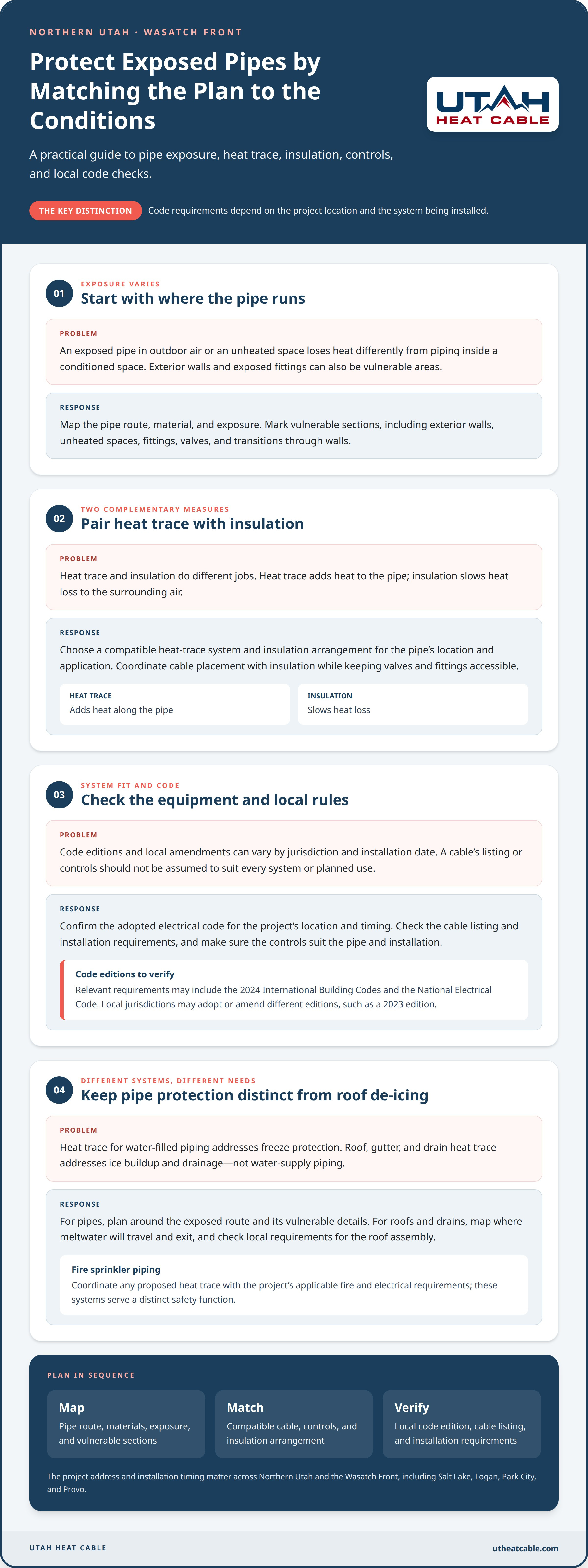
Freeze protection combines measures to limit heat loss from water-filled piping in cold conditions. Heat trace is an electrical cable installed along a pipe to add heat, while insulation slows heat loss to the surrounding air. An exposed pipe in an unheated area loses heat differently from one inside a conditioned space, so the protection plan should reflect the pipe’s location and exposure.
First map the pipe route, material, exposure, and vulnerable areas, such as exterior walls and unheated spaces. Then choose a compatible heat-trace system and insulation arrangement for the application. Controls can manage when a system operates, but their setup must suit the pipe and installation. Check the cable’s listing and installation requirements, and identify the electrical code adopted for the project’s jurisdiction and installation date.
Local design conditions provide useful context, but they don’t establish one statewide pipe-depth rule. The Town of Jackson lists a 34-inch frost-line depth in its residential design criteria. That figure is a local design reference, not a universal instruction for every pipe route or heat-trace installation. Aboveground sections still need a plan that considers their direct exposure and insulation.
For an installation, the practical sequence is to map vulnerable sections, select compatible cable and controls, and coordinate insulation with the planned layout. A pipe-trace installation can address a specific freeze-protection need; request help planning pipe protection for the conditions at your property.
Protection of aboveground piping
Aboveground piping in Northern Utah and along the Wasatch Front is exposed to outdoor air or unheated spaces rather than buried or enclosed. Because of that exposure, it may need more attention to freeze protection than piping in conditioned areas. Map exposed runs, fittings, valves, and transitions through exterior walls first. These details help identify where heat trace and insulation may be needed.
The applicable adopted codes and local requirements govern heat trace on fire sprinkler piping. Requirements may vary across Northern Utah and Wasatch Front communities, including Salt Lake, Logan, Park City, and Provo. Because these systems serve a distinct safety function, coordinate their design and any proposed heat trace with the project’s applicable fire and electrical requirements.
Roof, gutter, and drain heat trace addresses ice buildup and drainage, not water-filled supply piping. Electrical work must comply with the adopted electrical code and local amendments, and the project location determines the relevant code edition. In cities such as Bountiful, Draper, and North Ogden, check local requirements for the roof assembly. These requirements are separate from heat-trace rules.
Before selecting a system for an aboveground run, document its route, nearby materials, exposure, and connection points. Coordinate cable placement with insulation, while keeping valves and fittings accessible. For roofs and drains, map where meltwater will travel and exit. These details help tailor the plan to the actual pipe or roof area instead of treating every exposed surface alike.
Utah Heat Cable
Utah Heat Cable helps property owners address cold-weather concerns with de-icing and snow-management systems. If you’re comparing Wyoming code requirements with protection needs at a northern Utah property, keep the distinction clear: the local code adoption governs the project, while the property’s exposure and layout shape the protection plan.
Utah Heat Cable installs roof de-icing systems, roof snow retention, controller options, and sidewalk and driveway de-icing systems. Each addresses a different need, from managing snow on a roof to reducing ice on outdoor walking and driving surfaces. Choose an approach based on the area to protect and how it is used.
For a cold-weather protection project in the Wasatch Front or nearby northern Utah communities, contact Utah Heat Cable for a free consultation and quote.
Plan the Next Step With Confidence
Before work begins, turn the code review into a practical project record. Note the installation location, system purpose, selected cable, controls, and applicable local requirements. This connects design choices to the property’s needs instead of treating every pipe or roof area alike.
For projects in Salt Lake, Park City, Logan, and other Northern Utah and Wasatch Front communities, use applicable local building code requirements for heat trace as a planning checkpoint alongside project-specific electrical and building-code review. Utah Heat Cable installs self-regulating and constant-wattage heat cable and provides de-icing services for cold-weather protection. Start by matching the system to the area you need to protect.
A clearly defined scope makes it easier to discuss the work and plan property protection. When you’re ready, request a free consultation and quote from Utah Heat Cable.
Frequently Asked Questions
Which building, plumbing, and electrical codes are currently adopted in Wyoming?
Wyoming has adopted the 2024 International Building Code, Fire Code, Fuel Gas Code, Mechanical Code, and International Existing Building Code. For a project in Park City or Logan, Wyoming’s adopted editions aren’t the applicable starting point; the project location in Utah determines which local code adoption to consult. Keep the state and project jurisdiction clear when comparing code requirements across the border.
Do Wyoming building codes require heat tracing for water pipes in unheated or exposed areas?
Building code requirements for heat trace in Wyoming depend on the codes adopted for the project’s location and the installation conditions. An exposed pipe alone does not determine whether heat tracing is required. For a Northern Utah property, assess the applicable requirements under its Utah jurisdiction rather than applying a Wyoming interpretation across state lines.
What insulation and freeze-protection requirements apply to plumbing pipes under Wyoming code?
Applicable plumbing provisions depend on the project jurisdiction and its adopted code edition. For a pipe near an exterior wall or in an unheated space, account for its route and exposure when considering insulation and freeze protection. Evaluate a Park City or Salt Lake property under its own local requirements rather than assuming they match Wyoming’s.
What electrical code requirements apply to heat-trace cables, including GFCI protection and dedicated circuits?
Electrical requirements follow the locally adopted National Electrical Code and any applicable local amendments. Assess GFCI protection and circuit arrangements for the specific heat-trace installation instead of assuming they are identical across projects. The same distinction applies to Wasatch Front properties: use the code adoption applicable to the Utah project, not a Wyoming edition by default.
Do Wyoming cities and counties have local amendments or heat-trace requirements?
Wyoming jurisdictions may adopt different code editions or amendments, so building code requirements for heat trace can vary by project location. For a Northern Utah installation, determine the applicable local adoption in that Utah jurisdiction separately. Comparing a Wyoming project with one in Heber or Bountiful helps clarify which location’s rules apply to each scope of work.