
Commercial buildings in Jackson, Wyoming, need winter protection suited to their pipes, roofs, and drainage systems. Heat trace for commercial buildings in Jackson, WY uses cables to provide controlled heat to pipes and other surfaces, helping protect water lines and fire-suppression systems from freezing. On roofs and in gutters, heat trace helps manage ice dams and snow buildup.
Insulation slows heat loss, but by itself may not prevent pipes from freezing or maintain the temperature a system requires. The right setup depends on pipe material, exposure, and operating needs. This article explains how self-regulating and constant-wattage cables differ, where heat trace supports pipe temperature maintenance and roof de-icing, and what to consider when planning a commercial system. Coordinating the cable, controls, and installation with the building’s needs helps shape effective winter protection.
Key Takeaways
- Match the cable type to the building’s temperature needs and how evenly heat must be maintained.
- Account for pipe material, outdoor exposure, and operating conditions when planning a system.
- Consider roof and gutter de-icing as part of a coordinated winter protection plan for the property.
- Use system design and controller options to align heat trace with the building’s specific needs.
Pipe freeze protection and temperature maintenance
Electrical heat trace delivers controlled heat to pipes and equipment exposed to cold. For commercial buildings in Jackson, it can help protect pipes from freezing and maintain process temperatures.
Pipe and Equipment Freeze Protection
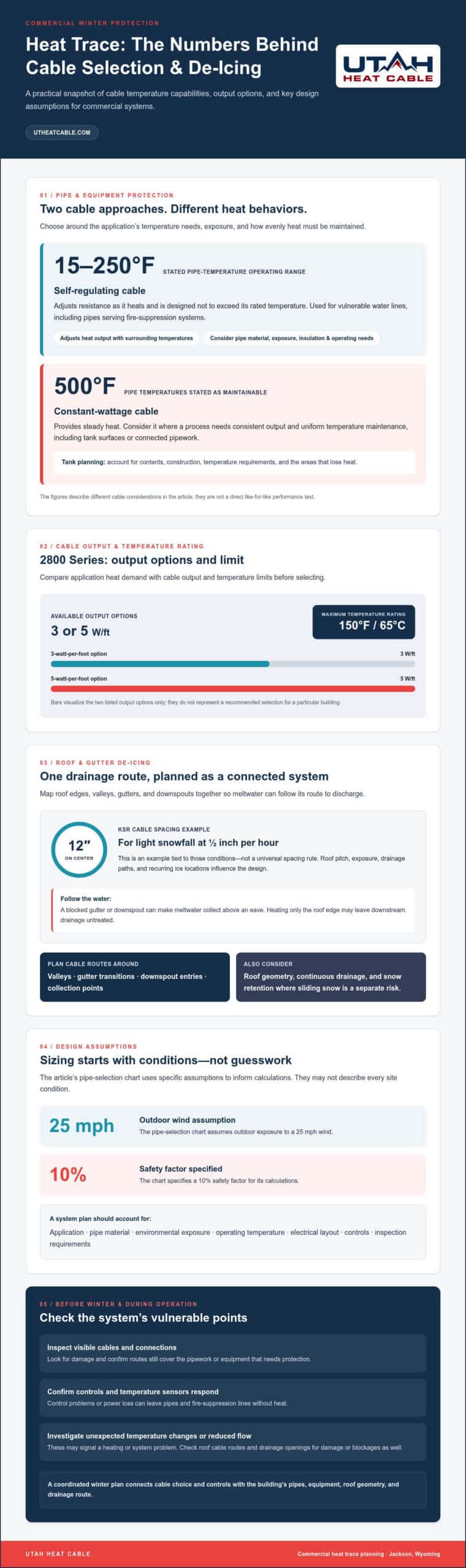
Self-regulating cable adjusts its resistance as it heats and is designed not to exceed its rated temperature. The stated operating range for pipe temperature is 15°F to 250°F. Use it to add heat along vulnerable water lines, including pipes serving fire suppression systems. When planning coverage, account for pipe material, outdoor exposure, insulation, and operating needs. Include exposed equipment connected to the line, since cold sections can interrupt flow even when nearby pipe is protected.
Tank Heating and Freeze Protection
Tanks need a heating plan that accounts for their contents, construction, and temperature requirements. Heat trace can help limit freezing and support temperature maintenance on tank surfaces or connected pipework. Constant wattage cable provides steady heat and can maintain pipe temperatures up to 500°F. That makes consistent output a consideration where a process needs uniform heating. Identify the areas that lose heat, then match cable type and coverage to the tank’s operating conditions.
Safety, Maintenance, and Failure Modes
Plan for electrical safety, cable damage, control problems, and power loss. A damaged cable or failed control can leave a pipe or fire-suppression line without heat. Before winter, inspect visible cables and connections, and confirm that controllers and temperature sensors respond as intended. Check whether pipework or equipment changes have left any sections uncovered. During operation, investigate unexpected temperature changes or reduced flow promptly, as these may indicate a heating or system problem.
Heat trace design accounts for pipe material, environmental conditions, and operating needs. Self-regulating heat-trace cable adjusts its heat output in response to surrounding temperatures, helping maintain fluid flow in cold conditions.
Roof and gutter de-icing
Roof heat trace helps manage snow and ice where meltwater could refreeze. For heat trace for commercial buildings in Jackson, WY, map roof edges, valleys, gutters, and downspouts as one connected drainage route. A blocked gutter or downspout can cause meltwater to collect above an eave. Complex commercial rooflines need careful planning because runoff may cross from a warmer area into a colder one.
Cable placement should reflect roof shape and snowfall conditions, not a single spacing applied everywhere. A guide gives KSR cable spacing of 12 inches on center for light snowfall at ½ inch per hour. This example is tied to those conditions, not a universal layout. Roof pitch, exposure, drainage paths, and recurring ice locations all influence the design. A heat trace layout for commercial buildings in Jackson, WY should also follow meltwater through gutters and downspouts to its discharge point.
At an industrial property, identify valleys, gutter transitions, downspout entries, and other spots where water could collect. Plan cable routes to address those areas. Heating only the roof edge may leave downstream drainage untreated. Roof snow retention may also be appropriate where sliding snow poses a separate risk. Before winter, inspect visible cable routes and drainage openings for damage or blockages. Consider the roof and drainage layout together when planning commercial de-icing.
Properties with process piping may need cold-weather measures beyond roof drainage. Insulation alone cannot prevent pipes from freezing or ensure fluid flows efficiently in cold conditions. Electrical heat trace helps maintain industrial fluid temperatures and consistent product quality. These process-piping considerations complement, but do not replace, attention to the connected drainage route on the roof and in the gutters.
Heat trace design and supply
Design begins with the application, exposure, and operating temperature. For heat trace for commercial buildings in Jackson, WY, coordinate cable selection with each area that needs protection.
Heat Trace System Types
Commercial systems may use self-regulating or constant-wattage cable for pipes and equipment, while roof and drainage plans address ice buildup. Start by identifying the need: freeze protection, temperature maintenance, or de-icing. Pipe material, environmental exposure, and operating requirements all shape the design. A building may need one approach for its pipework and another for roof drainage.
Cable Types and Comparisons
Self-regulating cable adjusts resistance as it heats and is designed not to exceed its rated temperature. Constant-wattage cable delivers steady heat for uniform temperature maintenance. The 2800 series has 3- and 5-watt-per-foot options and a maximum temperature rating of 150°F/65°C. Compare the application’s heat demand with cable output and temperature limits before selecting.
Sizing and Installation
List each run requiring protection, including pipes, tanks, roof edges, gutters, downspouts, and drains. The pipe-selection chart assumes outdoor exposure to a 25 mph wind and specifies a 10% safety factor. These assumptions inform calculations, not every site condition. A heat-trace plan for commercial buildings in Jackson, WY should also account for roof geometry and continuous drainage routes.
Codes, Permits, and Inspections
Applicable requirements and permits depend on the project scope and jurisdiction. Installation planning includes electrical layout, controls, and inspection requirements. Energy use depends on cable output, operating hours, and control settings; incentives likewise depend on current program terms and project eligibility. Local installation and service options should be considered as part of project planning.
Utah Heat Cable: De-Icing Services
Utah Heat Cable provides De-Icing Services for properties addressing winter ice. For roof edges and drainage routes, Roof Snow Retention and Controller Options can form part of a broader snow and ice management plan. Sidewalk and Driveway Deicing Systems address ice on entrances, walkways, and vehicle access areas.
Choose options based on the areas where ice could disrupt access or drainage. Matching the service to the affected surfaces keeps the plan focused: roof snow management for roof concerns, and de-icing systems for sidewalks or driveways. Contact Utah Heat Cable to discuss your building’s de-icing needs or visit utheatcable.com.
Plan Winter Protection Before the Next Cold Snap
Start with the building’s priorities: identify vulnerable systems, define operating needs, and match cable selection to the areas requiring protection. For heat trace for commercial buildings in Jackson, WY, planning ahead of winter gives property teams time to coordinate the design with site conditions and maintenance routines.
Utah Heat Cable offers Self Regulating Heat Cable, Constant Wattage Heat Cable, and De-Icing Services for different heating and ice-control needs. The next step is to explore the available options and consider which applications matter most for your property. Explore heat trace and de-icing options and take a practical step toward a more prepared winter season.
Frequently Asked Questions
How is heat trace designed for Jackson, Wyoming’s winter temperatures and snow loads?
Design takes account of the building’s exposure, roof shape, drainage route, and operating requirements for the protected system. On roofs, cable placement follows areas where snowmelt could refreeze, including gutters and downspouts. Heat trace helps manage ice and meltwater, but does not carry structural snow loads. Roof snow retention addresses snow movement separately, so consider both needs in the property’s winter protection plan.
What are the energy costs and efficiency considerations for commercial heat trace?
Energy use depends on cable output, operating hours, and control settings. Match the cable and controls to the building’s heating needs.