
What if the snow fence you picture along a highway could also help manage a dangerous slide from your roof? If you’ve asked, “What is Snow fence?” the answer depends on what you need to protect. Ground-based fences slow wind and guide drifting snow away from driveways and walkways. Roof snow-retention systems hold snow on a roof so it is less likely to slide off all at once.
In Utah, Idaho, and Wyoming, windblown drifts and roof slides can affect access to a property and put people, gutters, and landscaping at risk. This guide explains how ground fences and roof systems differ, what to consider when choosing roof snow retention, and how it can work alongside heat cable. The right approach depends on your roof, drainage, and site conditions.
Key Takeaways
- What is Snow fence? It’s a snow-control barrier. The right type depends on whether you need to manage ground-level drifts or restrain snow on a roof.
- Roof pitch and roofing material are important when assessing roof snow-retention options.
- Consider where snow could fall and where meltwater will drain, including near entrances, walkways, gutters, and landscaping.
- Professional installation can help reduce the risk of poorly fitted roof snow guards causing leaks or roof damage.
What is Snow fence? Understanding the Physics, Function, and Types
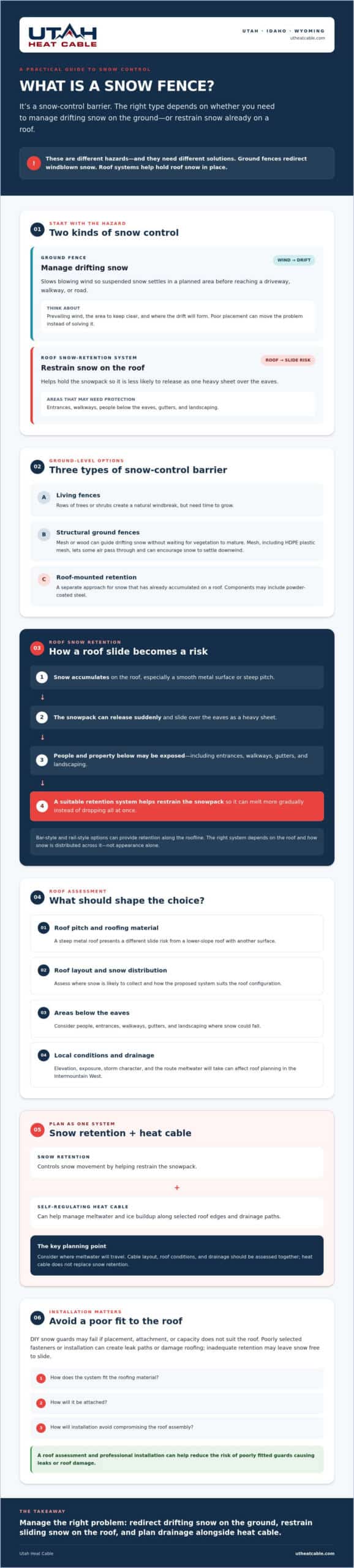
What is Snow fence? It’s a barrier that helps control where snow accumulates by changing how wind moves or by holding snow in place. A ground fence slows blowing wind, encouraging suspended snow to settle in a planned area before it reaches a driveway or road. Its location matters: the aim is to form a drift where it won’t block access or create another hazard. The Snow fence overview explains the relationship between wind, barriers, and drifting snow.
Snow-control barriers generally fall into three categories: living fences made from rows of trees or shrubs, structural ground fences made from mesh or wood, and roof-mounted snow-retention systems. Living fences can create a natural windbreak, but take time to grow. Structural ground fences can guide drifting snow without waiting for vegetation to mature. Roof systems have a different job: they help restrain snow that has already accumulated on a roof.
Ground-Based vs. Roof-Mounted Snow Fences
Ground fences manage windblown snow across open areas. Mesh, including mesh made from HDPE plastic, lets some air pass through. This can reduce wind speed and encourage snow to settle downwind. Before choosing a location, consider the prevailing wind, the area you want to keep clear, and where the drift is likely to form. Poor placement can shift the problem rather than solve it.
Roof-mounted systems manage snow that could slide off in a heavy sheet, particularly from smooth metal roofs or steep pitches. Snow-retention components, which may include powder-coated steel, act as a brake to restrain the snowpack. This can help protect people below, as well as gutters and landscaping. A ground fence redirects drifting snow; a roof system addresses the separate risk of snow sliding off the building. In Utah, Idaho, and Wyoming, roof snow retention may also be planned alongside heat cable to help manage winter buildup around roof edges.
Roof Snow Fences: Preventing Dangerous Roof Slides
On a metal roof, accumulated snow can release suddenly and slide over the eaves in a heavy sheet. A roof snow fence, also called a snow-retention system, helps hold the snowpack in place so it can melt more gradually instead of dropping all at once. This matters near entrances and walkways, where someone may pass below, and around gutters and landscaping that could be damaged by a sudden slide.
The Critical Role of Snow Retention for Metal Roofs
Metal’s smooth surface can make sudden snow slides a concern, especially on steep roof pitches. The right system depends on the roof and how snow is distributed across it. Bar-style and rail-style options can provide retention along the roofline, but appearance is only one consideration. Ask how the proposed system suits your roofing material, roof layout, and the areas below the eaves. For more detail, see Snow Retention for Metal Roofs: Safety & Performance.
People asking, “What is Snow fence?” may be thinking of mesh beside a road, but roof retention addresses a different hazard: snow already on the roof. A properly designed system helps restrain the snowpack instead of allowing it to release as one mass. As snow melts, water still needs a clear drainage path. Heat cable may help manage ice buildup in selected areas, but it does not replace snow retention.
For roof and site planning in the Intermountain West, the Wyoming State Forestry Division’s Living Snow Fence Program offers a look at tree-based windbreaks, a separate way to manage blowing snow. To explore roof snow retention and related heat-trace options, review roof snow retention services.
Choosing and Installing Snow Fences in the Intermountain West
Choosing roof snow retention isn’t a one-size-fits-all decision. The system needs to suit the roof’s pitch, roofing material, and the snow loads it must manage. A steep metal roof presents a different snow-slide risk from a lower-slope roof with another surface. Local conditions matter too: elevation, exposure, and the character of a storm can affect how snow accumulates. In Utah, Idaho, and Wyoming, a roof assessment can help identify where snow is likely to collect, where it could slide, and which areas below need protection.
DIY snow guards may fail if their placement, attachment, or capacity doesn’t suit the roof. Poorly selected fasteners or installation can create leak paths or damage roofing, while inadequate retention can leave snow free to slide. Before work begins, ask how the system fits the roofing material, how it will be attached, and how the installation will avoid compromising the roof assembly.
Integrating Snow Fences with Heat Cable Systems
Snow retention controls snow movement, while self-regulating heat cable can help manage meltwater along selected roof edges and drainage paths. Plan the two systems together. Retaining snow without considering where meltwater will travel may contribute to ice buildup. Cable layout, roof conditions, and drainage should be assessed as part of the design, not treated as afterthoughts.
If you’re asking, “What is Snow fence?” for a home in Utah, Idaho, or Wyoming, consider how snow retention and drainage will work together on your specific roof. Utah Heat Cable is a licensed electrical contractor specializing in roof snow-retention and heat-trace systems. Its team designs solutions for residential, commercial, industrial, and HOA properties. When discussing your roof, ask how retention and heat cable can be coordinated for its material, pitch, and drainage paths.
Prepare Your Roof for the Next Snowfall
What is Snow fence? On a roof, it’s a snow-retention system that helps control snow movement and reduce the risk of sudden slides. The right design depends on roof pitch, roofing material, and local winter conditions. Ground fences manage windblown drifts, while roof-mounted systems help protect people, gutters, and landscaping from shedding snow.
Snow retention can also be considered alongside heat cable to help manage winter buildup and drainage. Because installation must suit the roof, professional guidance can help you assess the options for your property. Utah Heat Cable specializes in roof snow retention and heat-trace systems for properties in Utah, Idaho, and Wyoming. Contact Utah Heat Cable to discuss a custom snow-retention system for your property.
Frequently Asked Questions
Do I really need a snow fence on my roof?
Roof snow retention may be worth assessing if snow could slide from your roof onto an entrance, walkway, parked vehicle, gutters, or landscaping. It is especially relevant on smooth metal roofs and steep pitches. The right approach depends on the roof material, pitch, and local snow conditions in Utah, Idaho, or Wyoming. A qualified professional can evaluate the risks around your property.
How far back from the road should a ground snow fence be placed?
Placement depends on fence height, prevailing wind, terrain, and the area you’re protecting. As a general principle, a ground snow fence is placed upwind of the road or driveway, far enough away for the drift to form before reaching it. The research guidance suggests a distance of at least 35 times the fence height, but local site conditions can affect the layout.
Will a snow fence cause ice dams to form on my roof?
A roof snow-retention system doesn’t automatically cause ice dams, but retained snow and meltwater need to be considered together. If water can’t drain properly, ice may build up. Roof design, insulation, ventilation, and weather conditions also affect ice-dam risk. In Utah, Idaho, and Wyoming, have the retention layout and drainage plan assessed together. Heat cable may help manage ice in selected areas.
What is the difference between a snow guard and a snow fence?
Both terms can describe roof snow-retention equipment, but “snow guard” often refers to individual pieces or small components, while “snow fence” commonly describes a continuous bar or rail system. Both are intended to restrain snow and reduce sudden slides, not to remove snow from the roof. If you’re asking, “What is Snow fence?” on a roof, it’s a retention system rather than a ground-level drift barrier.