In Park City, a single winter storm can dump more than two feet of snow on your roof, turning a minor oversight into a massive structural liability. You already know that managing a large-scale property in Climate Zone 6 requires more than just standard maintenance. It requires a proactive defense against the 300 inches of annual snowfall we face every year. This guide will show you how to implement a long-term, automated strategy for commercial roof deicing Park City businesses can rely on to meet the updated July 2026 Utah State Construction Code while slashing energy waste.
We understand the pressure of keeping your tenants safe and your overhead low. High energy bills from inefficient heat tape and the constant worry of falling icicles over your main entrances are risks you can’t afford to take. We’ll walk through the latest 2026 NEC standards for wiring clearances and explain why custom-engineered self-regulating heat cables are the gold standard for industrial ice prevention. By the end of this article, you’ll have a clear roadmap for achieving code compliance and reducing your liability through professional-grade protection.
Key Takeaways
- Understand how Park City’s 2026 building codes and high-altitude micro-climates dictate the specific engineering requirements for industrial roof safety.
- Compare the long-term energy efficiency of self-regulating heat cable against constant wattage options to protect your operational budget.
- Discover specialized drainage solutions for flat TPO roofs and snow retention strategies to prevent the “avalanche effect” on commercial metal buildings.
- Learn how automated controller options and advanced moisture sensors eliminate energy waste and reduce the need for manual system monitoring.
- Identify why professional commercial roof deicing Park City requires a licensed electrical contractor to ensure proper system design and liability protection.
Commercial Roof De-icing in Park City: Navigating High-Altitude Risks
Professional commercial roof deicing Park City projects require a shift in mindset from simple property maintenance to precision industrial engineering. While a homeowner might pick up a roll of retail-grade heat tape at a big-box store, commercial properties face entirely different stakes. Industrial systems utilize advanced electric heat tracing technology designed to handle the massive thermal loads found on large-scale facilities. These systems aren’t just accessories; they’re essential components of a building’s safety and structural integrity.
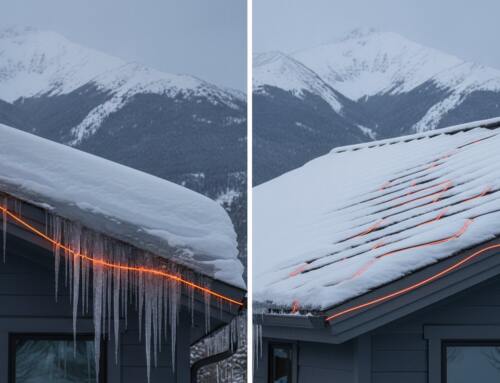
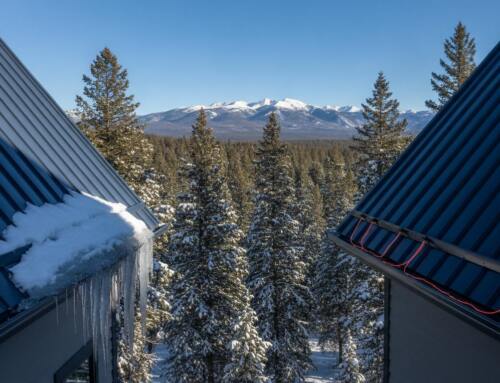
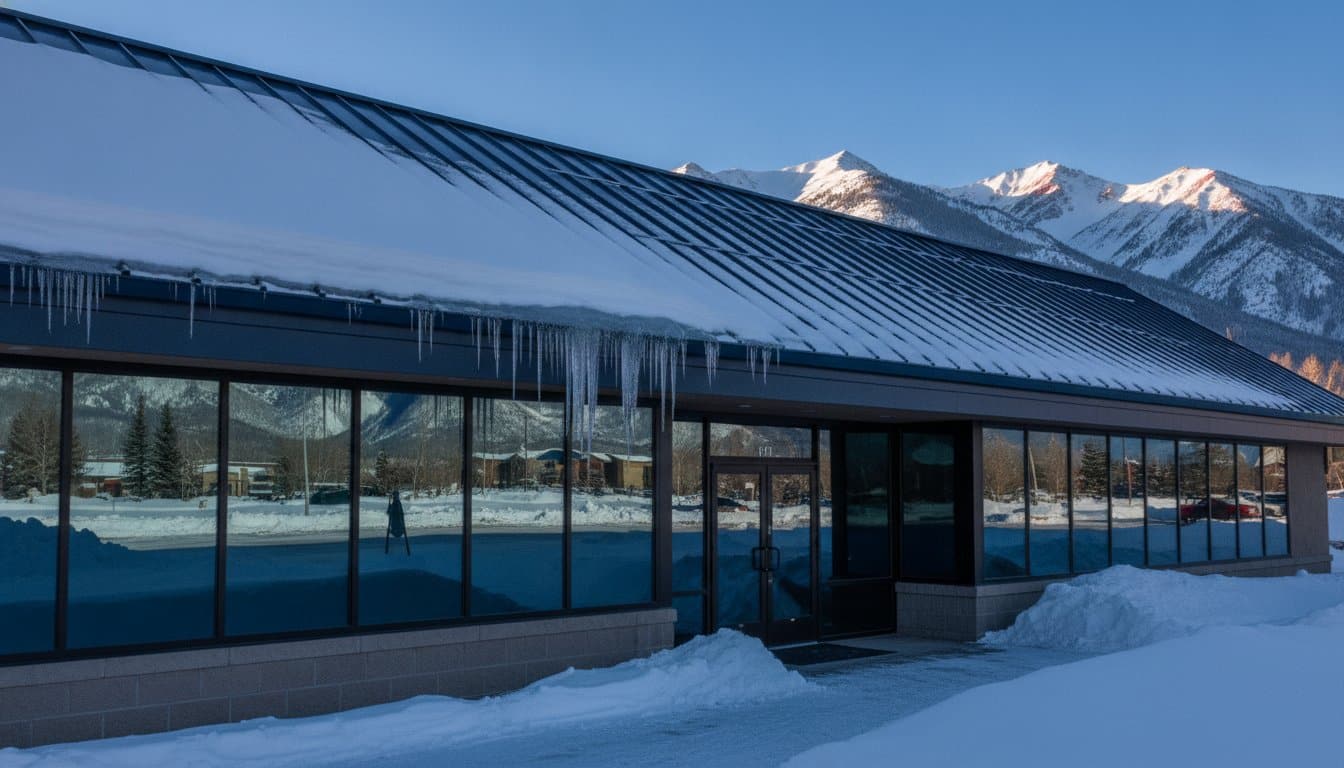
Park City’s elevation, ranging from 7,000 to over 9,000 feet, places it in IECC Climate Zone 6. This high-altitude environment creates unique micro-climates where the sun’s intensity can melt snow on south-facing roof slopes even when the air temperature remains well below freezing. When that meltwater reaches the shaded, north-facing eaves or cold parapet walls, it flash-freezes. Over a winter that averages 300 inches of snowfall, this cycle creates thousands of pounds of ice that can buckle steel supports or shear off gutters. Beyond structural concerns, the liability of falling icicles over commercial entrances or loading docks is a risk no business owner should ignore.
The Anatomy of a Commercial Ice Dam
On a large-footprint commercial roof, ice dams don’t just form at the edges. They often develop around internal drains, HVAC curbs, and parapet walls. Internal building heat loss from warehouses or multi-story offices warms the roof deck from below, melting the bottom layer of a heavy snowpack. This water flows toward the drainage system, but if the drains or scuppers are frozen solid, the water pools and refreezes. This creates a “reservoir effect” where standing water can back up under roofing membranes, leading to catastrophic leaks that aren’t visible until the damage is done to the interior inventory or equipment.
Park City Building Codes and Safety Standards
Compliance is a moving target that requires professional oversight. As of July 1, 2026, Utah House Bill 65 has updated the State Construction Code to align with the 2024 International Building Code (IBC). These updates emphasize more stringent building envelope requirements to reduce heat loss, which directly impacts how de-icing systems must be designed. Additionally, the 2026 National Electrical Code (NEC) Section 300.6(E) now mandates that all wiring methods must stay at least 1.5 inches from the roof decking to prevent damage from fasteners.
Hiring a licensed electrical contractor isn’t just about following the law; it’s about protecting your investment. Most commercial roof warranties are voided if de-icing cables are installed by unlicensed personnel or in a way that damages the membrane. A professional installation ensures your system meets the Park City 2026 Supplemental Standard Plans, providing a safe, automated solution that stands up to rigorous municipal inspections.
Industrial Heat Cable Selection: Self-Regulating vs. Constant Wattage
Choosing the right heating element is the single most important factor in determining your system’s long-term performance and operating costs. In the context of commercial roof deicing Park City properties require, the cable acts as the engine of the entire installation. If the engine is underpowered or inefficient, the system will either fail to clear ice or drain your maintenance budget through excessive utility bills. Understanding the technical differences between self-regulating and constant wattage cables allows you to make an informed investment that protects your facility for decades.
The Mechanics of Self-Regulating Technology
Self-regulating heat cable is the industry standard for high-altitude environments because of its internal “brain.” The cable features a specialized conductive core between two parallel bus wires. As the ambient temperature drops, the core contracts, creating more electrical paths and increasing heat output. When the sun hits the roof and temperatures rise, the core expands and reduces its power consumption. This internal adjustment is essential because it prevents the system from wasting energy during the warmer hours of a typical five-month Park City winter.
Because the cable responds to local temperature changes along every inch of its length, it provides heat only where it’s needed. This technology is foundational for managing how ice dams form on complex commercial structures with varying sun exposures. Self-regulating heat cable typically operates within a range of 5 to 10 watts per foot, automatically throttling its power consumption as the roof surface warms. Unlike older technologies, these cables won’t overheat or burn out if they happen to overlap in a gutter or drain, making them significantly safer for TPO and EPDM membranes.
Commercial Grade vs. Retail Grade Cables
It’s tempting to look at retail-grade “heat tape” as a cost-saving measure, but these products are not designed for industrial snow loads. Retail cables often use thin plastic jackets that become brittle under the intense UV radiation found at 7,000 feet. In contrast, professional-grade cables utilize fluoropolymer outer jackets that resist chemical exposure and mechanical damage. While a big-box store product might last two or three seasons, an industrial-grade system from a specialist like Utah Heat Cable is built to provide reliable protection for 10 to 20 years.
Constant wattage cable still has a place in specific industrial applications where a consistent, high-power thermal output is required regardless of the temperature. These are often used in massive internal drains or areas where extreme ice buildup is guaranteed. However, because they don’t “turn down” when the weather warms, they require sophisticated external controllers to prevent astronomical energy waste. For most Park City businesses, a custom-designed self-regulating system offers the best balance of safety, durability, and return on investment.
Custom De-icing Solutions for Flat and Metal Commercial Roofs
The architectural variety of commercial properties in Summit County means a one-size-fits-all approach to commercial roof deicing Park City installations simply won’t work. A flat-roofed medical plaza faces entirely different hydrological risks than a steep-pitched metal warehouse. To ensure long-term asset protection, your de-icing strategy must be tailored to the specific drainage mechanics and material properties of your roofing system. Whether you’re managing a TPO membrane or a standing-seam metal deck, the goal remains the same: controlled melt and safe snow management.
Flat Roof Ice Mitigation and Drainage
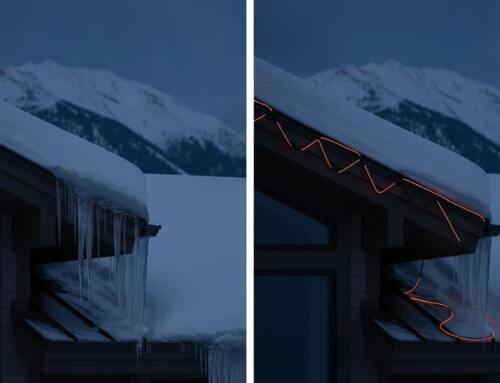
Flat roofs, often finished with TPO or EPDM membranes, rely on a network of internal drains and scuppers to shed water. When temperatures fluctuate in Park City’s high-altitude environment, these drainage points become the primary failure zones. If an internal drain freezes, it creates an ice plug that prevents meltwater from escaping. This leads to massive ponding on the roof surface. The weight of this standing water, combined with the expansion of freezing ice, is the leading cause of membrane punctures and structural leaks. Our custom heat-trace designs focus on creating “melt paths” that lead directly to these drains, ensuring that water always has an exit route, even in sub-zero conditions.
- Internal Drains: We install self-regulating heat cable deep into the drain pipe to prevent the “plug” effect.
- Scuppers: Perimeter scuppers are high-risk areas where ice buildup can block the entire drainage flow.
- Equipment Protection: Rooftop HVAC units often shed heat, causing localized melting that refreezes into “ice islands” around the equipment base.
Commercial Snow Retention for Metal Roofs
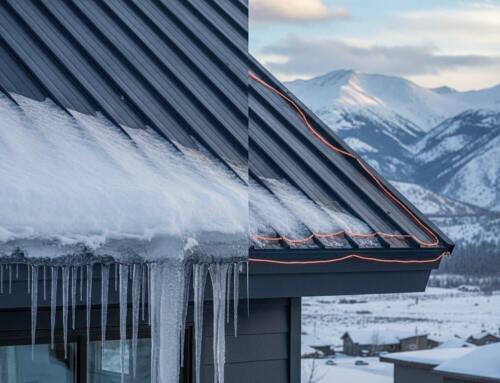
Metal roofs are notorious for the “avalanche effect,” where an entire season’s snowpack can slide off the slick surface in a matter of seconds. On a large-span commercial warehouse, this mass can weigh several tons, posing a lethal threat to anyone near entryways or loading docks. To manage this, we integrate Roof Snow Retention systems with our heat cable layouts. Snow guards act as a mechanical brake, holding the snowpack in place while the heat cable creates controlled melt channels at the eaves. This dual-system approach prevents the sudden release of snow while ensuring that ice doesn’t build up behind the snow guards.
Calculating the shear force is a critical part of the design process. We analyze the roof pitch and the expected snow load to determine the exact placement of snow guards. When these mechanical barriers are paired with professional de-icing, the result is a comprehensive safety shield that protects your property, your employees, and your bottom line from the unpredictable nature of Utah winters. By addressing these specific structural challenges, you can avoid the costly repairs and liability claims that often follow a heavy storm cycle.
Maximizing ROI: Automated Controllers and Energy Efficiency
Investing in high-grade heating cable is only half the battle. Without an intelligent control strategy, a large-scale commercial system can quickly become a financial liability. Many facility managers still rely on manual on/off switches, which are prone to human error. If the system stays on during a clear, sunny afternoon in Park City, you’re essentially burning money. Conversely, if a staff member forgets to engage the system before a heavy overnight freeze, the resulting ice buildup can overwhelm the cables once they’re finally activated. Automated systems remove this risk by reacting in real-time to environmental changes.
Advanced Controller Options for Park City Businesses
Modern commercial roof deicing Park City systems utilize sophisticated Controller Options that take the guesswork out of winter management. These devices use a combination of ambient temperature and moisture sensors to determine exactly when the roof needs heat. Ambient-sensing technology monitors the air temperature, while gutter-mounted moisture sensors detect the actual presence of snow or meltwater. By using automated sensors to trigger the system only when moisture is present and temperatures are near freezing, you can reduce energy costs by up to 70% compared to manual systems.
For large industrial buildings, multi-zone controllers are essential. These allow you to manage different sections of a facility independently. For example, a north-facing loading dock may require heat long after a south-facing entrance has cleared. Additionally, high-performance controllers feature soft-start logic. This gradually applies power to the cables, protecting your electrical panel from the massive power surges that can occur when miles of cold cable are suddenly energized. If you want to optimize your property’s performance, you can explore our professional controller options to find a solution tailored to your building’s footprint.
Maintenance and Troubleshooting for Longevity
Even the most advanced automated system requires periodic oversight to ensure it remains code-compliant and effective. Annual pre-winter inspections are the best way to catch minor issues before they lead to mid-season failures. Your facility team should look for physical damage from summer maintenance crews or nesting birds, which can compromise the cable’s outer jacket. Common failure points often include moisture ingress at end seals or loose connections in junction boxes caused by thermal expansion and contraction.
Safety is non-negotiable in commercial environments. Every industrial de-icing system must be protected by Equipment Protection (EPD) ground-fault breakers. During a professional inspection, we perform megger testing, which measures the insulation resistance of the cable. This technical diagnostic can identify microscopic cracks in the cable core that a visual inspection would miss. Staying ahead of these maintenance needs ensures your system remains a reliable shield against the elements rather than a recurring repair expense.
Why Utah Heat Cable is the Preferred Commercial Partner in Park City
Choosing a partner for commercial roof deicing Park City projects involves more than just finding a contractor who can lay cable. It requires a specialist who understands the intersection of electrical engineering and high-altitude building science. Many general contractors offer de-icing as a secondary service, but Utah Heat Cable operates as a licensed electrical contractor specializing specifically in these systems. This distinction ensures that every installation is not only effective at melting ice but also fully compliant with the rigorous 2026 Utah State Construction Code and NEC safety standards.
Our team brings a master craftsman’s perspective to every property. We recognize that a resort hotel at the base of Canyons Village faces different environmental pressures than a retail center in Kimball Junction. Because we live and work in the Wasatch Back, we have firsthand knowledge of local snow patterns and the specific ways ice builds up on our region’s unique architecture. We don’t rely on guesswork. Our process is methodical, starting with a comprehensive evaluation of your roof’s “danger zones” and ending with a system that provides total property care.
Custom Heat Trace Design for Industrial Facilities
Large-scale commercial properties require significant power management. When we design a system for a massive warehouse or an HOA complex, we start with custom CAD designs to map out every foot of Self Regulating Heat Cable. This allows us to calculate precise electrical load requirements, ensuring your building’s existing infrastructure can handle the system without tripping breakers or requiring expensive panel upgrades. By balancing the load across multiple circuits and utilizing soft-start technology, we protect your electrical components from unnecessary wear.
We are committed to using only high-quality, industrial-grade materials. While others might cut costs with thinner jackets, we prioritize durability. Our systems are engineered to withstand the intense UV exposure and extreme freeze-thaw cycles typical of Park City’s 7,000-foot elevation. This focus on precision engineering is why we are trusted to protect some of the most prominent commercial landmarks in the region, providing long-term ROI through reduced maintenance and zero ice-related structural damage.
Get Started with a Professional Consultation
The best time to address ice damming is before the first major storm cycle hits. A professional roof assessment allows us to identify potential failure points in your current drainage system and propose a tailored solution. We work closely with architects, HOA boards, and facility managers to ensure our de-icing systems integrate seamlessly with other building components, such as Roof Snow Retention guards and automated smart-building platforms. This collaborative approach ensures that your safety strategy is both comprehensive and cost-effective.
Waiting until icicles are hanging over your main entrance is a high-stakes gamble. By taking a proactive stance, you protect your tenants, reduce your liability, and preserve the lifespan of your roofing membrane. Our team is ready to provide the technical expertise and local reliability you need to navigate the challenges of a Utah winter with confidence. Contact Utah Heat Cable today for a commercial de-icing audit.
Secure Your Facility Against the 2026 Winter Season
Managing a commercial property in Summit County means staying ahead of the 300 inches of annual snowfall that can compromise your roof’s integrity. By prioritizing custom-engineered heat trace designs and energy-efficient automated controllers, you don’t just clear ice; you protect your long-term asset value. Implementing a robust system for commercial roof deicing Park City requires the precision of a specialist who understands high-altitude micro-climates and the latest building code updates. Moving from a reactive maintenance mindset to a proactive, automated defense is the only way to ensure your facility remains safe and efficient when the next storm cycle hits.
As a Licensed Electrical Contractor specializing in Custom Industrial Heat-Trace Design, our team is uniquely equipped to handle the extreme Park City Snow Loads that local businesses face every year. We take pride in delivering professional-grade protection that offers lasting peace of mind. Don’t wait for the first freeze-thaw cycle to discover the weak points in your drainage system.
Protect your property—Request a Professional Commercial De-icing Quote. We look forward to helping you safeguard your investment with a solution built for the Wasatch Back.
Frequently Asked Questions
How much does it cost to run a commercial roof de-icing system in Park City?
Operational costs depend on the total linear footage of the cable and the specific type of technology used. Self-regulating cables are designed to throttle their power consumption based on the outside temperature, which helps keep utility bills manageable. Because Park City sits in Climate Zone 6, using an automated controller is the most effective way to ensure you aren’t paying for electricity when the roof is already clear or the weather is too cold for melting to occur.
Will installing heat cables on my commercial roof void the manufacturer warranty?
Installing a de-icing system won’t void your warranty as long as the work is performed by a licensed professional using approved attachment methods. Most roofing manufacturers require specific adhesives or mounting clips that don’t penetrate the membrane. We follow these strict protocols to ensure your TPO, EPDM, or metal roof warranty remains fully intact while providing the protection you need from ice buildup.
What is the difference between residential heat tape and commercial heat-trace cable?
The primary difference lies in the build quality, safety features, and power regulation. Residential heat tape is often a constant wattage product with a thin plastic jacket that can become brittle and fail within two or three years. Commercial-grade heat-trace cable utilizes a self-regulating conductive core and a durable fluoropolymer outer jacket designed to resist the intense UV radiation and heavy snow loads found at high altitudes.
How long does a professional commercial roof de-icing system last?
A high-quality industrial system typically has a life expectancy of 10 to 20 years when properly maintained. The longevity of your commercial roof deicing Park City installation depends heavily on the quality of the cable’s outer jacket and the precision of the initial design. Systems engineered for industrial use are built to withstand the constant expansion and contraction cycles of a Utah winter far better than retail-grade alternatives.
Do I need snow guards if I already have heat cables installed?
Yes, snow guards and heat cables serve two distinct safety purposes that work best in tandem. While heat cables prevent ice dams and keep drainage paths clear, snow guards are mechanical barriers that prevent large slabs of snow from sliding off the roof all at once. Integrating both systems ensures that you don’t trade an ice dam problem for a dangerous “roof avalanche” problem over your entryways or loading docks.
Can heat cables be installed on a flat commercial roof with EPDM or TPO?
Heat cables are an essential addition to flat roofs because they prevent internal drains and scuppers from freezing shut. On TPO and EPDM surfaces, it’s vital to use self-regulating technology because these cables won’t overheat, even if they overlap. This protects the sensitive roofing membrane from thermal damage while ensuring that meltwater always has a clear path to exit the roof deck.
What maintenance is required for an industrial-grade roof de-icing system?
Annual pre-winter inspections are the most important maintenance task for any commercial system. A technician should visually inspect the cables for any physical damage and perform electrical insulation testing, often called “megger” testing, to ensure there are no internal faults. Clearing debris from gutters and drains before the first snow ensures the system can move meltwater away from the building efficiently.
Are there energy-efficient options for commercial roof de-icing?
The most energy-efficient configuration is the combination of self-regulating heat cable and an automated controller. These controllers use sensors to detect both the ambient temperature and the presence of moisture. By only activating the system when both conditions are met, you eliminate the energy waste associated with manual switches or systems that stay on throughout the entire winter season.