
For an automatic roof de-icing system Utah homeowners can rely on, the goal is not simply to add more heat cable. Meltwater needs a clear route off the roof. If water has nowhere to drain, it can collect and refreeze, so the system’s layout matters as much as the cable itself.
An automatic system pairs heat cable with controls that manage when it operates. Depending on the design, sensors can detect temperature and moisture. The system is intended to maintain selected drainage paths, not clear the entire roof or guarantee against ice dams and leaks. To plan effectively, look at the roof’s slopes, eaves, valleys, gutters, and downspouts, along with the electrical requirements. This guide explains how automation works, which roof and drainage details shape the design, and how to choose a professionally installed solution.
Key Takeaways
- An automatic roof de-icing system Utah properties can use should follow the route meltwater needs to take, rather than rely on a one-size-fits-all cable layout.
- Map recurring ice locations and consider how roof shape, eaves, valleys, gutters, and downspouts affect the heated path.
- Include electrical access and control needs in the plan so system operation suits the property.
- Licensed electrical installation, heat cable options, controller choices, and roof snow retention can all contribute to a well-planned solution.
What an Automatic Roof De-Icing System Does for Utah Properties
An automatic roof de-icing system Utah property owners may choose combines heat cable with controls that manage its operation. Depending on the design, sensors can detect temperature and moisture to help determine when the cable runs. The goal is not to heat the entire roof or melt every inch of snow. Instead, cable is placed along selected paths to help water move toward a suitable drain instead of collecting and refreezing at vulnerable points.
Local conditions matter. A home in a lower-elevation valley may have different winter patterns from a property at higher elevation, where colder temperatures or longer-lasting snow can affect where ice develops. Roof shape, sun exposure, and the route water takes toward eaves, gutters, and downspouts all influence which areas need attention. Conditions vary across Utah, Idaho, and Wyoming, so the design should reflect the property rather than assume one layout fits every roof. The Utah roof de-icing considerations can help frame that local assessment.
How roof de-icing differs from whole-roof snow removal
Heated areas support meltwater movement along planned drainage routes. They are not designed to clear the whole roof. Ice dams can form when snow melts higher on a roof and water refreezes near the colder edge. For more on the process, see Understanding Ice Dams. A de-icing system can help manage conditions that contribute to buildup, but it does not replace roof maintenance or guarantee against every ice dam. Keep roof and drainage components maintained, and use ice dam prevention guidance to understand additional protective measures.
How to Plan Automatic Roof De-Icing Around a Utah Roof
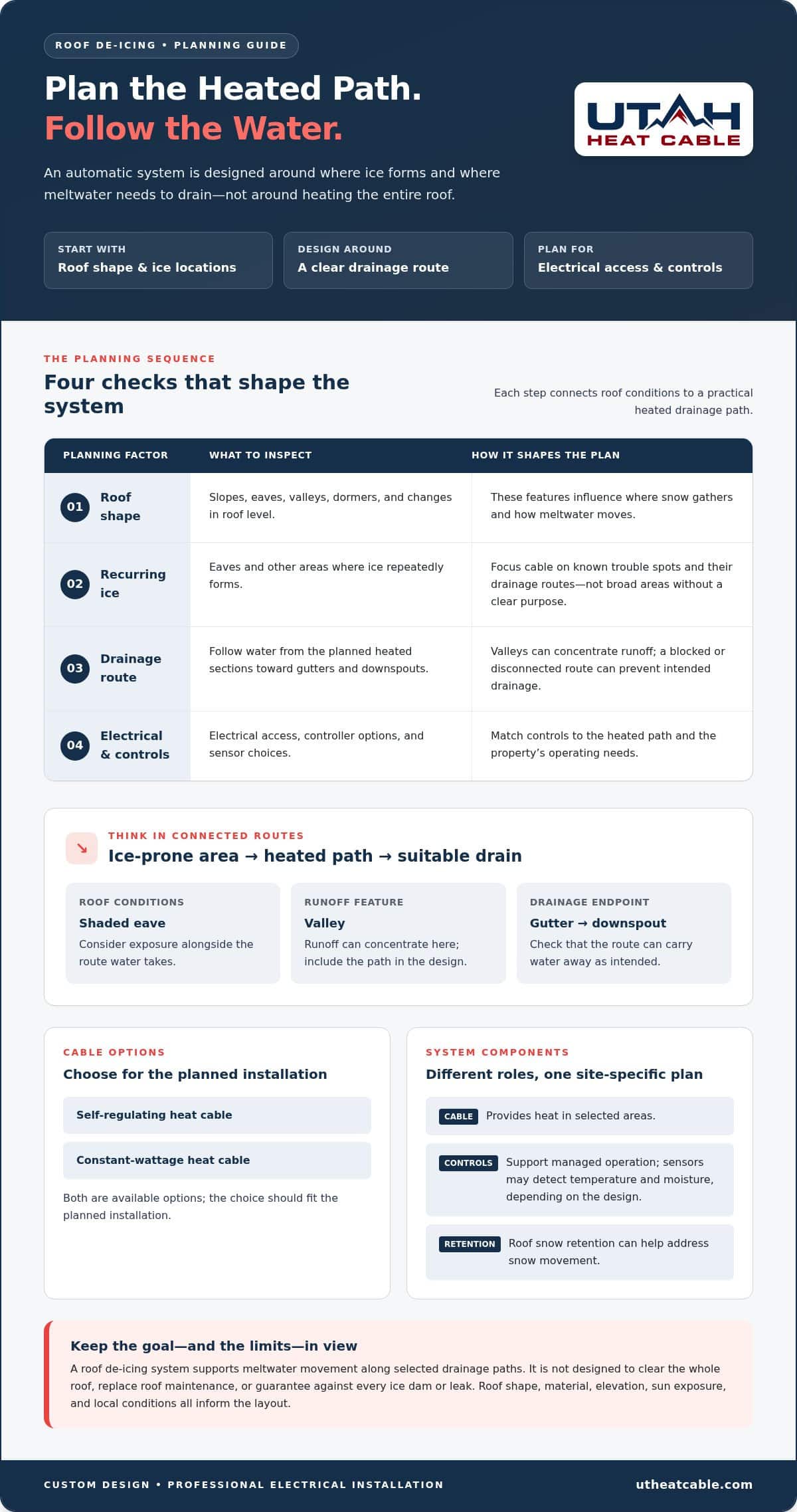
A practical plan starts with the roof and follows the water. Before choosing cable or controls for an automatic roof de-icing system Utah properties can use, identify where ice forms, where meltwater needs to travel, and what the electrical installation requires. This sequence helps focus the design on the roof’s actual drainage needs instead of assuming every property needs the same heated layout.
- Map the roof shape. Note slopes, eaves, valleys, dormers, and changes in roof level. These features influence where snow gathers and how meltwater moves.
- Mark recurring ice locations. Record the eaves and other areas where ice repeatedly forms. Focus the design on known trouble spots and their drainage routes, rather than heating broad areas without a clear purpose.
- Trace the drainage route. Follow water from the planned heated sections toward gutters and downspouts. Valleys can concentrate runoff, while a blocked or disconnected route can keep water from draining as intended.
- Review electrical access and controls. Electrical access informs the installation plan. Controller and sensor choices should suit the heated path and the property’s operating needs.
Which roof details shape the system plan?
Consider exposed roof areas and drainage routes together. A shaded eave, a valley that collects runoff, and a gutter leading to a downspout present different design conditions. Roof material, elevation, and local exposure can also affect cable placement. There is no universal layout. The plan should connect areas prone to ice with a practical route for water to drain.
For more cable context, explore the self-regulating heat cable guide. Self-regulating and constant-wattage cables are both available options, and the choice should fit the planned installation. Once you understand the planning factors, you can learn about Utah Heat Cable’s approach to custom heat-trace design and installation.
What Utah Heat Cable Includes in a Professional Automatic De-Icing Plan
A professional automatic roof de-icing system Utah property owners can consider involves more than heat cable alone. Utah Heat Cable designs custom heat-trace systems and provides professional electrical installation, planning cable routes and controller choices around the roof and its intended drainage path. As a licensed electrical contractor, the company installs systems according to applicable code requirements.
Options include self-regulating and constant-wattage heat cable, controller options, de-icing services, and roof snow retention. Each serves a different role in the overall plan. Cable provides heat in selected areas, controls support managed operation, and snow retention can help address snow movement on the roof. The right combination depends on the property. Equipment alone does not guarantee that every ice dam or winter issue will be prevented. Explore roof de-icing products and services to understand the system categories available.
From roof assessment to a professionally installed system
Planning begins with the roof’s conditions and the property’s needs. The design considers where ice recurs, how meltwater should travel, and where cable routes can support that path. These details guide cable and controller selection, followed by electrical planning and installation. A residential roof, commercial building, industrial property, or HOA may need a different layout, so the system is tailored to the site rather than treated as a fixed package.
This approach aligns equipment, controls, and installation with the roof instead of relying on a one-size-fits-all solution. To take the next step, discuss a Utah roof de-icing system designed around your property’s conditions.
Prepare Your Roof Before Winter Returns
Recurring ice is a reason to plan before the next freeze-thaw cycle, when there is more time to consider the roof and electrical work. Note where ice tends to return and where meltwater should drain. These observations help shape a practical plan for an automatic roof de-icing system suited to Utah conditions, without treating any system as a guarantee against every winter risk.
Utah Heat Cable provides custom system design and installation across Utah, Idaho, and Wyoming. Controller options and roof snow retention can also be part of a solution tailored to your property. Explore a professionally designed roof de-icing solution and take the next step toward winter preparation.
Frequently Asked Questions
Does an automatic roof de-icing system run all winter?
No. Automatic control does not mean the cable heats continuously all winter. Operation depends on the system design and controller setup, so schedules can vary by roof. For an automatic roof de-icing system Utah homeowners are considering, the cable layout and controls should suit the intended drainage path. Automation does not guarantee a fixed energy use or remove the need to monitor system performance.
Can an automatic roof de-icing system prevent every ice dam?
No. Heat cable can support drainage in designed areas, but weather, roof conditions, and water pathways still influence ice formation. A recurring problem at one shaded eave, for example, may call for a different plan than ice appearing across several roof edges. A professional assessment can identify useful de-icing locations and whether roof snow retention may complement the plan.
Is an automatic roof de-icing system suitable for a metal roof?
It may be suitable, but the design needs to account for the specific metal roof, its drainage, and how snow moves across it. Panel seams, slope, and areas where snow may slide can influence planning. Heat cable supports de-icing in selected areas, while roof snow retention addresses snow movement. Consider both rather than assuming one standard cable layout fits every metal roof.
When should Utah property owners plan roof de-icing?
Start planning before winter conditions make roof access and electrical work more difficult. Early assessment gives you time to document recurring ice-prone spots and consider the design needs. Properties in Utah, Idaho, and Wyoming can face different local winter conditions, so timing depends on the roof and project scope. Photos of problem areas and notes about past drainage issues can help inform the plan.