
What if your roof heat cable ran in response to winter conditions instead of following a fixed timer? An automatic roof de-icing controller can manage when the cable operates, but choosing the right control depends on your roof, cable setup, and preferred level of automation.
For a Utah property, compare how each control operates, what information it uses, and whether it fits the cable and electrical configuration. Utah Heat Cable offers five options: a manual switch, Wi-Fi smart switch, Control4 integration, thermostat control, and a temperature-and-moisture sensor. Understanding the differences helps you plan a system around your roof rather than treating the controller as a standalone device.
Key Takeaways
- An automatic roof de-icing controller can operate by manual switch, schedule, thermostat, or temperature-and-moisture sensing. Choose based on how you want the system to run.
- Match the controller to the roof, heat-cable type, and electrical setup.
- Utah Heat Cable offers five control options, including smartphone scheduling and Control4 integration.
- Plan in sequence: assess the roof and cable requirements, choose control functions, then design the installation for your Utah property.
What Does an Automatic Roof De-Icing Controller Do?
An automatic roof de-icing controller manages when a roof heat-cable system operates. Depending on the control, you can switch the cable on and off manually, set a schedule, or have operation respond to temperature or moisture. The controller manages cable operation; the roof and cable system still need to be designed for the property.
That distinction matters because ice dam formation involves winter conditions and the way a roof sheds melting and refreezing snow. Heat cable can help maintain drainage paths, while the controller determines how the cable is operated. It does not correct every cause of ice buildup.
A basic ON/OFF switch gives you direct control. A scheduled switch lets you set operating times, while temperature and moisture controls respond to their respective inputs. The practical difference is how much operation depends on you remembering to switch the system on and off.
How temperature and moisture sensing guide operation
Utah Heat Cable’s Temperature & Moisture Sensor activates only when snow or moisture is present. Thermostat Control operates based on temperature. These options use different inputs, so choose between them based on the control function you want and the design of the heat-cable system.
Cable may be routed along roof areas such as eaves or valleys, or through gutters and downspouts, depending on the property’s drainage needs. These are design considerations, not a standard layout for every roof. The cable route and control plan should be considered together so the system is designed around the areas it needs to serve.
How to Choose an Automatic Roof De-Icing Controller for Your System
Start with how you want to operate the system, then make sure the control fits the roof, cable, and electrical setup. A manual switch gives direct control; scheduled and sensor-based options can reduce reliance on remembering to turn the cable on and off. The right choice depends on the property and your preferences.
Which control option fits your operating preference?
Compare the operating method first. Then consider whether you want remote access, scheduling, integration with a smart-home platform, or operation based on measured conditions.
| Control option | How it operates | Best suited to |
|---|---|---|
| Basic Lighted Switch | Manual ON/OFF control | Those who prefer to operate the system directly |
| Wi-Fi Smart Switch | Smartphone control with scheduling | Those who want to manage operation remotely and set a schedule |
| Smart Home Control | Integrates with Control4 | Those whose home uses the Control4 platform |
| Thermostat Control | Operates based on temperature | Those who want temperature-based control |
| Temperature & Moisture Sensor | Activates when snow or moisture is present | Those seeking control based on sensed roof conditions |
Before choosing an automatic roof de-icing controller, identify the roof material, cable type, voltage, and control functions needed. These details affect the system design, so do not select a controller based on features alone or assume every control fits every cable setup.
Cable compatibility is another key decision. Constant Wattage Heat Cable is 120 V and designed for shingle roofs only. Self-Regulating Heat Cable is available in 120 V and 240 V and is compatible with metal, shingle, wood-shake, and membrane roofs, including TPO, EPDM, PVC, and rolled roofing. Utah Heat Cable designs heat-cable systems and controls around the property and its requirements.
Plan a Roof De-Icing Controller System with Utah Heat Cable
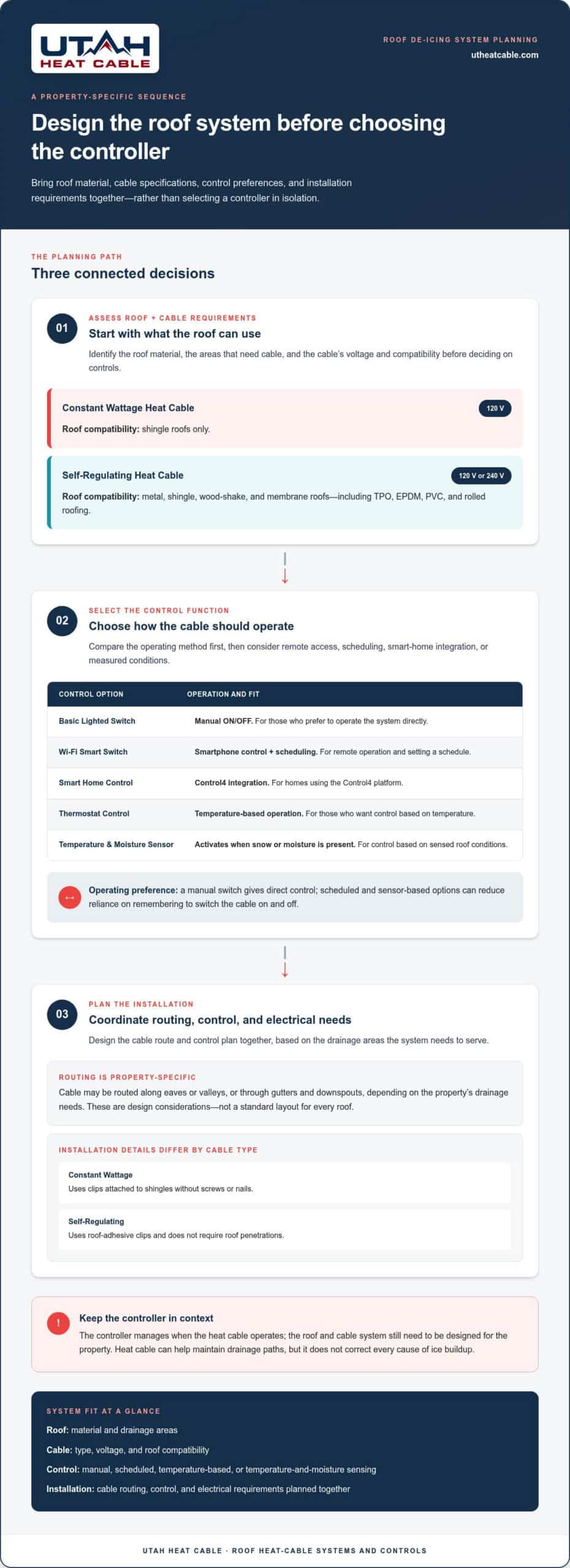
A practical plan starts with the roof, not the controller alone. Utah Heat Cable designs and installs roof heat-cable systems and offers controller options for Utah properties. The system plan brings roof material, cable specifications, control functions, and installation requirements together.
What to include in a Utah system plan
- Assess the roof and cable requirements. Identify the roof material and areas that need cable, then match the design to the cable’s stated compatibility. Constant Wattage Heat Cable is 120 V and for shingle roofs only. Self-Regulating Heat Cable is available in 120 V and 240 V and is compatible with metal, shingle, wood-shake, and membrane roofs, including TPO, EPDM, PVC, and rolled roofing.
- Select the control functions. Decide whether manual, scheduled, temperature-based, or temperature-and-moisture control fits how you want the system to operate. Plan the controller alongside the cable and electrical configuration.
- Plan the installation. Coordinate cable routing, control, and electrical requirements as one property-specific design instead of choosing a controller in isolation.
Installation details vary by cable type. Constant Wattage Heat Cable uses clips attached to shingles without screws or nails. Self-Regulating Heat Cable uses roof-adhesive clips and does not require roof penetrations. Keeping these requirements distinct helps ensure the automatic roof de-icing controller is part of a compatible system.
A roof in Park City and one in Tooele each need a plan based on their own roof materials and cable requirements. Utah Heat Cable’s technicians each have more than a decade of specialized experience, and the company has installed more than one million feet of roof heat cable in Utah. Explore the company’s roof heat-cable and de-icing services to see how system design and controller options fit together.
Make Your Roof Ready for Winter
The controller is one part of preparing your property for winter. Consider how the roof, heat-cable system, and preferred level of automation should work together. Utah Heat Cable plans and installs roof heat-cable systems with control options selected for the property.
Utah Heat Cable’s technicians each have more than a decade of specialized experience, and the company has installed more than one million feet of roof heat cable in Utah. Request a free consultation and quote for a roof de-icing system designed for your property.
Frequently Asked Questions
Can an automatic roof de-icing controller work with any heat cable?
No. The controller needs to fit the cable system’s electrical setup and intended operation. For an existing system, consider the cable type, voltage, and circuit configuration together rather than choosing a replacement controller based on appearance or features alone.
Is it better to leave roof heat cable on all winter?
Not necessarily. A system can use a switch, schedule, thermostat, or moisture-responsive control, and each manages operation differently. Manual control relies on someone switching the cable on and off; scheduled or condition-based controls use their selected settings or inputs. Follow the operating plan for the installed system.
Can I add an automatic controller to an existing roof heat-cable system?
It depends on how the existing cable and electrical system are configured. The controller must work with the installed cable and circuit, and an upgrade may involve changes to electrical connections. Compatibility should be part of the system plan before a control upgrade is made.
Does an automatic roof de-icing controller reduce electricity use?
A schedule or condition-based control can limit operating time compared with leaving the cable on continuously. Actual electricity use depends on the system and how it operates through winter. A controller does not guarantee a specific reduction, but matching operation to the system’s purpose can help avoid unnecessary run time.