
Is saving a few dollars on a hardware store heat kit worth the risk of a roof fire or a massive spike in your winter power bill? Most homeowners in our region just want a permanent way to stop ice dams without worrying about safety or high electricity costs. When comparing self regulating vs constant wattage heat cable, it’s clear that the choice isn’t just about the initial price tag. It’s about how the technology interacts with your shingles and your local electrical codes.
You’ll discover the critical differences between these two technologies to help you choose the safest, most efficient ice dam prevention for your property. We will explain how “smart” cable technology adapts to the weather, why professional installation is vital for 2026 safety compliance, and which system offers the best long-term protection for your home.
Key Takeaways
- Understand the technical differences of self regulating vs constant wattage heat cable to see how “smart” materials adjust their heat output based on the ambient temperature.
- Discover why self-regulating technology allows for safe cable overlapping in gutters and valleys, eliminating the fire risks often associated with traditional constant wattage systems.
- Evaluate how professional-grade systems provide the durability needed to withstand heavy mountain snow loads while maintaining compliance with 2026 electrical codes.
- Learn how the initial investment in high-efficiency heat trace technology pays for itself through significantly lower monthly utility bills and a longer system lifespan.
The Mechanics of Heat: How Self-Regulating and Constant Wattage Cables Differ
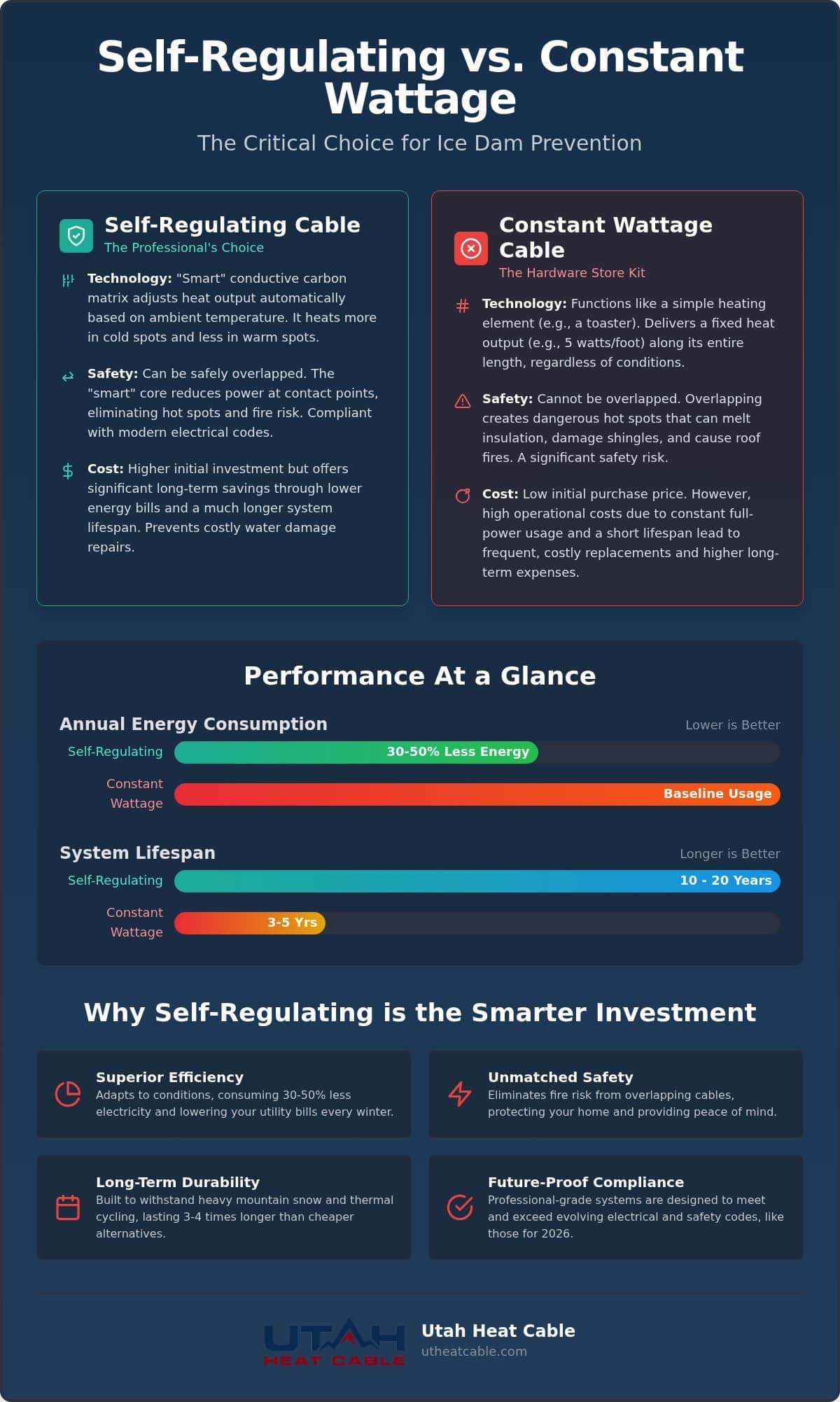
To understand the debate between self regulating vs constant wattage heat cable, we must look at the internal components. Constant wattage cable operates much like a simple toaster element. It delivers a fixed amount of heat, typically 5 watts per linear foot, the entire time it’s powered on. While this provides a consistent temperature, it creates a significant risk. If the cable isn’t constantly submerged in cold snow or ice to dissipate that energy, it can reach dangerously high temperatures. This “fixed output” often leads to damaged shingles or, in extreme cases, catastrophic roof fires.
The Mechanics of Heat are fundamentally different in self-regulating systems. These cables utilize two parallel bus wires encased in a specialized conductive carbon matrix. This matrix acts as the system’s “brain,” allowing the cable to vary its power output at every point along the line independently. This means one section of cable in the shade can run at full power while another section in the sun throttles down.
The “Brain” Inside Self-Regulating Technology
The carbon matrix is a temperature-sensitive material that reacts to its environment. In freezing conditions, the matrix contracts, creating more microscopic electrical paths and increasing heat output. When the sun hits your roof or temperatures rise, the matrix expands, breaking those paths and reducing energy consumption. This smart reaction ensures you aren’t wasting electricity on a clear day. We’ve detailed how these components resist common failure points in our Need To Know section.
Maintaining system integrity over a decade requires high-quality bus wires and durable outer jackets. These layers protect the internal matrix from moisture and UV degradation. Professional-grade cables are built for the long haul, using materials that won’t become brittle or crack under the intense thermal cycling of a mountain winter.
Performance in the Field: Choosing the Right Cable for Utah Winters
Heavy snow loads in regions like Park City or Jackson Hole put immense physical pressure on roof de-icing systems. When evaluating self regulating vs constant wattage heat cable, durability becomes the primary concern. Constant wattage “heat tape” found in big-box stores often fails after just three to five seasons because it lacks the structural reinforcement to handle deep snow packs. In contrast, professional-grade self-regulating systems are engineered to last 10 to 20 years.
Maintaining high Performance in the Field requires adherence to rigorous energy and safety standards. When homeowners weigh the long-term costs of self regulating vs constant wattage heat cable, the efficiency gap is undeniable. Self-regulating systems pay for themselves by consuming 30% to 50% less electricity over a typical winter. If you’re looking for a custom solution, our de-icing services ensure your system is sized correctly for your specific roof pitch and local climate.
Overlapping, Burnouts, and Fire Safety Risks
The physics of heat de-icing create a major safety divide. Traditional heat tape has a fixed electrical resistance. If two sections of this cable touch or cross in a gutter valley, the heat cannot escape, leading to a “hot spot” that causes the insulation to melt and the wire to burn out. This is a common cause of roof fires in residential properties.
Professional self-regulating cable eliminates this risk through the “Overlap Factor.” Because the core reduces output when it detects warmth, an overlapped cable simply dials back its heat at the point of contact. It stays cool to the touch in dry areas while delivering maximum power to ice-clogged gutters. For a deeper look at these safety mechanisms, read our Self-Regulating Heat Cable: The Professional Guide.
Long-Term Value: Installation Costs vs. Operational Efficiency
Choosing between self regulating vs constant wattage heat cable often comes down to the initial estimate, yet the real cost of ownership reveals itself over several winters. While self-regulating technology requires a larger upfront investment, it prevents thousands in potential roof repairs and interior water damage. High-quality systems use automated controller options and sensors to maximize efficiency. These “set and forget” systems engage only when moisture and freezing temperatures are both present, ensuring the cable doesn’t run during a dry, cold snap.
Constant wattage systems generally lack these advanced brains. They often rely on manual on/off switches, which introduces the risk of human error. If you forget to flip the switch before a storm, an ice dam can form in hours. Conversely, leaving the system on during a sunny week wastes significant energy. Professional installation also ensures your property meets the 2023 National Electrical Code (NEC) standards required in Utah, Idaho, and Wyoming, providing a level of safety that DIY kits cannot match.
Why Professional Design Beats DIY Kits
There is a massive quality gap between the “heat tape” found at big-box retailers and industrial-grade heat-trace cable. A custom design accounts for north-facing slopes that never see the sun and complex roof valleys where snow accumulates most. Our team engineers solutions that address these specific regional challenges rather than providing a one-size-fits-all fix. You can explore our range of custom-engineered Products & Services to see how we protect homes across the Intermountain West.
Securing Your Property Against Winter Hazards
Selecting the right de-icing system is a decision that impacts your home’s safety and your monthly budget for years to come. While comparing self regulating vs constant wattage heat cable often starts with price; the long-term benefits are undeniable. You gain a system that adjusts to the weather, prevents dangerous hot spots, and operates with superior energy efficiency. Professional installation ensures your setup meets strict electrical codes while providing a shield against recurring ice dams.
As a licensed electrical contractor serving Utah, Idaho, and Wyoming, we specialize in ice dam prevention tailored to our unique mountain climate. Don’t wait for the first heavy snowfall to discover the weaknesses in a generic store-bought kit. Get a Custom Heat Trace Design Quote Today to protect your shingles and enjoy peace of mind throughout the coldest months. We’ll help you secure your property with a durable, efficient solution.
Frequently Asked Questions
Can I cut self-regulating heat cable to length on-site?
Yes, you can cut self-regulating heat cable to any length during installation. When comparing self regulating vs constant wattage heat cable, this flexibility is a major advantage. Constant wattage versions have fixed circuits that cannot be shortened. Our parallel bus wire design allows us to tailor the fit to your specific roof valleys and gutters, ensuring a custom fit for complex Utah homes.
Does self-regulating heat cable still need a controller or thermostat?
Yes, we always recommend using a controller. While the technology adjusts its output based on temperature, it still consumes electricity as long as it’s powered. Using advanced controller options ensures the system only activates when both freezing temperatures and moisture are present. This prevents the system from running on dry, cold days, which significantly reduces your winter utility bills and protects the cable core.
Is it safe to leave my heat cable plugged in all winter?
It is technically safe for self-regulating systems, but we don’t recommend it without an automated sensor. Leaving constant wattage “heat tape” plugged in all winter creates a higher risk of overheating if the cable isn’t covered in snow. When weighing self regulating vs constant wattage heat cable, the self-regulating version is much safer for long-term use because it won’t overheat if conditions turn dry.
Will heat cable damage my asphalt shingles or metal roof?
Professional-grade systems won’t damage your roofing materials if they’re installed correctly. Self-regulating cables are designed to stay within a safe temperature range that won’t melt asphalt shingles or degrade metal finishes. We use specific mounting clips that secure the cable without penetrating your roof’s waterproof layer. This preserves the integrity of your property while providing essential ice dam protection throughout the harsh winter.