Is a snow-free driveway in the middle of a Park City blizzard a luxury or a necessity when you’re facing ten feet of annual accumulation? Most homeowners realize the value of a snow melt system the moment the first heavy storm hits, yet the fear of a massive monthly utility bill often stalls the project. Understanding the true heated driveway cost Park City residents should expect involves more than just a surface-level estimate. It’s about engineering a system that survives the Wasatch Range’s unique climate while adhering to the strict 2026 stormwater discharge regulations and WUI codes that now govern our mountain community.
You need a solution that lasts twenty years, not one that fails during the first deep freeze. We agree that balancing a high-performance installation with manageable monthly expenses is the primary goal. This guide provides a clear breakdown of the price-to-value ratio for professional snow melt systems in our region. We’ll compare the efficiency of self-regulating electric cables versus hydronic options and explain how the average Park City electricity rate of $0.15 per kWh impacts your seasonal budget. You’ll also learn how new 2026 drainage requirements influence system design, giving you the confidence to invest in a solution that protects your property and your peace of mind.
Key Takeaways
- Park City’s unique micro-climate requires higher-wattage engineering and specialized materials to handle heavy mountain snow loads effectively.
- The total heated driveway cost Park City homeowners should expect depends heavily on whether the project is a new installation or a complex retrofit of an existing surface.
- Discover the formula for calculating your monthly utility impact and how modern automated sensors prevent wasted energy by only activating during active snowfall.
- Evaluate your home’s electrical capacity, such as 200-amp versus 400-amp service, to determine if infrastructure upgrades are necessary before installation begins.
- Understand why hiring a licensed electrical contractor is essential for meeting 2026 Summit County codes and ensuring your snow melt system lasts for over 20 years.
Understanding Heated Driveway Costs in Park City’s Climate
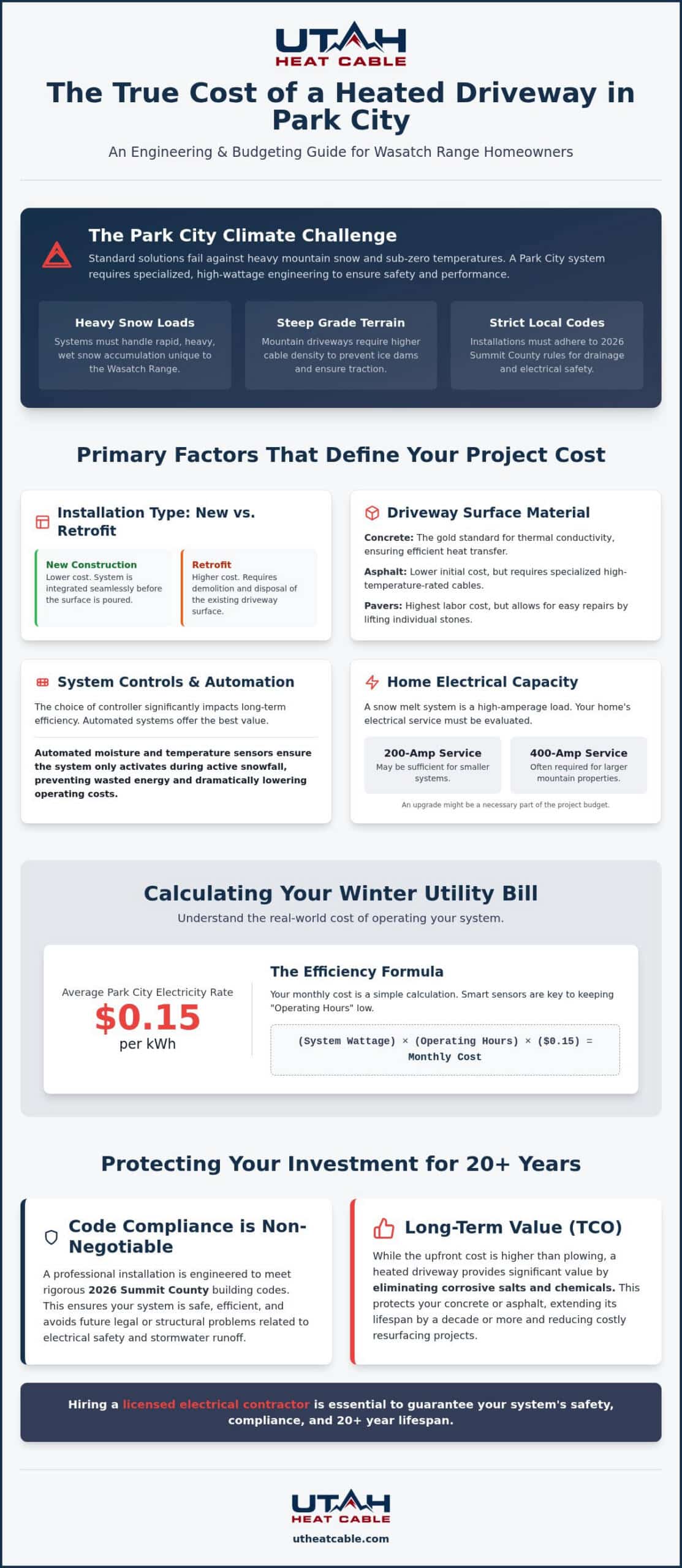
Investing in a heated driveway in Summit County is a strategic property decision that requires more than a standard surface-level estimate. The total heated driveway cost Park City homeowners encounter is built on three primary pillars: precision engineering, specialized materials, and technical labor. Unlike lower-elevation areas, our mountain environment demands a robust Snowmelt system capable of handling rapid accumulation and sub-zero temperatures. It isn’t just about melting snow; it’s about protecting your infrastructure from the harsh reality of a Wasatch winter.
Park City’s micro-climate presents a unique challenge for heat-trace design. A system built for a milder climate will simply fail when faced with two feet of heavy, wet snow. We specify higher-wattage solutions to ensure the surface stays clear during peak storm events. While the upfront investment is higher than traditional snow removal, it’s vital to consider the Total Cost of Ownership (TCO). Traditional salt and chemical de-icers aggressively corrode concrete and asphalt over time, leading to premature cracking and costly resurfacing projects. By eliminating these corrosives, you extend the lifespan of your driveway by a decade or more.
The Components of a Professional Snow Melt System
A reliable system is much more than just a cable buried under the pavement. The primary heating element choice usually falls between Self Regulating Heat Cable, which adjusts its heat output based on the ambient temperature, and Constant Wattage Heat Cable. Your Controller Options also dictate long-term efficiency. While a manual switch is less expensive to install, fully automated moisture and temperature sensors ensure the system only draws power when snow is actually falling. Additionally, professional infrastructure often requires electrical panel upgrades to support the high-amperage load required for large mountain properties.
Why Park City Terrain Impacts the Bottom Line
Slope and drainage are the two biggest variables in a local quote. Steep mountain driveways require higher density cable layouts to prevent sliding snow and ensure consistent traction. If the cable layout isn’t dense enough, “ice dams” can form at the base of the driveway, creating a significant liability risk. Current 2026 Summit County building codes also have strict requirements for runoff management and electrical safety. As a licensed electrical contractor, we ensure every installation meets these rigorous standards to prevent future structural or legal headaches. The heated driveway cost Park City residents pay reflects this commitment to professional-grade safety and local code compliance.
Breakdown of Installation Pricing: From Excavation to Electrical
While national averages provide a starting point, the actual heated driveway cost Park City residents encounter is rarely a flat rate per square foot. A standard 600-square-foot installation involves a baseline for the electric system itself, but site-specific variables often redefine the budget. For instance, the financial difference between a new construction project and a retrofit is substantial. New builds allow for seamless integration into the initial pour. Conversely, retrofitting an existing driveway requires full demolition and disposal of the old surface before the heating elements can be laid.
Choosing your surface material also dictates both performance and price. Concrete is widely regarded as the gold standard for thermal conductivity, ensuring the heat transfers efficiently to the surface. Asphalt offers a lower initial price point, but it requires specialized high-temperature cables that can withstand the heat of the paving process. Pavers represent the highest installation tier. While they demand more labor, they offer a significant advantage for long-term maintenance. If a repair is ever needed, individual stones can be lifted without destroying the entire driveway. Weighing these Pros and Cons of Heated Driveways is a critical step in your planning phase.
The “Steep Grade” Multiplier
In Park City, the terrain is often our biggest engineering hurdle. Most national estimates assume a flat lot, but our mountain topography frequently involves north-facing slopes and steep inclines. These conditions require tighter cable spacing to ensure 100% snow melt and prevent dangerous ice patches. Instead of the standard four-inch spacing, a steep grade might require a three-inch layout. This increases the total material requirements and labor time.
These high-wattage systems often exceed the capacity of a standard residential electrical panel. If your home only has 200-amp service, you may need a sub-panel or a dedicated transformer to handle the load. This is why working with a licensed electrical contractor is non-negotiable. We handle the complex high-voltage runs and ensure the system complies with 2026 Summit County safety codes. If you’re ready to see how these variables apply to your specific property, you can request a custom design consultation to get an accurate picture of your project.
Monthly Operating Costs: Calculating Your Winter Utility Bill
Many homeowners worry that a snow melt system will lead to astronomical monthly electricity bills. However, the actual heated driveway cost Park City residents see on their utility statements depends heavily on system intelligence rather than just square footage. To estimate your hourly operating expense, you can use a straightforward formula: (Total System Wattage ÷ 1,000) × $0.15. This calculation uses the average Park City residential electricity rate as of August 2026. For a typical 600-square-foot driveway designed for mountain snow loads, the power draw is significant but manageable when the system is engineered correctly.
When you compare these monthly utility costs to the price of professional plowing and salting services, the investment often balances out. Professional snow removal for a single season in Summit County can cost thousands, especially during years with heavy accumulation. Beyond the service fees, manual removal carries a hidden financial burden. Heavy plow blades and aggressive chemical de-icers cause concrete pitting, surface scaling, and structural degradation over time. By using a heated system, you eliminate the need for corrosive salts, which effectively doubles the lifespan of your driveway and prevents the need for a total surface replacement every decade.
The Efficiency of Self-Regulating Cables
Self Regulating Heat Cable is the preferred technology for our high-altitude environment because it functions like a smart appliance. These cables possess a specialized core that adjusts its heat output based on the ambient temperature of the pavement. When the ground is freezing, the cable draws more power; as the surface warms, the cable automatically throttles back its energy consumption. This internal regulation prevents the system from “burning out” and ensures it only uses the exact amount of energy required to keep the surface clear, significantly extending the system’s operational lifespan compared to older technologies.
Smart Controllers: The Key to Lower Bills
The most effective way to keep your seasonal expenses low is through advanced Controller Options. A basic system might rely on a manual switch, but a professional-grade setup utilizes both moisture and temperature sensors to ensure the system never runs on a dry, sunny day. Modern systems also offer remote monitoring, allowing you to manage your Park City home from anywhere in the world via your smartphone. Integrating a smart controller can reduce energy waste by up to 30%. Understanding the technical nuances of these components, as demonstrated by experts at Utah Heat Cable, illustrates why a precision-designed system is a financial asset rather than a drain on your resources.
Key Variables That Impact Your Park City Quote
When reviewing a project estimate, it’s common to wonder why two driveways of the same size result in different numbers. The heated driveway cost Park City homeowners pay is heavily influenced by the existing electrical infrastructure and the physical distance between the pavement and the power source. If your home currently operates on a standard 200-amp panel, adding a high-wattage snow melt system often requires an upgrade to 400-amp service. This isn’t just a suggestion; it’s a necessity for safety and system reliability. Without sufficient amperage, your system may trip breakers or fail to reach the temperatures required to melt heavy mountain snow during a mid-January storm.
Distance also plays a major role in labor costs. Trenching through the rocky, compacted soil of the Wasatch Range to run conduit from the house to the driveway is a labor-intensive process. The further the run, the more materials and man-hours are required to meet local electrical codes. Additionally, 2026 Summit County regulations have introduced more rigorous permitting and inspection phases. These steps ensure that high-voltage systems are installed safely and that runoff is managed according to the city’s updated stormwater discharge regulations under Municipal Code Title 13. Navigating these local hurdles requires a contractor who understands the specific logistics of construction in a mountain resort town.
The Cost of Electrical Infrastructure
A professional installation often requires a dedicated snow melt controller panel. This specialized hardware houses the contactors and sensors that manage the power load safely. Cutting corners with low-grade constant wattage cables might save money upfront, but the replacement labor is astronomical if a failure occurs under six inches of concrete. We prioritize high-performance Self Regulating Heat Cable because its durability reduces the long-term risk of system failure. Investing in high-grade conduit and code-compliant wiring now prevents the need for invasive, expensive repairs five years down the road.
Local Labor and Mobilization in Summit County
Specialized mountain contractors command a premium because they understand the unique behavior of “Sierra-cement” snow loads. This heavy, wet accumulation requires precise engineering that general landscapers often overlook. A local expert ensures that your system integrates with Park City’s specific drainage laws, preventing meltwater from freezing on public sidewalks or neighboring properties. Choosing a specialist who is also a licensed electrical contractor provides the assurance that your high-voltage system is both efficient and legal. If you want to ensure your infrastructure is ready for a professional snow melt system, contact us for a technical site evaluation today.
Choosing a Licensed Specialist for Your Park City Snow Melt System
Selecting the right team to install your snow melt system is just as critical as the materials themselves. While many companies offer de-icing services, a licensed electrical contractor is non-negotiable for high-wattage driveway systems. These installations involve significant power loads that require precise load calculations and strict adherence to Summit County safety codes. Relying on a general landscaper for complex heat-trace design often leads to system failures when the first heavy storm hits. Landscapers understand the aesthetics of a driveway, but they aren’t trained to manage the high-voltage electrical runs that power it with long-term reliability.
When you’re evaluating the heated driveway cost Park City contractors provide, look closely at the warranty terms. A professional-grade system should be designed to last 20 years or more. A comprehensive warranty doesn’t just cover the cable; it reflects the contractor’s confidence in their design and installation methods. We specialize in creating custom systems for mountain luxury homes, ensuring the layout accounts for the unique thermal properties of your chosen surface material and the specific snow patterns of your property. This specialized focus ensures your investment remains a functional asset rather than a maintenance headache.
Custom Design vs. Out-of-the-Box Kits
DIY heat tape or generic out-of-the-box kits might seem tempting for smaller areas, but they are often dangerous in high-moisture environments. These kits lack the durability and wattage required to survive the extreme freeze-thaw cycles of a Park City winter. Custom-engineered layouts prevent “cold spots” by ensuring uniform heat distribution across the entire surface. Our approach involves a detailed analysis of your driveway’s geometry to eliminate the risk of ice patches forming in missed sections. This precision is what separates a professional snow melt system from a temporary fix.
Next Steps: Getting an Accurate Quote
To get a realistic heated driveway cost Park City residents can rely on, a thorough site evaluation is essential. We measure the slope of the terrain, assess your home’s current electrical capacity, and determine the most efficient routing for conduit. Preparing your property details, such as existing blueprints or utility locations, helps streamline this consultation. A professional site visit ensures that your quote is based on the technical reality of your property rather than a generic square-foot average. If you’re ready to secure your property against the elements, you can Request a Custom Snow Melt Quote for Your Park City Property to begin the engineering process.
Securing Your Property Against the Wasatch Winter
Investing in a snow melt system is about more than just convenience; it’s a long-term commitment to property safety and structural preservation. By prioritizing precision engineering over generic kits, you ensure your system survives the unique challenges of our mountain environment. We’ve explored how the heated driveway cost Park City homeowners face is an investment in durable infrastructure that eliminates the corrosive damage of salt and heavy plow blades. Choosing high-performance technology, such as Self Regulating Heat Cable, coupled with smart controllers, keeps your monthly utility bills manageable while providing total peace of mind.
As a licensed electrical contractor specializing in mountain de-icing, Utah Heat Cable provides the technical expertise required for our steep terrain and rigorous 2026 local codes. We focus on custom-engineered designs that protect your home with professional-grade reliability. Don’t wait for the first heavy storm to reveal the weaknesses in your winter prep. You can Get a Professional Snow Melt Estimate from Utah Heat Cable and start planning a safer, clearer winter today. Your driveway should be a source of security, not a seasonal burden.
Frequently Asked Questions
Is a heated driveway worth the cost in Park City?
Yes, a snow melt system is a high-value investment in Park City due to the extreme snowfall and steep mountain terrain. Beyond the convenience of skipping manual labor, it eliminates the need for corrosive salts that destroy concrete surfaces over time. This preservation, combined with reduced liability for slip and fall accidents, makes the long-term heated driveway cost Park City homeowners incur a strategic move for property protection.
How much does it cost to run a heated driveway per month in Utah?
Monthly operating costs vary based on snowfall frequency and system wattage, but you can estimate expenses using the average local rate of $0.15 per kWh. For a standard 600-square-foot driveway, running a fully automated system during active storm cycles typically costs between $120 and $600 annually. Systems equipped with smart sensors ensure you only pay for power when weather requires it, preventing unnecessary energy waste.
Can you put a heated system under an existing driveway?
You cannot effectively install a heating system directly under an existing slab without removing the surface. Retrofitting requires either a full demolition of the old driveway or, in rare cases, adding a new layer of material over the top, which often creates drainage issues. Most homeowners find that the most cost-effective approach is to install the system during a planned driveway replacement or new construction project.
How long do driveway snow melt systems typically last?
A professionally installed snow melt system using high-grade materials like Self Regulating Heat Cable typically lasts 20 years or more. Because there are no moving parts buried under the pavement, the technology is remarkably durable. Ensuring your system is designed and installed by a licensed electrical contractor is the best way to prevent premature failure caused by improper installation or insufficient electrical infrastructure.
Do heated driveways increase property value in Park City?
Yes, heated driveways are a highly sought-after luxury amenity in mountain resort towns and can significantly increase a home’s resale value. Potential buyers in Park City often prioritize properties that offer maintenance-free winters. A documented, professionally installed system provides a competitive edge in the local real estate market, as it represents a permanent solution to one of the region’s biggest property management challenges.
What happens if a cable breaks under the concrete?
If a cable fails, specialized diagnostic tools can often locate the exact break point without tearing up the entire driveway. For paver systems, repair is simple because individual stones can be removed and replaced. For concrete or asphalt, a small section must be excavated and patched. Using high-quality conduit and professional-grade cable during the initial installation is the best way to avoid these invasive repairs altogether.
Which is better for Park City: Electric or Hydronic heating?
Electric systems are generally better for most Park City residential properties because they have lower upfront installation costs and require zero maintenance. Hydronic systems, while potentially cheaper to run for very large commercial areas, involve complex boilers and pumps that require regular servicing. In our climate, the simplicity and reliability of electric heat-trace technology make it the gold standard for residential peace of mind.
Do I need a special permit to install a heated driveway in Summit County?
Yes, Summit County and Park City municipal codes require specific electrical permits and inspections for snow melt systems. You must also comply with Title 13 stormwater regulations, which dictate how meltwater runoff is captured and managed on your property. Working with a specialist who understands these local mountain codes ensures your system is legal, safe, and doesn’t create drainage hazards for your neighbors or public sidewalks.